










Engine Monitor Refresh: Worth the Investment
One engine failure is all it takes to realize that investing in an upgraded engine monitor offers good utility and better backstop than vintage systems.


One engine failure is all it takes to realize that investing in an upgraded engine monitor offers good utility and better backstop than vintage systems.

If you’re building an aircraft from a kit, you probably agonize over which avionics to go with. But almost as important as the avionics suite is the electrical distribution bus that powers them—and the other electrical systems on the aircraft. If you come from the certified aircraft world, you’re used to the old-school mechanical circuit […]
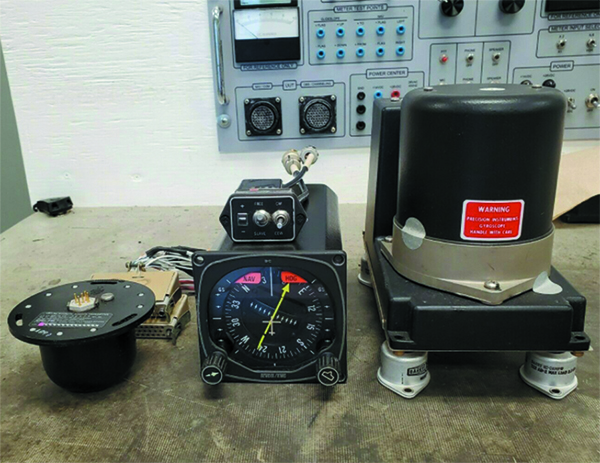
If you put the brakes on a big avionics upgrade because of the eye-watering price and lead time, you likely considered used equipment. In normal times that might not be a bad plan, but the market isn’t exactly what I consider normal. Have prices of pre-owned electronics skyrocketed as they have for aircraft? You bet […]

We see plenty of fuel exhaustion events in the NTSB wreck reports, and we suspect some might have been avoided with fuel totalizers. These are valuable devices, especially when interfaced with panel GPS navigators, because you’ll always know how much fuel you’ll have to a given waypoint in the flight plan. Better yet, if your […]

You wrote an eye-watering check to the avionics shop for the latest and greatest gear, but that doesn’t mean the new suite is invincible. An electrical failure in a single-alternator, single-battery aircraft will make the unprepared wish the vacuum system wasn’t in the rubbish bin on the shop floor. Herewith is our plan for affordable […]

If you think those features are a recipe for building the ultimate futuristic flight deck, you have it right. And even in a world where everything is connected over the internet, you might not expect to be able to remotely connect to the cockpit anytime, anyplace. But you can. That’s exactly what Honeywell has […]
The AV-20 fits into a standard 2.25-inch clock hole. This instrument is available in two versions, the AV-20 at $499 and the AV-20-S at $895. The difference? The AV-20-S has pitot/static input so it can display real airspeed, not GPS-derived groundspeed and it also functions as a capable attitude gyro. The entry-level AV-20 lacks the plumbing input and has no gyro, but it has multilevel clock and timer functions. Both are approved for installation under the FAA’s NORSEE rule-non-required safety enhancing equipment. Technically, that means it can’t replace a panel clock if the airplane requires one, nor can it provide a legal attitude source backup if one of those is needed.
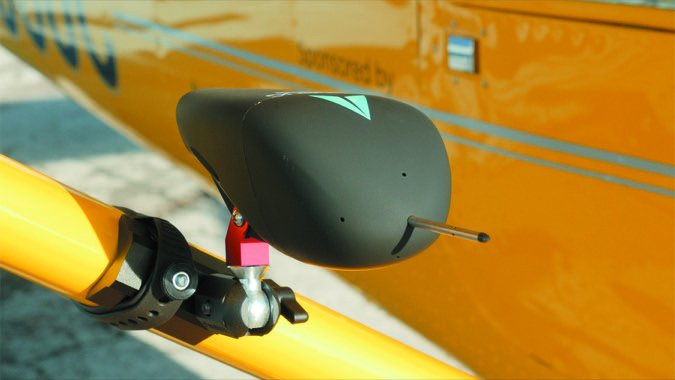
Now the standard cabin connection protocol, Wi-Fi provides a more stable connection than Bluetooth. Plus, Wi-Fi is more tolerant of electromagnetic interference (EMI)-and there’s plenty of it generated by charging systems and magnetos. But wireless connectivity is another challenge. The WingBug pod creates concurrent point-to-point Wi-Fi connections to multiple tablets or smartphones at once. But consider when multiple Wi-Fi devices like ADS-B receivers, satellite hotspots and action cameras are fighting to connect to the pilot’s tablet in a point-to-point peer connection. In a peer-to-peer connection, only a single device may be connected to a tablet or smartphone, requiring the user to manually select the device (in Wi-Fi settings). A portable Wi-Fi access point provides the fix, but the devices and applications must be able to support access-point connectivity. Not all do.

At first blush, the battery seems big, measuring 7.75 by 3.75 by 0.5 inches, but its saving grace is the thin profile. That makes it easy to slide into a map pocket, flight bag and the front pocket of a backpack. I stashed it in all of the above, but it was a touch too large to comfortably fit in a jacket or pants pocket. The casing is anti-slip, which keeps it from coming out of the hand, but I wish it were even grippier. The drawback to the thin footprint is that it can easily slide between a seat. When the airplane is put away, the battery could work on a motorcycle or bicycle, if there’s the right on-bike storage.

Conspicuous by its absence is any mention of the Evektor Sportstar. We had (past tense) several of them here in southern Indiana, and I administered a lot of checkrides in the Sportstar. I believe that the Sportstar is a major player in the LSA community, with a couple hundred of them flying in the U.S. At one point I think they were the third most numerous LSA, behind Flight Design and Legend. That would put them in the middle of the pack of the ones you considered. And I know the Sportstar had its share of accidents. Why did you omit the Evektor from your accident statistics?

Although its really an incremental upgrade to the long-body M20 series, the Acclaim Ultra was a major certification project for Mooney at a time when were not seeing many of those-from anyone. The results inarguably make the Acclaim Ultra the fastest four-place certified single-engine piston airplane and not just by a little. The Acclaim goes head to head with both its normally aspirated sibling, the Ovation Ultra (see February 2018 Aviation Consumer) and both Cirrus models, the SR22 and SR22T which, together, constitute the current market leaders. That puts the Acclaim into a niche within a niche-a slice of buyers who want speed, but care less about cabin size or payload. Pricewise, at $789,000 base, the Acclaim invoices below the typical Cirrus models.

The suite for the King Air has three high-resolution 12-inch color LCD screens. There’s pilot and copilot primary flight displays and a multifunction display. The displays are instant-on and the whole system comes up ready in roughly 20 seconds. The screens have multilayer anti-reflective coating that permits a pretty wide viewing angle-as much as 80 degrees. They simply have to be high performers for big cockpits and the are. There’s a dedicated autopilot controller directly above the MFD, plus two PFD controllers.