











There isn’t one among us who hasnt felt the butt pucker of descending towards minimums on the ILS or approaching a blackhole airport at night when we know the obstacles are out there.What would it be worth to you to see the trees, pavement, towers, and even other aircraft in rain, fog, thin clouds, smoke and darkness? Several companies have true Enhanced Flight Vision System (EFVS) that allow for
special approach flexibility under FAR 91.175, but usually these cost north of $1 million. Some companies are now offering simpler versions (read for advisory purposes only) for less than a tenth of that. We recently tried two standout forward looking infrared (FLIR) systems with different philosophies and technologies. Kollsman, Inc.s (www.kollsman.com) was the first to certify one of those million-dollar systems that uses a heads-up display and affords lower landing minimums in your Gulfstream G-V. Now theyre leveraging that technology for their General Aviation Vision System (GAViS). “Once you spend a lot of years on the technology,” says Rod Gentry, Kollsmans VP for Commercial Aviation Systems, “it makes sense to move it to another market.”
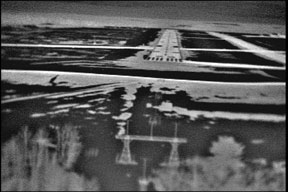
What Kollsman is moving is the latest digital sensor technology with software algorithms that optimize individual areas of the image independently to create the best overall picture. For tech geeks, they use a vanadium oxide digital microbolometer that has a NETD (noise-equivalent temperature difference) of less than 50 milli-Kelvin. What that means to the rest of us is a system that can show individual tree trunks at the far end of the runway, even when the RVR is 2500 feet or its a moonless midnight.
Seeing virga or a layer between two clouds in the dark can allow for a smoother flight, but the blackhole of night is turning out to be the surprise use for these systems. Test pilot Bob DiMeo was taxiing out in Kollsmans Cessna 340 one night when the flight engineer in the back told him there were deer on the runway.
“I looked out and I said, Where? He said, Look at your screen, Bob. And, sure enough, there they were. Thats when I thought, wow, this is really good stuff.”
We rode right-seat in Kollsmans 340 on a dark night ourselves and were amazed at what the system could see. Texture of the airport grass and the bark of nearby trees were visible. Paint stripes on the runway were visible from 400 feet on final.