











The six-seat retractable single is a market niche to which many prospective owners aspire. And why not? They are as fast as many twins, can carry prodigious payloads, come with plenty of panel space to install any goodies the previous owner neglected and generally are easy to fly. The solo powerplant avoids a twins upkeep costs while most systems-with landing gear being a notable exception-are almost as simple as the trainer first soloed. Despite all that, there really are only three broad models from which to choose: The 36-series Bonanza, Pipers Lance/Saratoga and Cessnas 210 Centurion. Yes, Piper also has the non-pressurized, cabin-class Matrix-ne Malibu-but its not really been on the market long enough or in great enough numbers to make most prospective purchasers lists. And if fixed gear is more your cup of tea, then both Piper and Cessna have other offerings making the cut. But the six-seat retractable offers a good mix of the things pilots with a need to go places and carry more than two people often look for: good range/endurance, loading flexibility, enough cruise speed that inevitable headwinds don’t prolong the agony that much and the ability to mix easily with the airliner flow into the larger airports. Dipping further into the details, someone in this market can easily (and mistakenly, in our view) get scared away from the Bonanza for reasons involving higher purchase and parts prices, and from the Lance/Saratoga by relatively slow cruise speeds and a thirsty engine. Often, the Mama Bear solution is the 210 Centurion; that our mythical buyer probably has substantial time in 100-series Cessnas makes it all the better. But there’s no free lunch: With the Centurion, possible downsides are finding a well-maintained example and keeping it that way, or adopting a problem child and paying to get it right. Centurion maintenance is not trivial, especially the landing gear. If too many items are deferred, the airplane may have annoyingly bad dispatch reliability. Owners tell us theyre better off when they pay the money now, fixing stuff before it breaks, rather than later when there’s little choice. Cruise speeds of about 170 KTAS can be routine, and equipped useful loads easily exceeding a half ton are common. Fuel capacities vary from model to model, but there should be enough to traverse a third of the U.S. without stopping while carrying at least three adults and their bags.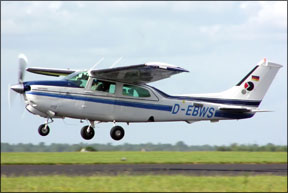
By almost any measure, the 210 is a flexible, successful airplane. Although early models were little more than retractable 182s, it eventually evolved into a sophisticated, sought-after series of three basic types, each with their own characteristics: the normally aspirated 210, the turbocharged version and the first-of-its-kind Pressurized Centurion (which is covered in a separate, dedicated report).
The 210s lineage extends back to the late 1950s, when tricycle landing gear-much less a retractable-signified a newly designed airplane. First certified in 1959 and marketed as a 1960 model, the original 210 and 210A were 2900-pound airplanes powered by a Continental IO-470-E of 260 HP, a fuel-injected version of the 182s engine. Also belying its 182 roots were a strut-braced wing and seating for four. Still, there were major differences.
Chief among them: Cessna engineers had to devise a way to hide its landing gear in the belly. They succeeded, but no one would call the results elegant. Hangar flyers throughout the world still remark on the “twist and tuck” gear retraction design first developed for the 210 and later extended to all high-wing retractable Cessnas. Early models relied on an engine-driven hydraulic pump, which was later upgraded to an electrohydraulic system.
Before that, though, Cessna made minor improvements in 1961, bringing out the 210A, still powered by the IO-470-E, with a 1500-hour TBO. A slightly larger cabin, 100-Pounds gross weight increase and different engine (IO-470-S) resulted in the 210B. Big news came in 1964, with the 210D, which received not only Continentals IO-520-A, but a 1700-hour TBO and another 100-pounds gross weight increase. Kiddie seats in the baggage compartment were optional.
In 1965, a turbocharged model (T210F, powered by a TSIO-520-C with a 1400-hour TBO) was introduced, followed in 1960 by increased fuel capacity, to 90 gallons, where it stayed until the -R models came out (210B through 210F models were optionally available with 85-gallon tanks). By the time production ended with