











When considering basic airplanes, the 150/160-hp four-place, fixed-gear single is about as ubiquitous as one can get. The niche serves as the beginning rung of a market ladder where airplanes begin to be used as practical transportation tools. They wont haul a lot of people or cargo, nor will they do it quickly, but they offer economical travel. They often serve as a pilots first “real” airplane after primary training, and the market demands they be reliable, inexpensive to operate and relatively easy to fly. Airplanes in this class are sort of like Toyotas: not terribly exciting or fancy, perhaps, but they do what you need them to without costing an arm and a leg. Cessnas Skyhawk owns this market, of course, and used-airplane prices reflect that dominance. At least two of its mainstream competitors, the Piper PA-28-151 or -161 Warrior and AGAC AA-5 Traveler/Cheetah, are good, solid airplanes that can be had for less. (Beechs entry, the Sport, is short on performance when compared to the Warrior and Cheetah.) The AA-5 went the way of the dodo in the late 1970s, and attempts to resurrect it (in the form of the Tiger) failed. Beginning in the mid-1980s, Piper, too, fell on hard times and was forced into bankruptcy, finally emerging several years (and a few abortive buyout attempts) later as the New Piper. In 2006, “new” was dropped from the companys name. Unlike the Skyhawk, and with only one or two exceptions, the Warrior has been in production throughout, even if the number of airframes manufactured in each model year could be counted on the fingers of one hand. Now in the “Warrior III” configuration, the model is marketed mainly as a trainer. A glance at current prices of mid-1980s Skyhawks and Warriors shows the PA-28-151/161 is a bargain compared to the Skyhawk: The 1984 Cessna averages $26,000 more than an 84 Warrior, according to the 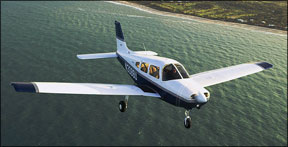
History
As general aviation was entering its heyday of the 1970s, Pipers line was beginning to look a little dated. The basic PA-28 had come out in 1962, and hadnt changed all that much in the intervening years. Pipers PA-28 and -32 singles all had the characteristic, constant-chord “Hershey bar” wing, and the company was about to lower the boom on the sleek Comanche. It was time to update the line.
A new airplane was planned, one that would take aim squarely at the Cessna Skyhawk. Previously, Piper didnt really have a direct competitor for the Cessna 172, even though it offered Cherokees with 150 or 160 horses through most of the 1960s. The Cherokee 140 was more cramped, being more of a 2+2 airplane than a true four-place, and it didnt perform as we’ll as the Skyhawk.
The first Warrior was introduced in 1974, powered by a 150-hp Lycoming O-320-E3D engine. It didnt replace the Cherokee 140, though the 140 did succumb to poor sales after the 1977 model year.
The Warrior boasted one big difference: A new, longer semi-tapered wing with a higher aspect ratio. This new wing helped the handling, with lighter roll control forces, and also boosted the climb rate. It also helped the airplanes looks. The new wing design first appeared on the Warrior, but eventually found its way into all of the PA-28 series as we’ll as onto the PA-32.
Interestingly, the new design represented a deviation from the production efficiencies originally touted as a virtue of the constant-chord wing. And its fun to recall some Piper engineers back when it was introduced
boasting that the fat, new, stubby wing was actually every bit as good as the sexier-looking tapered Comanche wing, aerodynamically. Pipers most significant upgrade to the Warrior came in 1977 when a slightly different O-320 engine-the -D3G-was bolted on, offering a 10-hp boost in output. The results were dubbed “Warrior II.”
A couple of other evolutionary changes occurred in 1978, when Warriors received more streamlined wheel fairings, and in 1983, when the battery was removed from under the rear seat and placed in front of the firewall. The new fairings-aftermarket versions of which are available under STC-yielded some seven knots in cruise speed according to the book, while the battery change shortened the run to the starter and helped combat starting problems (though these had been largely overcome, according to users, by swapping copper for aluminum cables).
Thanks to the change in weight and balance, shifting the battery location allowed the gross weight and useful load to be hiked by 115 pounds, and extended the aft CG to allow more of a load in the baggage compartment. (The boost is available via STC for older 160-hp Warriors.)
An attempt to create some interest in a moribund new-airplane market was made in 1988, when Piper released a version of the Warrior targeting flight schools called the Cadet. Basically a stripped-down version lacking creature comforts, it was available in VFR and IFR versions. The experiment continued through the 1994 model year. Another spruce-up resulted in the Warrior III in 1995, the model currently in production.