










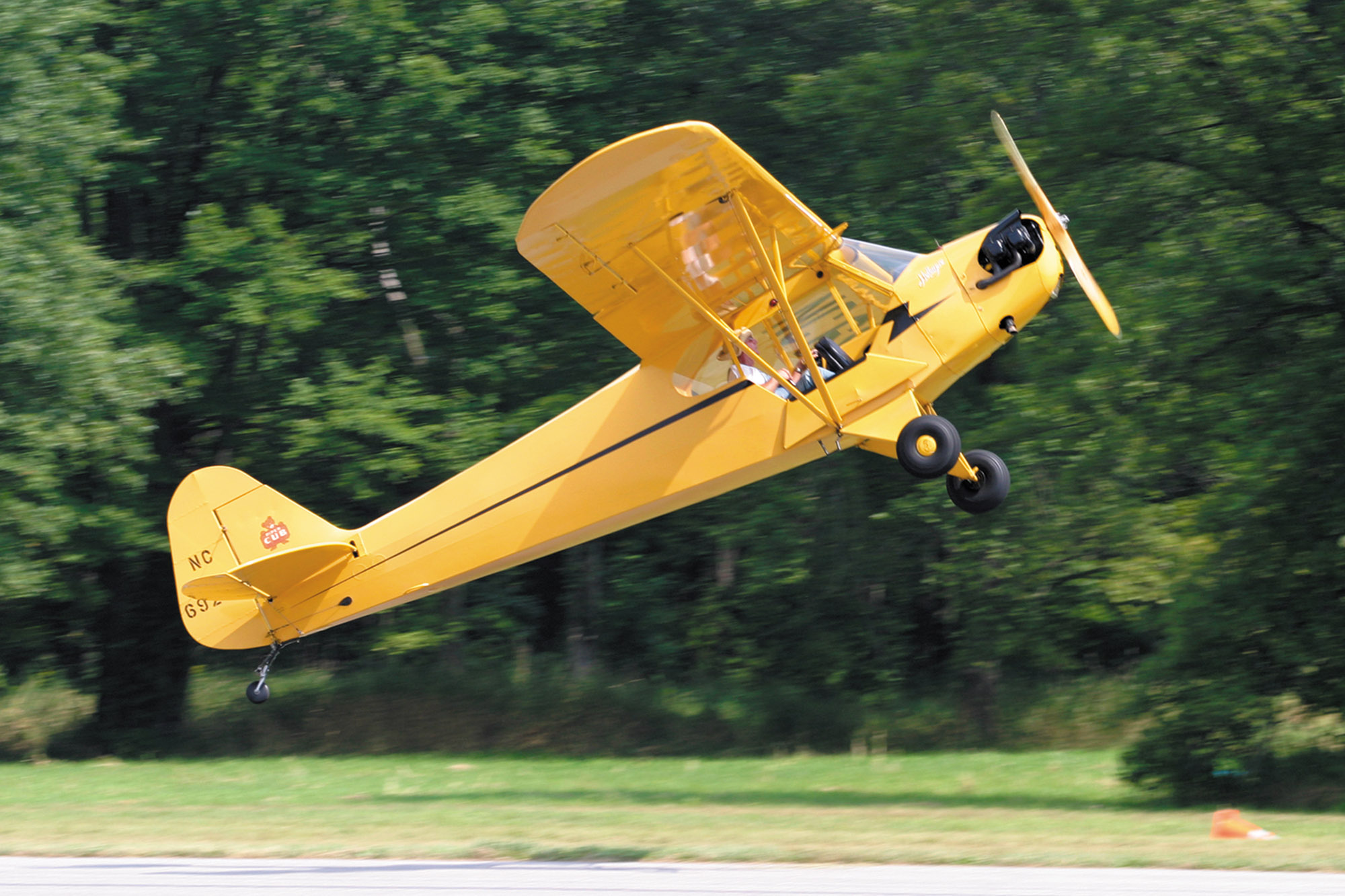
Piper J-3 Cub

Buy the best one you can find.

Piper J-3 Cub on takeoff
We think the J-3 can make for a decent first taildragger and the main image is proof that there’s no shortage of fun to be had. But don’t underestimate the need for good training and even better decision making.

To understand the significance of the J-3 Cub, look all the way back to Piper’s Lock Haven, Pennsylvania, heyday, where William T. Piper was rightly seen as a visionary. But no one could have imagined how enduring that vision would be, to the extent that over 80 years later, multiple companies are building brand-new Cub clones that clearly trade on the mystique of the old yellow classic. Two that are front and center in the market are Legend Aircraft and CubCrafters. We think both companies nail the quality and support and offer good value with their modern copies.

In a way it’s kind of depressing, because indirectly it signifies that a big chunk of the generation that made the real J-3 what it is has been displaced by younger folks who simply don’t understand the Cub romance and nostalgia.

The other reality is that Cubs are becoming a rarity at most airports, though we love a good barn find. And in the world of very old airplanes, we’ve seen plenty of buyers get stung when buying the wrong J-3. Our advice is simple: Buy the best one you can find, and be ready to pay the up-front premium.Piper J-3 Cub dimensions

Piper J-3 production

The first airplane to carry the Cub name wasn’t a Piper at all but a Taylor E-2 model, powered by a Salmson radial engine. It was first rolled out in the early 1930s with moderate success in the market. Piper’s version, the J-3, didn’t appear until 1937 and was an offshoot of the Taylor design. By modern standards, the first J-3 wasn’t much more than an ultralight, although it had the same tube and rag construction carried through to every Cub ever made.

The earliest J-3 was powered by a tiny 40-HP Continental A-40 and had a fuel capacity of nine gallons. The following year, Piper offered a 50-HP Continental as an option and a year later, in 1939, a steerable tailwheel and a 12-gallon fuel tank became standard. At that point, the 50-HP Franklin engine appeared as an option, in addition to an engine of similar horsepower made by Lycoming, whose plant was eventually just down the road a few miles in Williamsport, Pennsylvania.Piper J-3 Cub

Cubs were sold in high volume despite the Great Depression—more than 1300 in 1939. And with war on the horizon, 1940 saw the evolution of the J-3 into the classic form in which most models survive today, with a Continental 65 HP up front and, in fewer cases, the Lycoming or Franklin variants. Most had wood props, although those converted to Continental 85s were also converted to metal props.

The J-3 went to war in 1941 with Piper building 5000 L-4 military variants. Heck, Piper even claimed the L-4 could carry light bombs. Whether that ever happened, we’re not sure, but the L-4 did earn its stripes carrying artillery observers, couriers and, from time to time, a general or two.

Piper was ready when the war ended in 1945 and transitioned quickly into building airplanes for thousands of returning military pilots. The year after the war ended, an astounding 6320 Cubs were built, with production reaching 50 a day at one point, or one every 10 minutes.

With a market collapse, production sunk to 720 Cubs in 1947—which would be decent in 2025 standards. In 1948, the J-3 was supplanted by the PA-11, which had a larger engine, a bigger cockpit and a full cowling. But by the end of its production run, 14,125 J-3s had been built and many fly yet today. Want one? Buy it right.

J-3 cub engines

Although the Continental 65 was the standard Cub engine, many have been refurbished with 75-, 85- and 90-HP Continentals. There’s little difference between the 65- and 75-HP models, but the 85s and 90s provide extra climb rate, especially for high-attitude or float operations, where the Cub may otherwise be a marginal performer.

The larger engines may raise a Cub’s value. But from our experience, the 65-HP engine is perfectly adequate for most Cub flying and is preferred for ultra-original restorations, in which any variation from original configuration is considered a drawback—just like in the classic car world. But don’t expect exceptional performance from the 65s, either. The Lycoming and Franklin 65s are somewhat rare these days and carry a price penalty of a few thousand dollars. The Lycoming actually puts out something like 50 to 55 HP (with less fuel consumption), while the Franklin suffers from a parts scarcity, several shops told us in mid-2025.

Yes, we can attest that a bigger-engine J-3 can work for float flying, with some limitations.

Performance

Typical cruise speed is about 70 MPH with the 65-HP and 75-HP engines, while those sporting the 85-horse mills can streak along at 80 MPH. Then again, Cubs aren’t cross-country airplanes. With only 12 gallons aboard, practical unrefueled range is about 150 miles, after which you’ll want to get out for a stretch anyway. An Aviation Consumer editor once flew a Cub coast-to-coast in nine days, with 42 stops for gas.

The Cub comes into its own not in long-distance cruising but in operations off airports with grass runways. At light weights, on cool days, the Cub is an excellent short-field bird, particularly with the 85- and 90-HP engines. The fat wing delivers stall speeds somewhere around 40 MPH. Heavy or hot, it will still lift off in a short distance, but climbs over nearby obstacles can be unpleasantly sporty, given the airplane’s high drag and lack of surplus thrust.

The Cub has a reputation as a docile, easy-to-handle airplane that just about anyone can fly. It’s considered a big teddy bear, ever forgiving of ham-fisted pilots. It isn’t. On the runway, the Cub can be a ditch lover and like any other taildragger, it will groundloop if given the chance, although it’s considered one of the better-handling taildraggers. For pilots used to toe brakes, the Cub’s heel brakes are weak and awkward.

The wing has no dihedral, meaning little roll stability. It has very sluggish ailerons that generate a lot of adverse yaw, thus requiring a good deal of rudder. Even a mild turn will require a healthy stab at the rudder, something most pilots trained on nosegear airplanes have to learn.

The stall, if the controls are coordinated, is relatively docile; however, the horizontal stabilizer has no camber, which helps generate a very rapid roll-off and pitch down into an incipient spin at the stall if the ball is not absolutely centered.

A J-3’s instrument panel doesn’t get simpler.

J-3 purchase checklist

For such a small, simple airplane, a Cub has the potential to eat up lots of cash. Derek DeRuiter of Northwood’s Aviation in Cadillac, Michigan, has, with his father, rebuilt scores of Cubs over the years and offered some comments regarding things to check carefully on any J-3 you’re considering.

• Fabric condition: Cubs were originally covered with Grade A cotton; it should be avoided unless you are a fanatic for authenticity and willing to pay the price of regular recovering. It lasts maybe eight years if the airplane is hangared. Most Cubs are now covered with Dacron fabrics such as Ceconite. Properly applied and protected from ultraviolet radiation, these fabrics will last as long as you’re likely to own the airplane.

• Engine condition: TBO of the little Continentals is listed as 1800 hours, but the number is almost irrelevant, since most J-3s aren’t flown much and succumb to time and lack of use rather than hours. An engine may have only 600 hours since overhaul, but if the overhaul was in 1979, the engine may or may not be long for this world. Check compression and oil pressure.

• Rust: Check the lower rear longerons and the tail post. They do rust; don’t buy an airplane without carefully checking this area.

• Wing struts and strut forks: Made of the same rust-prone steel as the fuselage tubes, these critical parts have a long history of corrosion problems. A series of ADs applies to this critical area requiring inspection every 100 hours until replacement; make sure that all have been complied with.

• Fuel tank and drain: Original Cub fuel tanks were made of lead-coated steel, and they rust out regularly where water collects in the bottom. (Be especially wary of the 1940-45 J-3 and L-4 models, when the factory was skimping on the lead coating.) An AD also requires a new fuel drain. Many, if not most, of these tanks have been replaced by aluminum tanks but check the logs and inspect to be sure.

• Wooden wing spars in pre-1946 airplanes: Check for dry rot and cracks.

• Landing gear attach fittings: A weak point; check between them for condition, especially if the airplane has been on floats. The landing gear bungees are good for about three years.

• Misc items: The elevator trim system components wear out; inspect carefully. The rudder and elevator hinges wear out; also check carefully and look closely for corrosion. As for accident damage, Cubs are subject to all sorts of minor landing and takeoff accidents and their huge wings and light weight make them very prone to wind damage while tied down. We would suspect that the vast majority of Cubs have been damaged at some time or another and a fair number of those now flying were built from the wreckage of two or three or more and one data plate. Or from a data plate and parts from Univair. That’s OK, if the work was done correctly. Only a Cub expert will know, however, so we recommend contacting one of the Cub groups for a list of shops that know the airplane.

We wouldn’t be put off by an airplane that has been groundlooped— most have—but make sure damage has been repaired correctly. The two big suppliers of Cub parts are Univair and Wag-Aero, both of which stock a complete selection of PMA’d Cub service parts. Wag-Aero Group is in Lyons, Wisconsin, at 800-558-6868 and at www.wagaero.com. Contact Univair Aircraft Corp. at 888-433-5433 and at www.univair.com.

An excellent owner group is the Piper Cub Club, in Hartford, Wisconsin. Find them on Facebook.

Grove brakes are a worthy upgrade.

No frills—it’s a cub

You won’t be overly comfy in one. It’s loud, the seats are utilitarian at best and getting in and out is, well, an exercise. And yes, you wear the airplane more than you sit in it. But that’s part of the Cub experience, we suppose.

Getting into the back seat—from whence you solo—is not so bad but ingressing the front requires some contortions. Once in the back, legroom is acceptable, with the legs extended forward to the rudder pedals and brakes. The front seater is balled up in a painfully cramped seating position that’s not comfortable for any length of time.

Baggage room is essentially zip; there’s room for perhaps a loaf of bread in the canvas “luggage compartment” behind the rear seat. These days, most J-3 pilots mount a portable GPS somewhere in the cockpit, along with a handheld VHF radio for self-announcing on CTAFs. Beyond that, the instrument panel has the bare necessities. There’s a tach, an airspeed indicator, oil pressure gauge and altimeter. The fuel gauge consists of a cork float supporting a vertical wire that is visible through the windshield.

Training to fly a cub

Our advice is to take this seriously. First, a J-3 is a first-rate spin trainer; it will stall and spin easily compared to later training aircraft such as the Cherokee 140. Conventional anti-spin control inputs will recover it easily.

The soft bungee cord suspension absorbs bounces well and the big rudder gives excellent directional control. However, the Cub can be humbling to land, requiring deft footwork to maintain directional control, especially in all but the lightest crosswinds. The Cub’s light wing loading makes it a kite in gusty conditions. With the low landing speed, a 15-knot crosswind can present a major challenge. New Cub owners are well advised to seek competent instruction before soloing.

Put some money away for regular training with an instructor who understands these planes. Speaking of money, you’ll need a handful (or two) of cash to buy a good J-3 and we suggest not bottom feeding. These are ancient machines and money is well spent on one that’s been nicely restored, or at least well-kept.

On the low end of the spectrum, you might pay $35,000 for an average J-3 and perhaps north of $65,000 for one that’s pristine. Last, don’t forget a hangar—these aren’t fabric-covered classics to keep outside.