











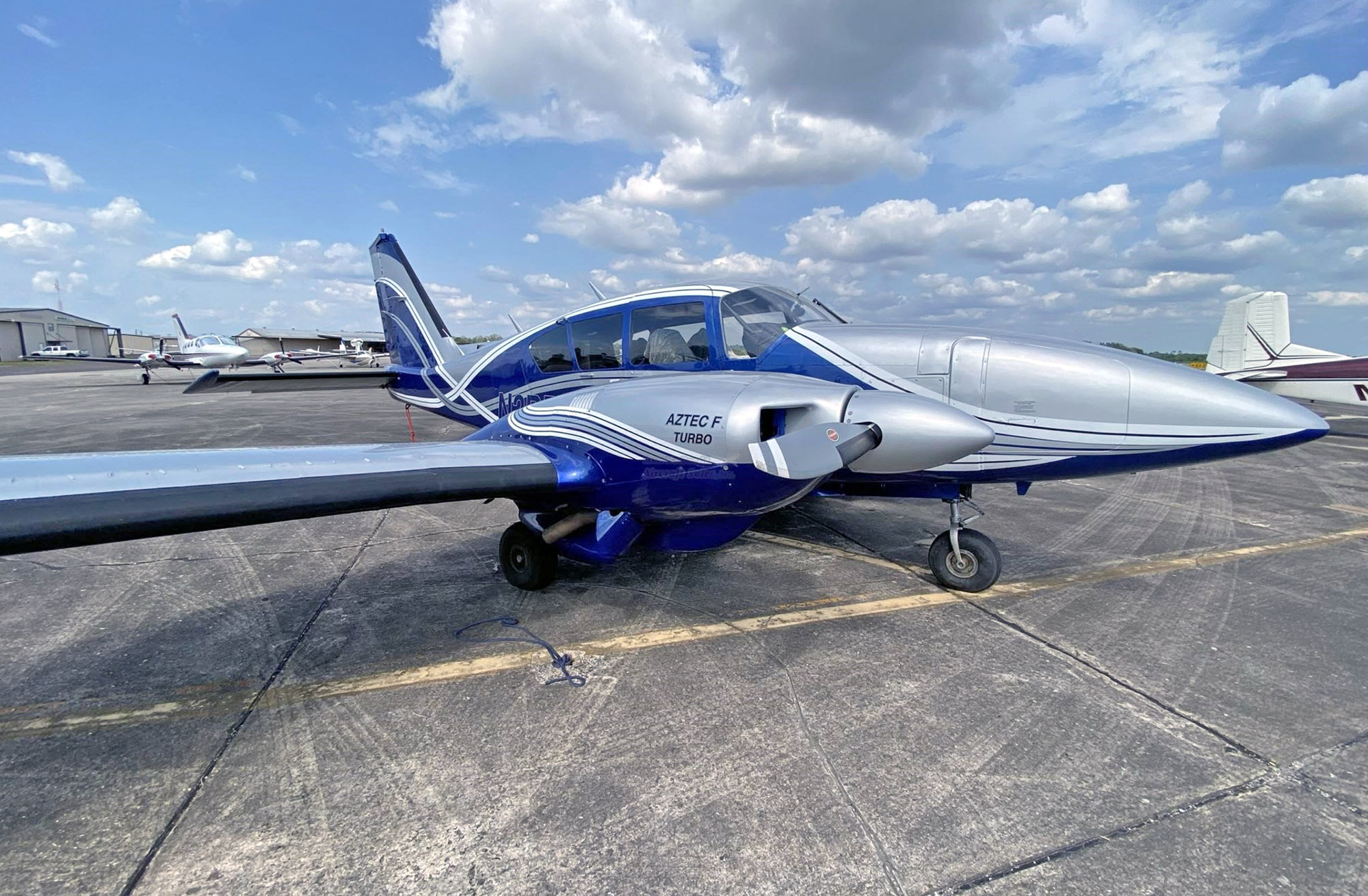
That’s a turbocharged Aztec in the photo above, wearing a sharp Scheme Designers paint scheme. It’ll cruise at around 195 knots.
Piper’s stock Apache has long been for initial twin-engine training and time building because it’s reasonably economical, but it isn’t necessarily the best traveling. The good news is the PA-23 line—which started with the Apache—also includes the more capable Aztec.
Choose your power—turbocharged or normally aspirated—but understand that these are aging twins, which means being careful not to choose one that’s light on maintenance.
Prices on the PA-23 are up slightly from when we looked at the market a few years ago, but the insurance market for twins, including the Aztec, is more difficult. The airplane’s recent NTSB wreck stats aren’t helping. There are lessons to be learned.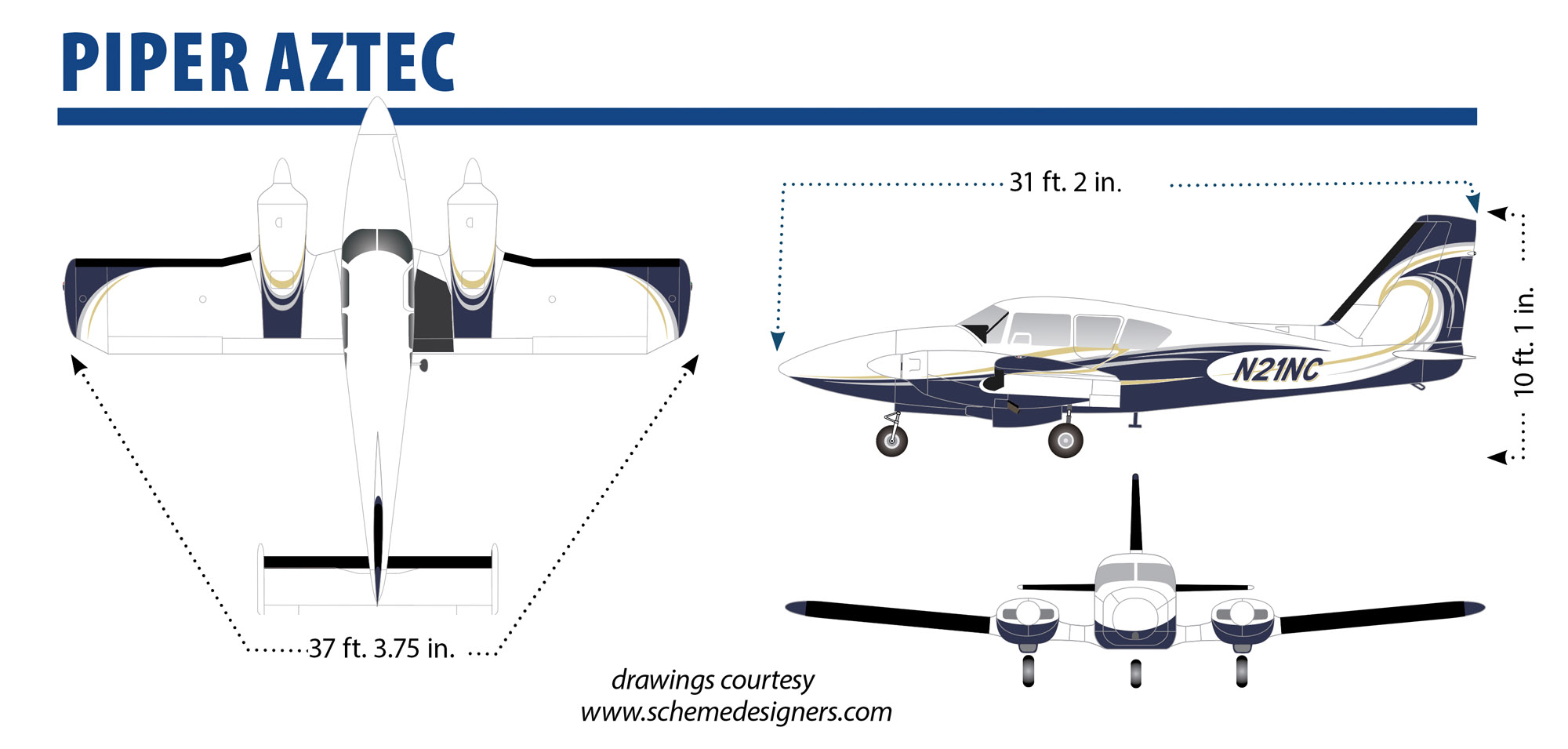
From the Twin Stinson
Look back in time to around 1950 where the post-war boom had aircraft manufacturers in a race to build a personal light twin. Beech took the lead, and although Piper had been cranking out steel tube-and-fabric airplanes, it bought the Stinson Division of Consolidated Vultee. That created the Twin Stinson—a tube-and-fabric “executive” light twin with little 125-HP engines and a twin tail. Eventually covered in aluminum skin (and losing the twin tail), the airplane got two 150-HP engines and in 1954, the Piper Apache came to market.
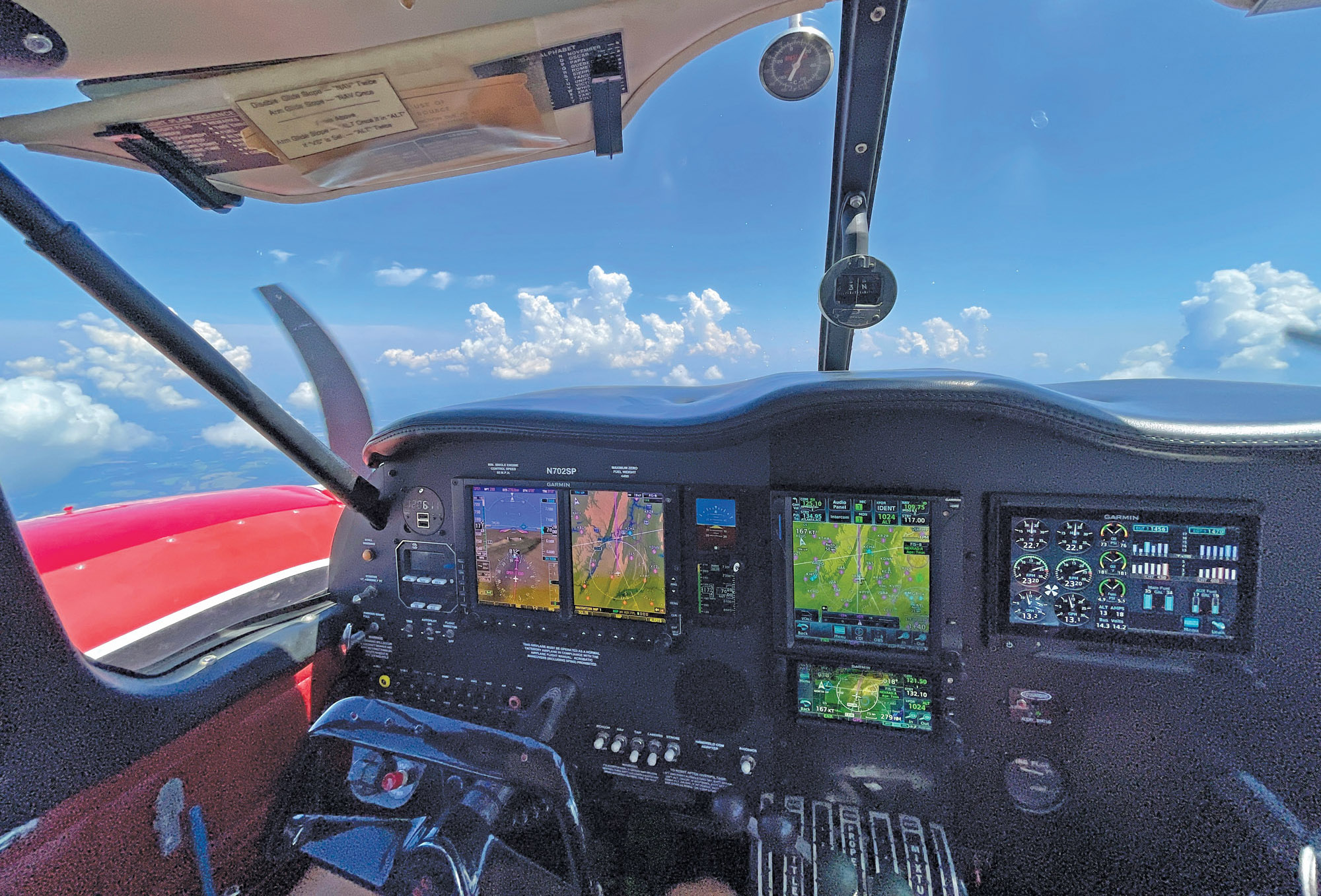
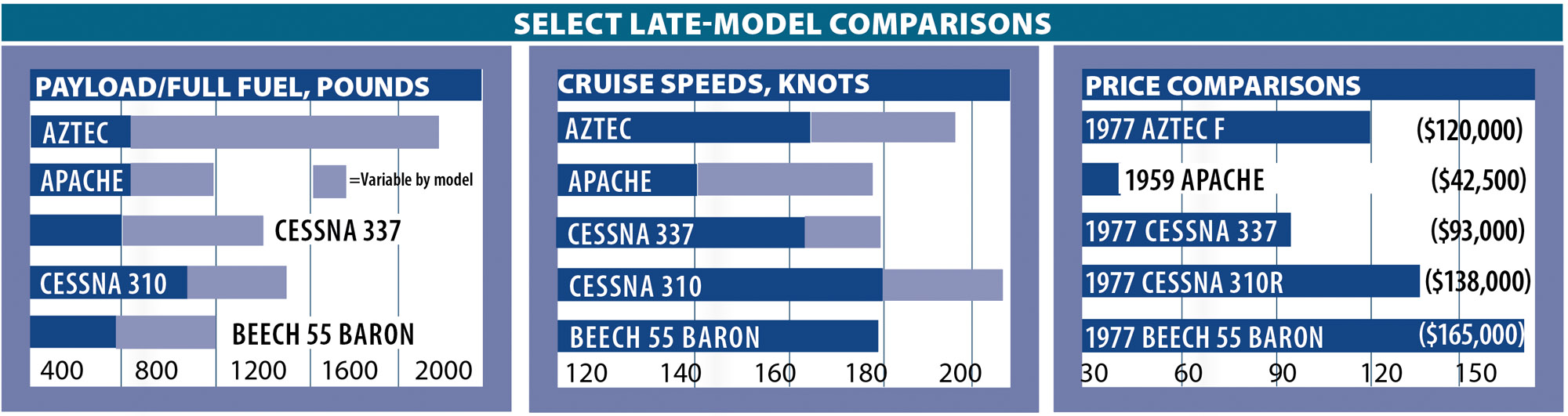
The Apache had a fat constant-chord wing that made it work well for short runways, but its draggy stubby snout kept cruise speeds pretty slow—around 140 knots on a good day for a well-rigged airframe. Powered by two Lycoming O-320-A1A engines (150 HP), the Apache had a five-seat cabin and 3500-pound gross weight. Useful load was 1320 pounds.
Back in the day, the Apache typically retailed for around $36,000, and in the current market you might pay well north of $60,000 for ones with upgrades and that haven’t been used hard as trainers.
After a few years into production, Piper put more horsepower on the Apache—160 HP per side—using Lycoming O-320-B3B engines with full-feathering props. Along with the extra horses came a 300-pound gross weight increase, but the extra weight didn’t do much to help single-engine performance, which is lethargic at best, especially when it’s high and hot.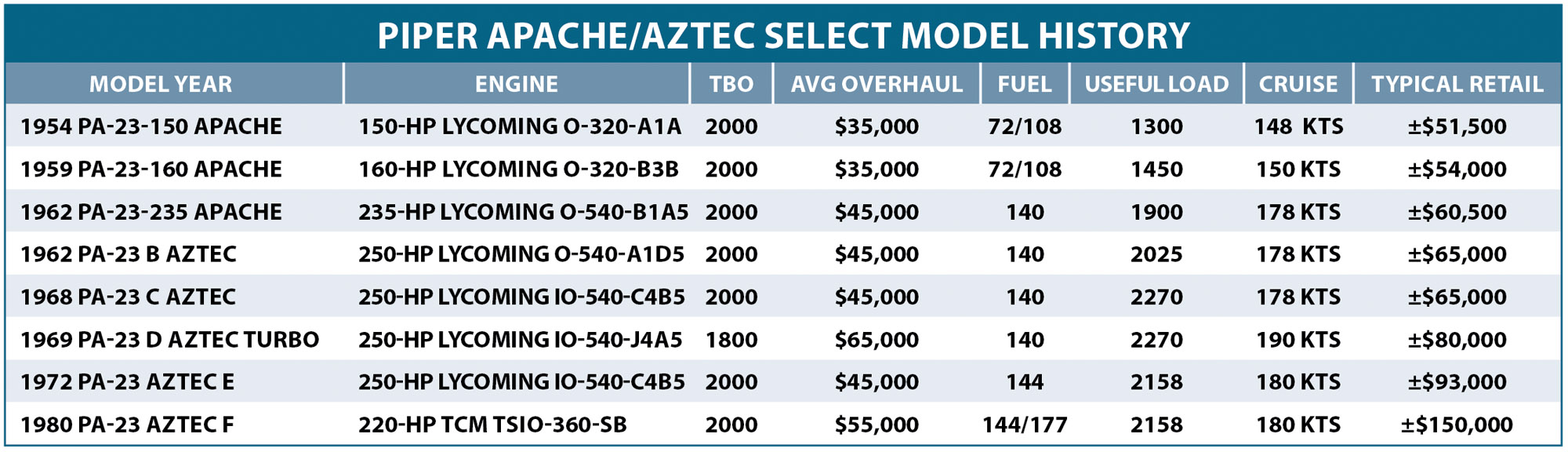
The Aztec came along in 1960 and it had a stretched airframe, a bigger tail with a stabilator and 250-HP Lycoming O-540-A1B5 engines. With a max gross weight of 4800 pounds and more power, the Aztec killed Apache sales (the Apache was still offered in the Piper lineup) and in 1961 the company only made 28 of them, compared to 362 Aztecs.
Still, Piper wouldn’t let the Apache go and tried selling the airplane with O-540 engines, calling it the Apache 235. Meanwhile, the Aztec kept looking better (and sleeker), fitted with a longer nose with a baggage area. That 1962 B-model Aztec had six seats and an emergency exit window, plus optional fuel injection and turbochargers from AiResearch. Piper finally pulled the plug on the Apache in 1965 after making 114 airplanes.
Meanwhile, the Aztec kept getting better and in 1964 the C model got fuel injection as standard, plus a 5200-pound gross weight and eventual extension of engine TBO from 1200 to 2000 hours. In 1966, Piper offered the turbo version as a separate model rather than as an option on normally aspirated ones. The D-model Aztecs got a rearranged instrument panel layout and the E and F models got a nose extension. The pointier beak really steps up the ramp appeal, in our view, and it’s the easiest way to tell newer models from older ones. It was a decent run for the PA-23, with roughly 2300 Apaches and 5500 Aztecs delivered.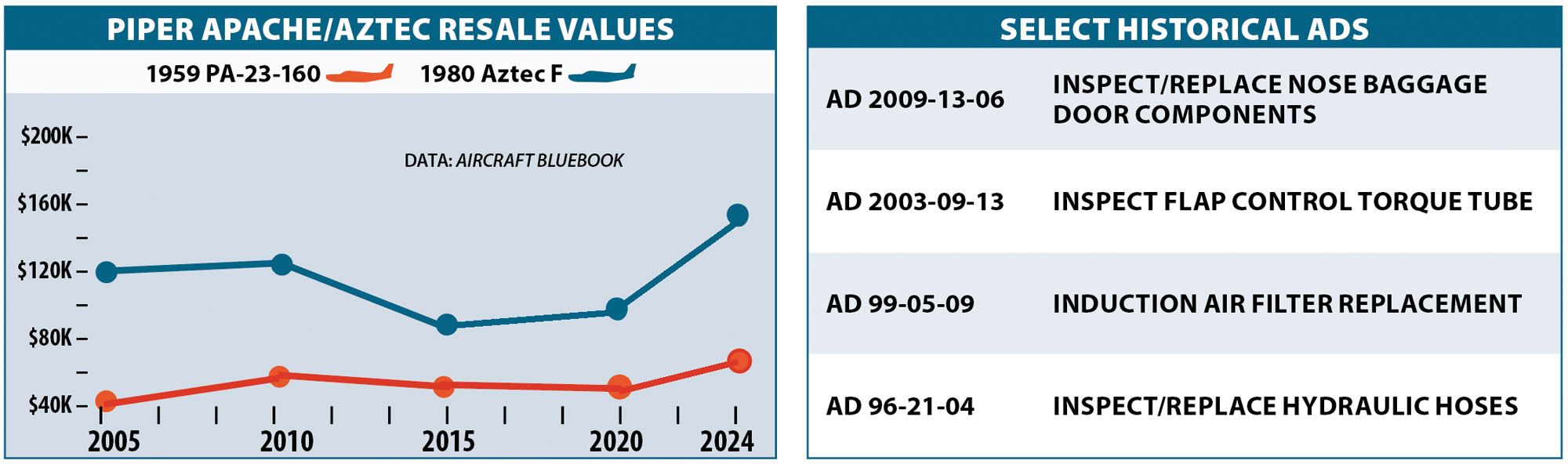
Systems, dwelling
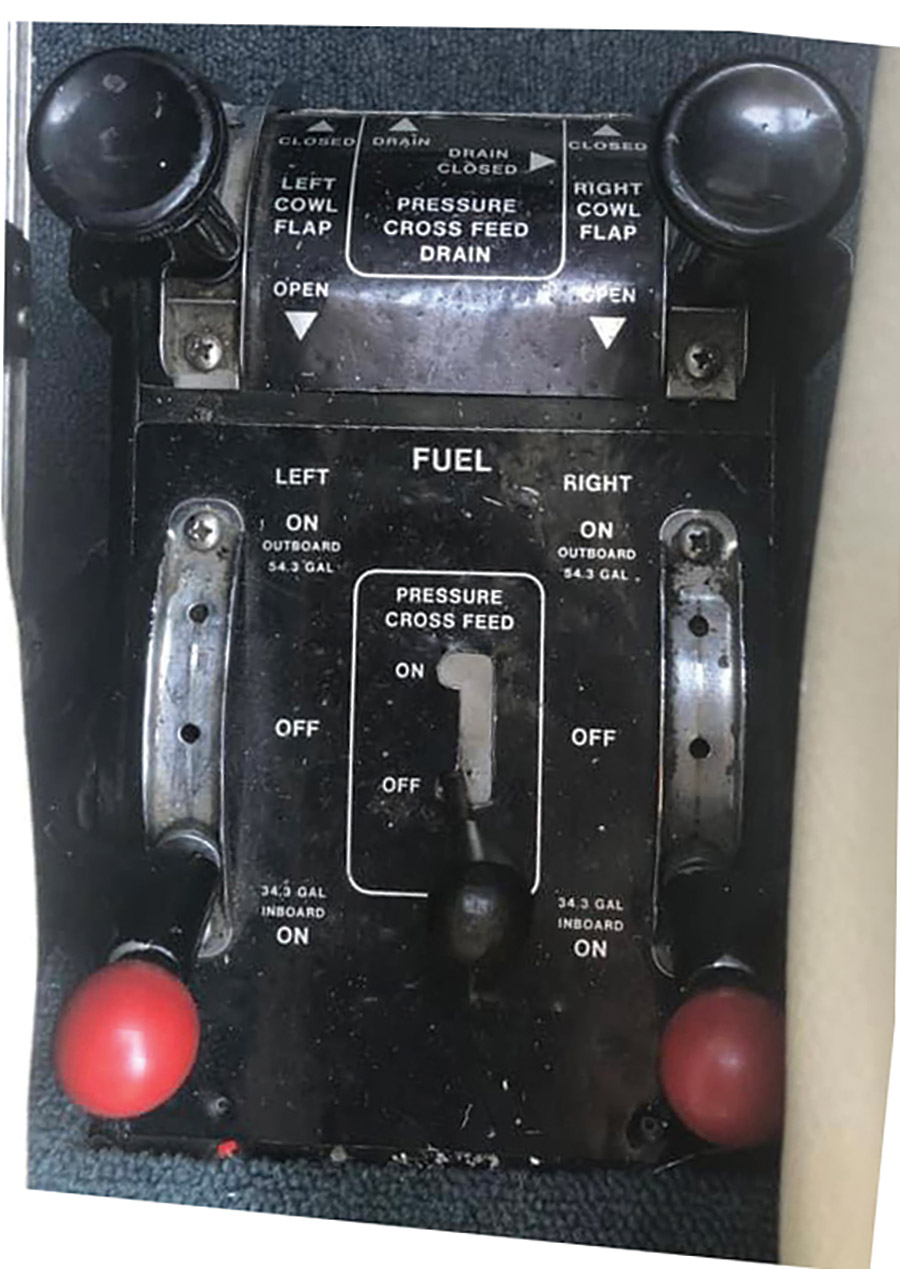
When searching for an Apache or Aztec (and when maintaining them), look closely for fuel leaks. All Apache 150s and 160s have one 36-gallon fuel bladder in each wing and you’ll find that many have an 18-gallon aux tank on each side. Apache 235s and Aztecs have two 36-gallon cells in each wing. The F model could also be fitted with 20-gallon internal tip tanks. Also on the Aztec F’s options list was an auxiliary hydraulic pump on the right engine. Earlier models came with only one pump on the left engine to operate landing gear and flaps.
If the left engine gives you the middle finger, there’s a hand pump underneath the control console that requires 30 to 50 strokes to get the gear up or down—a significant challenge during a real emergency. There’s also a CO2 bottle to blow the gear down if the emergency pump doesn’t work. Something to seriously consider is that the landing gear and wing flaps are hydraulic and proven to be a source of leaks and constant upkeep. We heard from one owner who replaces some valves, hoses and fittings every year so that everything was changed over five to six years. Another told us he stocks a replacement gear pump, knowing he’ll use it at some unexpected time.
To check the level of the hydraulic fluid, the airplane must be up on jacks with the gear retracted and flaps extended. Otherwise, adding fluid overfills the system, leading to a very red airplane when the gear is retracted after takeoff. Some Apaches have been upgraded with dual alternators and vacuum pumps, and we would avoid those that have not.
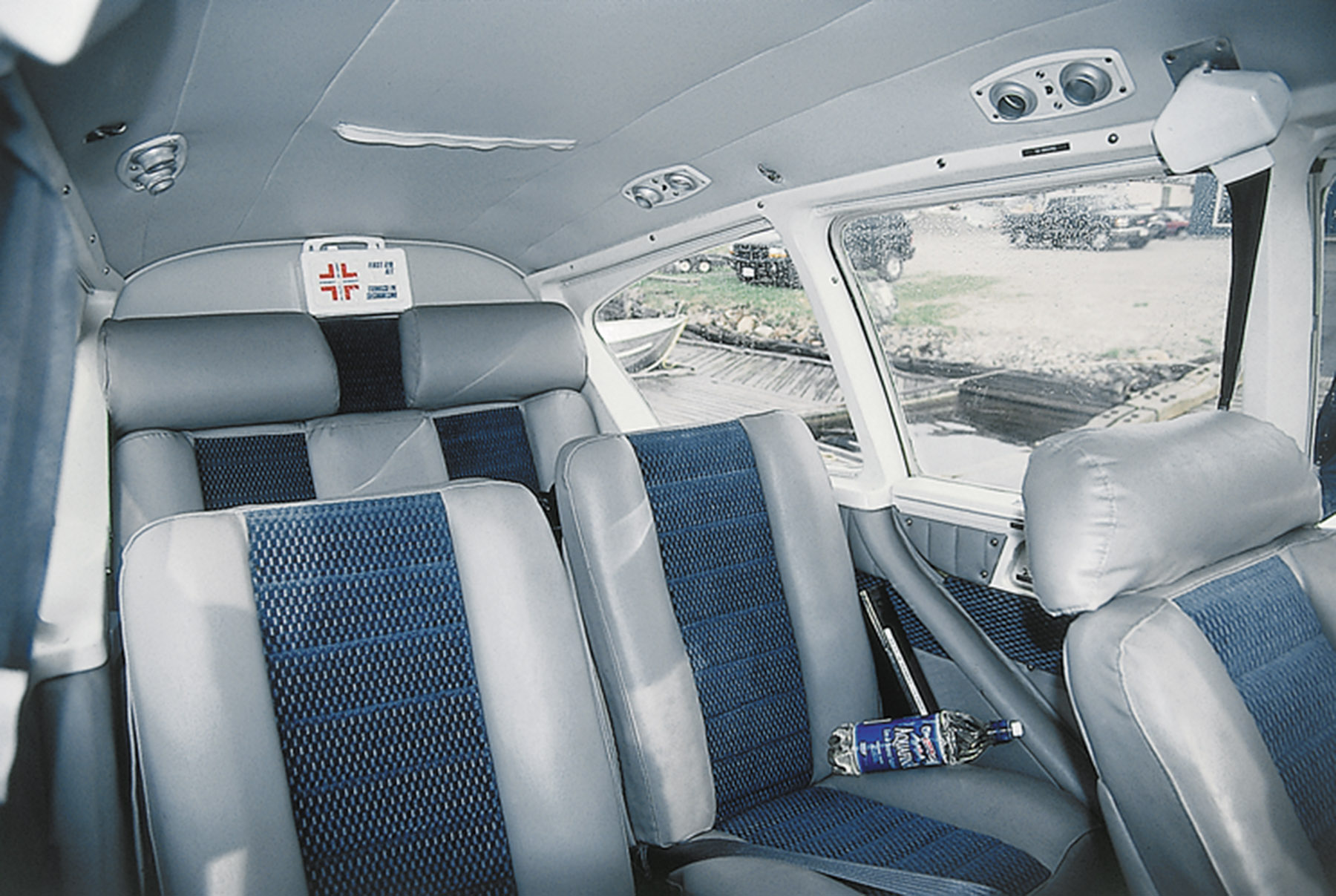
For some aging models, the passenger cabin isn’t exactly a cozy dwelling. We’ve heard horror stories of heater issues, with one owner reporting his passengers had to wrap up in sleeping bags to stay warm during winter flights. That airplane turned out to have crushed heating ductwork requiring many hours of labor to fix and even then, the result was not adequate, despite also plugging the many leaks in the aft cabin bulkhead. Airflow in the fuselage is from the tailcone forward. Some models of the gas-fired heater have maximum hours between overhaul limits, so a Hobbs meter on the heater is a good investment as is budgeting big for an overhaul or replacement.
 For hauling people, the fifth seat in Apaches and early Aztecs is relegated to the back of the cabin, where it takes up a lot of space in the 200-pound capacity baggage compartment. Some Apache owners might even remove the seat from the airplane, as it is virtually unusable and is just excess weight. Beginning with the B-model Aztec, there are three full rows of seats and 150-pound capacity baggage compartments fore and aft.
The PA-23 cabin is spacious and comfortable, with plenty of elbow, head and leg room. We’ve flown Aztecs on good-sized trips and attest that the airplane offers a decent ride. An Aztec can haul a respectable load, but don’t believe owners who suggest you can fly with anything you can close the doors on. Still, even well-equipped Apaches and Aztecs can carry full fuel, four or five adults and baggage, despite zero-fuel-weight restrictions imposed by an Airworthiness Directive (83-22-01) that was issued to prevent damage to wing attach fittings.
The Apache 235 and the original Aztec have zero-fuel-weight limits of 4000 pounds. In naturally aspirated B through F models, any load above 4400 pounds must be fuel. For turbocharged models, the limit is bumped to 4500 pounds. We have found that a surprising number of owners are not aware of the limitation, so wing attach fittings should be a checklist item on a prebuy inspection. While there, check for corrosion in the tubes in the bottom of the fuselage.
Performance
These are stable airplanes at slow speeds thanks to the fat, high-lift airfoil. But that shaves some speed. We’ve heard from owners of 150- and 160-HP Apaches that 135 to 145 knots on 16 GPH at 75 percent power is about right.
The big-engined Apache is faster but at more fuel burn. Realistically, figure on about 160 knots on 29 GPH at high cruise for the Apache 235. Early Aztecs claim 178 to 182 knots while burning about 26 to 28 GPH at 75 percent, but in our experience more realistic cruise is 160 to 165 knots. The E and F models are a few knots slower on the same fuel. Up high, around 24,000 feet, a Turbo Aztec can cook along at 190 to 200 knots at a thirsty 30 to 35 GPH.
These are good short-field machines, especially with VGs installed. The Apache models need less than 1100 feet to get in or out over a 50-foot obstacle, although the published Vx is very near Vmc. Early Aztecs require less than 1250 feet. Newer, heavier Aztecs use up a bit more pavement, but not much: Figure on about 2000 feet to get out and less than 1600 feet to get back in (over a 50-foot obstacle) in an E or F model. The Apache 235 and Turbo Aztecs climb at about 220 FPM on one mill. However, some Apache owners have told us they’d consider themselves lucky to hold altitude at gross weight with only one engine running, and we saw barely 100 FPM while getting single-engine practice in a lightly loaded Apache 160 on a hot day. Then again, we felt a similar pucker factor climbing on one engine in a Seneca I. Practice it. A lot.
In the air, with everything working properly, the Apaches/Aztecs feel like big Cherokees, but with more responsive controls. However, the ailerons are somewhat heavier than the rudder and stabilator (elevator in early Apaches). The manual pitch trim control, by the way, is (like older Cherokees) a large crank on the ceiling with a smaller crank (a knob in later models) inside it for yaw trim; both are very sensitive. Another idiosyncrasy is the location of the gear lever on the right and the flap lever on the left of the center pedestal. Pilots do get these mixed up, and the latch that’s supposed to prevent inadvertent gear retraction doesn’t always work.
Geronimo conversion
Apaches and Aztecs are old airplanes. That means parts can be either simple or difficult to source. We know firsthand (by wrenching our fair share of PA-23s) that some components should be stockpiled, while others are a phone call away. Salvage dealers are often a good source, and of course Piper is worth a try. Don’t forget that many years of service can create lots of required inspections—and some are quite expensive. In our check of ADs for the PA-23, we found over 105 listed.
Last, Montana Diamond Aire (www.diamondaire.com) performs the worthy Geronimo mod (that’s a converted 1960 Apache shown in the lower left), including a 180-HP Lycoming engine and prop conversion with an advertised 25-MPH speed increase. It also offers a number of other STC’d mods for the Apache-Aztec line including redesigned noses, dorsal fins, a speed-slope windshield, gap seals, vortex generators, tip tanks and inflatable door seals. The company offers an instrument panel upgrade for Aztec, Apache and Geronimo models. The one-piece design eliminates clutter and is shock-mounted. We’re sorry to hear of the recent passing of Montana Diamond Aire’s CEO and owner, John Talmage—who knew how to support the customers. The Geronimos we’ve worked on and flew were in many ways better than Aztecs.
“For fuel efficiency and cost in a twin, it’s hard to beat the Geronimo mod,” one owner told us.