











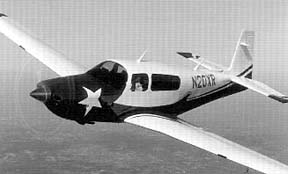
Once prized for squeezing lots of knots out of relatively small engines, Mooneys are no longer taking a back seat in the horsepower race. The trend toward hot-rodding Mooneys is continuing, with the introduction of the Mooney Missile from Darwin Conrads Rocket Engineering, which consists of a large-block, normally aspirated engine stuffed into the Mooneys slick airframe. Rocket Engineering also does conversions to the 305 Rocket, in which a TSIO-520 is mated to an M20K airframe.
Not to be outdone by the aftermarket crowd, the Mooney factory rolled out its own high-horsepower act in 1994, in the form the M20R Ovation. Both of these aircraft represent essentially re-engining of existing airframes. Darwins Missile transplants the Mooney 201s stock IO-360 with Continentals IO-550 rated at 300 horsepower; the Ovation uses another variant of the same engine, derated to 280 horsepower.
Another big-bore mod was under development when the Missile came out, the GTO from LoPresti Speed Merchants, but it did not come to fruition. Nevertheless, buyers have the choice of three high-horsepower Mooneys, all with similar performance but with operating characteristics quite different from those of the turbocharged engines traditionally associated with go-fast airplanes.
Turbos dead?
Does the trend toward large-displacement, normally aspirated engines mean that the turbocharger has seen its day? Hardly. Both Rocket and Mooney say that the new models simply give buyers the option of high performance without turbocharging. The Missile is based in large part on the 305 Rocket mod that has been successful for Rocket. Rockets Conrad notes that this is our answer for the pilot who wants a faster Mooney, but doesnt care to spend the extra money for the Rocket or already has a 201 and wants to improve its performance without the expense of a turbo.
The Ovation, which carries a much higher price tag than the Missile, probably wont compete directly with the modified model; rather it should appeal to the buyer who seeks near 200-knot performance without dragging the airplane into the flight levels. The Ovation is essentially a TLS airframe with everything new from the firewall forward. Jeff Dunbar, Mooneys sales VP, explained that the Ovation fills out the Mooney line perfectly, fitting in between the MSE (M20J) and the TLS (M20M) in both performance and price.
Missile motivation
For the Missile, Rocket Engineering uses the same engine configuration as found in the A-36 Bonanza, producing 300 horsepower at full throttle. The engine installation is virtually identical to the Rockets, replacing the original four-point Mooney engine mount with Rockets eight-point mount. The Missiles engine, like the Rockets, is canted 2-1/2 degrees to the right and 1/2 degree down to offset torque effects. Conrad retained the heavy-wall, stainless steel exhaust with a flanged exhaust tube replacing the turbo controller and a hefty muffler with heater muff replacing the turbo, suggesting that adding a turbo down the line would be a cinch.
There’s no way that big Continental would fit under the same cowl as the stock Lycoming, so the Missile has a modified cowling from a Mooney 231, with different baffling, no air induction inlet for the non-existent turbo and no cowl flaps. As on the Rocket, the cowl is cut down at the front to clear the spinner, a slight bulge is added to the left forward upper corner of the lower cowl to clear the number six cylinder and a large oil access door is added. The engine is mated to a 75-inch Hartzell Scimitar three-bladed, full-feathering prop. The feathering prop proved popular on the Rocket and Conrad pushes it as a safety feature.
Firewall back
Aft of the firewall, there are few changes to the Missiles cockpit. A mechanical tachometer replaces the original electronic type and a digital fuel flow gauge is required, if one isn’t already in the panel. Owners whose aircraft are equipped with a push/pull throttle can opt for a vernier control during conversion and wed suggest that as money we’ll spent. The ram air and cowl flap knobs arent connected but Conrad leaves them in place, leaving open the option to add ram air later.
A new slide-in aluminum battery box fitted with two 12-volt, 35-amp batteries is installed in the tail cone, helping to counterbalance the big engine up front. Actual installed weight of the engine and accouterments adds 250 pounds. Rocket welds in 11 structural pieces to upgrade the M20J to M20K structural specs, allowing a gross weight of 2997 pounds, up from 2740 pounds in the original 201. The net impact of the conversion is an eight pound gain in useful load.
Earlier models (1977-1980) with square wingtips require installation of the tapered 231-style tips with integrated lighting. Likewise, models earlier than 1981 must comply with SB 1720-220, which calls for a fuselage tubular structural clamp to reinforce the longerons. Many buyers are likely to opt for installing the STCed Monroy auxiliary fuel tanks which add an extra 35.5 gallons (30 gallons if speed brake equipped) to the original 64-gallon capacity.
Flying the Missile
We flew the first certified Missile only hours after it had been signed off and the Experimental placard removed. Taxiing out at Spokanes Felts Field, the airplane handled much like any stock M20. With the Missile lined up and throttle firewalled, launch seems the operative word. Acceleration was rapid and pronounced and we were off in about 1000 feet, as claimed. With full tanks and equipment, we were about 200 pounds under gross. Initial rate of climb was 1500 feet per minute, which correlates with Rockets claim of 1550 feet per minute at sea level and gross weight.
The canted engine reduces P-factor effect to next to nothing and its possible to climb at full power with feet on the floor and the ball only slightly off center. The right rudder required feels to be about the same, perhaps even a bit less, than the original 201. Lowering the nose slightly for a better view reduced the rate of climb to about 1100 feet per minute. This bled off to about 1000 feet per minute at around 6000 feet and about 800 at 10,000 feet. We continued to 17,500 feet, where climb rate was still better than 200 feet per minute. Despite the lack of cowl flaps, the temps never got out of the lower part of the green.
Conrad claims a top speed and max cruise of 193 knots at 8000 feet. Our flight verified that as attainable. Conrad explained that he had hoped to see 200 knots in the Missile and that this speed may be reachable with ram air added. Our speeds and fuel flows jibed closely with the charts we were given. Pilots can expect better than 185 knots from 4000 feet through 14,000 feet, with fuel flows ranging from 16 gallons to as low to 11.8 gallons at altitude. At 17,500 feet, we saw 179 knots true, carrying 15 inches and 2500 rpm for a fuel flow of 10.7 gallons. By comparison, at 10,000 feet, 55 percent power will yield 170 knots. Noise levels are reasonable at full power and the cabin seems quite quiet in cruise.
Conrad suggested we try out the feathering prop so we established ourselves over an airfield and proceeded to slowly reduce power and allow the engine to cool down. With the mixture at idle cutoff, it took a hefty pull on the prop control to get the prop to feather, after which it stopped dead. The improved glide ratio is noticeable. A stock 201 with a stopped prop has a respectable 12 to 1 glide ratio; the feathered prop increases that to 16 to 1, an improvement that could make a difference in a genuine engine-out situation. Following the glide test, we were happy to restart the engine to try a series of stalls, and minimum controllable air speed exercises. We found no unusual behavior; just typical, predictable Mooney performance. Landings were also straightforward, with no discernible difference from the stock 201. So, what you have here is an honest, 190-knot airplane. Beyond that, its the same M20J Mooney you started with, for better or worse. While the Missile conversion will give you a big, shiny new engine and lots better than new performance, it doesnt make it a brand new aircraft.
New Ovation
For new all around, the Ovation is waiting, albeit at significantly higher cost. Mooneys version of the IO-550, the G model, features a tuned induction system, similar to the one incorporated on the 252. A 73-inch diameter McCauley three-bladed prop turns the horsepower into motive force. Mooneys Dunbar said that much effort went into the induction system to achieve even fuel distribution with ram air recovery totaling 1 to 1.5 inches.
The G-model has no altitude-compensating fuel metering, so the pilot must lean the mixture manually above 3000 feet MSL in the climb. To facilitate this, the EGT gauge is marked, in blue, with a climb range from 1400 to 1450 degrees. Dunbar claimed this was done to reduce complexity and to allow more precise fuel management. Were not sure this isn’t a step backwards.
Mooney derated the IO-550G to 280 horsepower by limiting maximum RPM to 2500. This probably contributes to the engines claimed 2000-hour TBO. Whether thats a realistic number wont be known until the aircraft accumulates some history, so buyers are duly cautioned not to bank on the high TBO. Dunbar said the power was limited primarily to reduce noise. However, we were told that there’s another good reason for limiting engine output: Higher horsepower might have made it difficult to meet certification requirements during stalls.
The most noticeable difference on the Ovation exterior is a new sculpted cowl which slopes down to the pair of the small cooling inlets which seem the rage these days. These inlets are smaller even than those on the MSE but they still manage to provide adequate airflow. No cowl flaps are fitted so cooling air exhausts around the dual exhaust pipes.
Not your fathers Mooney
The interior belies Mooneys reputation for cramped and uncomfortable cockpits. The extended fuselage, which the Ovation shares with the TLS, makes a big difference. Mooney consigned the chintzy plastic interior panels from prior models to the waste heap. All interior panels on the Ovation (and TLS) are now a laminated composite material with very nice natural wool cloth or synthetic material coverings. This really upgrades the cabins looks, in keeping with the contemporary, upper-end tenor of the new aircraft. The composite panels also reportedly do a better job attenuating sound than the thin plastic they replace.