










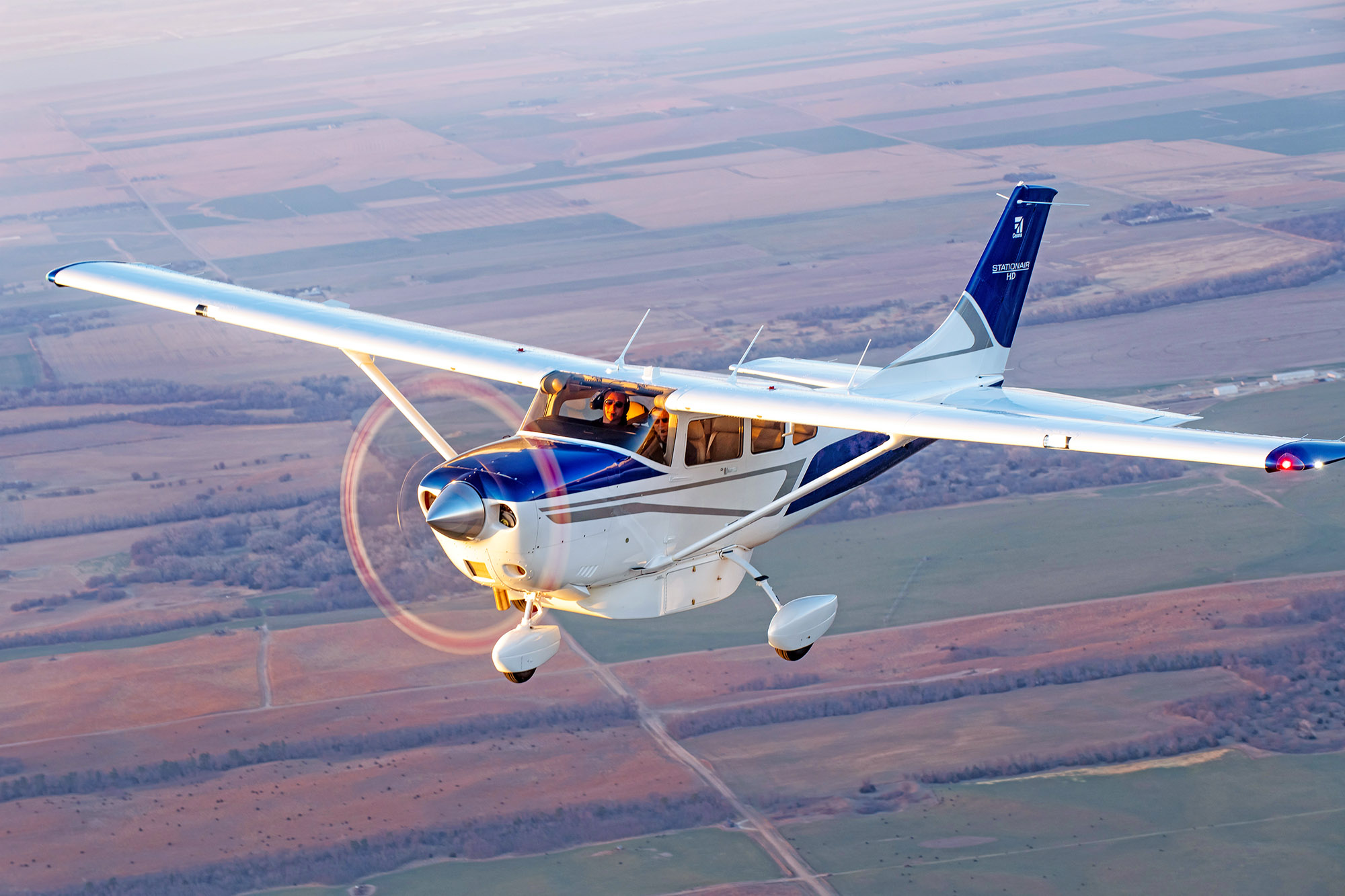
Cessna 206 Stationair

It comes close to hauling anything you can fit into its cabin, but expect to pay a premium for later G1000 and turbo models.

You can load even more with an optional cargo belly pod as shown on the late-model Cessna 206
You can load even more with an optional cargo belly pod as shown on the late-model Cessna 206. Photo courtesy of Textron Aviation.

You can load even more with an optional cargo belly pod as shown on the late-model Cessna 206 in the lead photo, courtesy of Textron Aviation.

For pilots moving up the Cessna food chain, the Cessna 206 Stationair isn’t a bad choice if the mission includes hauling people or stuff (or both). With the right transition training it should be easy to handle for those coming out of Skyhawks and Skylanes, it’s stable for IFR flying and just about any competent mechanic can wrench it.

The other good news is its long production run, so there are plenty to choose from at various price points. It’s time to take another look at the market and as expected, these haulers maintain their value, but use caution buying ones that are light on maintenance.Cessna 206 Stationair dimensions

Cessna 210 DNA

It’s easy to see the resemblance, and what ultimately became the 206 Stationair was originally introduced in 1963 as the 205, a fixed-gear 210, technically known as the 210-5. It had two doors up front and a relatively small rear door on the left side. The engine was a 260-HP Continental IO-470. This airplane was a fixed-gear version of the recently revamped 210; it was produced for two years, with 577 delivered. Keep in mind that Cessna’s biggest fixed-gear piston single is really three models, though all are essentially the same airframe.

In 1964, Cessna responded to demand for more utility and created the U206 (U for “utility”) Super Skywagon, with a 285-HP Continental IO-520-A, redesigned wing and bigger flaps. Intended as a flying pickup truck, even the seats were optional. There was one door for the pilot and a big double door aft on the right side.Cessna 206 Stationair Model History

The next model year saw the 205 become the P206 Super Skylane, with “P” representing “personal” or “passenger,” depending on with whom you’re speaking. The P206 had the same door arrangement as the 205, but with the bigger engine from the 206. The U206 was by far the more popular of the two.

In 1967, the U model got a takeoff-weight boost and a new engine, the 300-HP Continental IO-520-F, while the P model kept the 285-HP O-520-A. Turbocharging became available with the 285-HP Continental TSIO-520-C. The P206 was discontinued in 1970, with a total production run of 647. The remaining U206 and TU206 were offered with either a utility or passenger interior and renamed Stationair.Cessna 206 Stationair

A stretch of the fuselage brought into being the 207 Skywagon in 1969, powered by the 300-HP IO-520-F. One more seat was added, bringing the number available to seven. Useful load went up by about 30 pounds. An additional bonus was a nose baggage compartment, easing the task of getting the CG in the proper place during loading. The turbo model of the 207 was powered by a TSIO-520-G, also with 300 HP.

Camber-lift wings, which feature a slightly cuffed leading edge, were added in 1972. These improved low-speed handling at almost no cost to cruise speeds. At the same time, the baggage compartment got a 7-inch stretch. An aerodynamic cleanup in 1975 boosted cruise speed by about 6 MPH. The cleanup included more-streamlined wheel pants and improved cowl flaps.Cessna 206 Stationair Model Comparisons

In 1977, the horsepower of the turbo engine was upped to 310 (for takeoff only) on both the TU206 and the T207. A wet-wing fuel system was introduced in 1979.

In 1980, another seat was added to the back row of the 207, making it an eight-place airplane. This created the Stationair 8, but the Cessna designator remained Model 207. The world would have to wait for the Caravan to see a Model 208 and what may be the ultimate evolution of the high-wing, strut-braced single. The 207 was discontinued in 1984, and the 206 two years later. It was a great run.

Along the way, 206s saw several suffixes added, starting with the 206A in 1966 and culminating, temporarily, with the 206G in 1986. More than 7000, by serial number, U206s had entered the market, along with 647 P206s, the 577 aforementioned 205s and another 788 207s.

But then a funny thing happened: In the mid-1990s, Cessna started making piston-powered airplanes again. After starting up assembly lines for the 172 and 182, the Model 206 returned in 1998 as the 206H, powered not by a Continental IO-520 but by a normally aspirated 300-HP Lycoming IO-540-AC1A. It was joined by the T206H, powered by a turbocharged 310-HP Lycoming TIO-540-AJ1A.

Cessna stopped production of the normally aspirated 206 somewhere around 2013 but has kept going with the T206H and in 2025 is selling them for well north of $900,000. Unlike the Continental-powered 206s, the H model is available with a five-place, club-seating option.

Big cargo doors make for easy loading.

Load it up, but not much luxury

That’s why you buy a 206—full-fuel payloads of 1000 pounds or better are not at all uncommon. Plus, owners like the big rear cargo doors—creating an opening more than 44 inches wide—that make getting bulky cargoes inside less of a chore than in other aircraft. Another nice touch is the lack of a lip at the doors, so cargoes don’t have to be maneuvered up and over to load. Better yet, the airplane can be flown with the cargo doors off which, combined with solid low-speed handling, makes it popular with aerial photographers and public benefit flying organizations involved in conservation research and monitoring. Public benefit flying organizations LightHawk and CAVU have owned multiple 206s, using them in remote areas.

The allowable CG range is unusually long, making cargo/passenger positioning less of a juggling act than with many aircraft. However, despite some pilots’ assertions that “If you can get it in, you can take off,” weight and balance computations are not optional. Plenty of accidents over the years show it is possible to load a Stationair outside its envelope.

Newer Stationairs are nicely appointed, but these airplanes aren’t exactly flying Benzes. While the Stationairs have large cabins, they’re not long on comfort with a full load of passengers. Noise levels, particularly during takeoff and climb, can be fairly high as piston-engined singles go. And the rearmost seats—row three in the 206, rows three and four in the 207—leave little in the way of legroom.

Cessna 206 Garmin G1000
Garmin G1000 panel.

Flying them

Hardly speedsters, Stationair top speeds run in the 145-knot area while burning 17 gallons per hour or more. Throttling back to a more leisurely 135 knots cuts fuel consumption to a more reasonable 13 GPH. Operating LOP can reduce those numbers 2 or 3 GPH while keeping CHTs down—a consideration in hot climate operations.

Like most Cessna singles, the 206 does pretty well in short/soft/rough field operations, a big factor in the purchase decision for many of our respondents. Early models had 40 degrees of flap, which helped tremendously for short arrivals. However, the airplane just won’t climb with that much aluminum hanging out in the breeze. Cessna later limited flap travel to 30 degrees.

Handling matches the aircraft’s size—which is truck-like. Pilots who transition to the Stationair after climbing the Cessna model ladder may find the aircraft is just more of the same—only heavier, although the ailerons are notably responsive, even at slow speeds. Few owners seem to mind the fairly heavy controls because face it, snappy handling is not why they bought the airplane.

This is not without its benefits, though. It makes the Stationair an excellent IFR platform—stable and rock-solid. It also makes for a relatively smooth ride in turbulence. When heavy, especially with full flaps, it may take some altitude before you can establish a positive rate of climb. Transition training should include practicing balked go-arounds with full flaps deployed. Learn to trim, too.

Along with the big cargo door and Garmin panel, the built-in oxygen makes this Turbo 206 a good traveler.

A drawback of the forward CG tendency is a proclivity for inexperienced 206 pilots to arrive nose first during landing, especially at light weights. It takes a hefty pull on the yoke to flare properly. Thus, Stationairs are no strangers to hard, nose-first landings that sometimes damage the aircraft. In the 207, the nose baggage compartment can simply add to the nose heaviness. However, using less than full flaps for landing (say only 20 degrees) can ease the control forces required to flare, and so can the loading configuration.

When loaded toward the aft CG limit, the equation changes significantly. It doesn’t take nearly as much effort to flare to land. A pilot who isn’t ready for the lighter control forces can get surprised at how easy it is to get the nose up.

The 206 can feel like two different airplanes when it is light with a forward CG versus at gross weight and a mid- to aft-CG loading. We strongly recommend that any checkout in a 206 include time with the airplane loaded light and forward and heavy and aft. Part of that should be what it takes to get to the runway when heavy, with full flaps and slow. Be prepared to put the throttle to the stop.

Thorough Inspections

Be careful choosing a used Stationair for many of the same reasons that tag along with other models.  Its simplicity is a good thing and helps keep maintenance costs down. But on the other hand, Stationairs are working airplanes by and large, and wear and tear can easily turn the tide in the other direction. Turbocharged engines add to the complexity, of course. And aging Stationairs aren’t immune to corrosion issues, especially ones that have been on water floats.

We’ve seen problems with the tail, mostly corrosion caused by the foam-filled elevator and trim tab getting soaked with water and pulling off rivets, screws and nuts—a concern if the airplane was ever on floats. There have also been some instances of cracking door posts, though these problems have not proven to be a safety issue.

Given the number of respondents who routinely operate out of short and rough fields, combined with the nose-heavy landing tendency, we recommend paying close attention to the landing gear, brakes and the prop for erosion from the detritus on backcountry strips.

There have been a couple of 206/207 specific ADs: 85-2-7 calls for inspection of a roll pin in the fuel selector, and 85-10-2 mandates recurrent inspection or modification of the induction air box.

Other ADs of note are 91-15-4 and 82-27-2, inspection of the prop; 97-26-17, ultrasonic inspection and possible replacement of the crankshaft; 96-12-22, recurrent inspection of the oil filter adapter; and 2011-10-09, seat rails and roller housing inspection.

The 206/207 is subject to the infamous 84-10-1 fuel tank bladder AD.

Market, comments

The used market seems to be stabilizing from a price standpoint, though you’ll pay a price premium for late-model Stationairs. Can you believe low-time early 2000s turbo models sell for around $900,000? In mid-2025, we found a 2001 206H with an Aspen flight display and Garmin GTN 750 GPS for around $400,000. Do a good avionics inspection on these models because they were equipped with the BendixKing Silver Crown Plus equipment, including KAP140 autopilot, and were subject of a long list of service bulletins. Servos, flight computer and HSI issues only scratch the surface of the growing pains.

Even first-gen Garmin G1000 planes might have traps because some aren’t equipped with WAAS capability. Still, owner satisfaction overall is good.

“I typically cruise at around 130 knots in economy cruise, burning about 15 GPH. This airplane is comfortable for me (I am 6-feet-4-inches tall), and it easily hauls my wife, three sons and full fuel. This is the first aircraft I have owned, but to me it seems stable, safe, reliable and predictable,” Vincent Rieger told us about his 1999 model.

For aging (or inexperienced) pilots, the Stationair seems to be insurance-friendly because of its fixed landing gear and familiar design. There are worthy mods, too. CAV Ice Protection has the weeping wing TKS upgrade for 206 F, G and H models. One can even opt for an STC’d 450-SHP Rolls-Royce turboprop engine, courtesy of Soloy (www.soloy.com). If that is too much, and the factory IO-520 isn’t enough, maybe an IO-550 from Texas Skyways (www.txskyways.com) would be another solution.