












Tamer Abubakr said his Continental O-290-powered 120, lead image, with the addition of some solid axles and small tundra tires, is a load of fun to fly around the desert.
For buyers wanting a taste of tailwheel flying on a budget, we think the first stop might be the Cessna 120/140. Although these little birds might lack the nostalgia of Piper Cubs, they’re a bit cheaper to buy and generally have more forgiving handling qualities. These aren’t legacy light sport planes—they’re too heavy for the existing LSA category.
The little Cessna is less fragile than a Cub because of the metal construction (some have fabric wings), so you can park it outside—only if hangaring isn’t an option. And unlike the Cub and others, maintenance doesn’t include periodic re-covering. Owners we talk with say that sourcing parts isn’t really a problem, though parts are far from cheap.
Shoppers will find lots of project airplanes for sale, and it’s imperative to do the homework on the front end. Choose one that’s been loved and make sure any repairs (most have been pranged at one point or another—a tailwheel thing) are well documented. As expected, these birds are up in value since we looked at the market a few years ago. Here’s a refresh.

Vintage flyer
The general aviation industry as we know it—at least as far as large numbers of aircraft are concerned—traces its beginning to the period immediately after World War II. Piper was churning out Cubs and eventually Cruisers and Pacers and during these halcyon days. Cessna also came into view as a major manufacturer, though the company had actually been in business since 1911.
The 120s model history is rather short, since it was only produced for four years. The first 120 emerged from the factory immediately after World War II, in 1946. Cessna had in mind the training market so the 120 sold for a mere $3245, or around $53,000 in 2025 dollars. And talk about simple. The 120 had side-by-side seating, yokes instead of sticks, no flaps, no rear window and no electrical system as standard equipment, although an optional generator system was available, and many aircraft have that feature today. Worth mentioning are the wing struts, which were the first on a Cessna model.
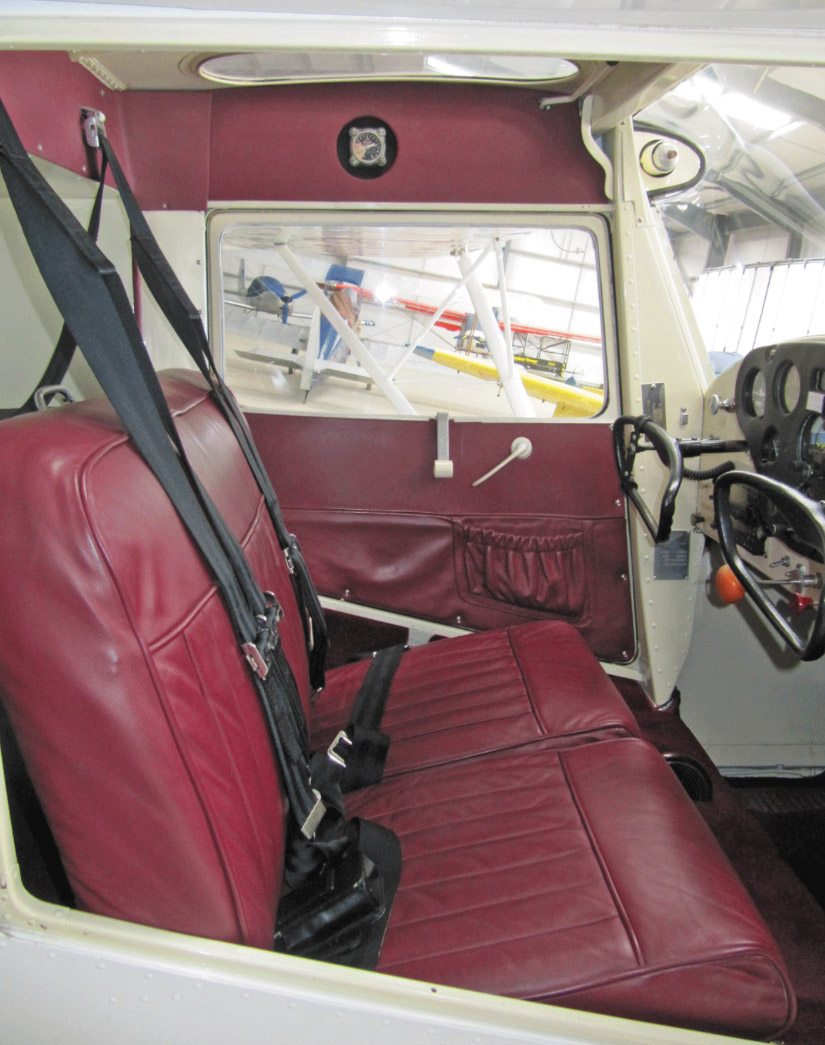
Like in the car market, Cessna offered a luxury version of the 120, which was dubbed the 140. It has flaps, an electrical system, fancier seats and rear windows along the side of the fuselage, not the Omni-view windows that later became standard in the Cessna single-engine line. These airplanes sold moderately well and although there was demand, there was also competition. Piper was building acres of Cubs and other companies such as Taylorcraft, Swift and Luscombe were also offering two-place taildraggers. Altogether, Cessna made some 7000 120s and 140s until sales tanked in the late 1940s, and in 1949 Cessna cut the 120 altogether and brought out the model 140A. The revised model came with a redesigned, all-metal tapered wing with a single strut, presaging what was to come from Cessna’s singles. The strut replaced the two-piece struts of its predecessors, with a single attach point at the fuselage and two attach points under the wings, in what would to this day be the design of Cessna singles. For powerplants, there was an optional 90-HP four-cylinder Continental C-90-12F over the standard 85-HP C-85-12 engine. Sales weren’t great and the 140 line stopped rolling in 1951. Roughly nine years later, the 140 reemerged with a nosewheel and you guessed it—along came the Model 150.
In the current 2025 market, you might pay more for a well-kept 140 than a 150. We found some nice ones in the $40,000 price range. But ones needing work are considerably less. Still, there are a lot more 150/152 models on the market than there are 120/140 models.
A simple machine
The skins are riveted over ribs in conventional monocoque construction. Even for the 1940s, this was nothing special; all-metal Luscombes were on the market before the war. But it also was durable and easy to fix, especially by the hordes of aircraft mechanics trained by the military during WWII. Early 120s had fabric-covered wings, a “feature” carried over to the 140, as well. When Cessna upgraded the line to the 140A, the wings were all metal. We’re told that many of the older airplanes originally delivered with fabric wings have been converted to metal. More than one owner told us there are some mutts, with a few 140s sporting 120 wings, i.e., a 140 without flaps. On finding one, dive deeply into the logbooks in search of airframe damage history.
By now, there have been lots of engine mods over stock, including the Continental O-200 used in the Cessna 150—said to be mostly a bolt-on conversion—and the O-235 used in the Cessna 152. At least one STC involves installing an O-200 crankshaft and cylinders to a C-85 crankcase. These mods are necessarily all about performance as much as they are for serviceability.

Flying it
One thing that aids ground handling is toe brakes, a vast improvement over the heel brakes found in the typical aircraft of this vintage. 120s without a rear-window modification essentially blind the pilot from getting a good look at what’s behind and to the sides. But the 120/140’s taxi stance is not so sharply pitched a pilot can’t see over the nose; the short cowling and somewhat flatter deck angle are a real plus compared to other tailwheel airplanes. The 140s, with their rear windows, are a bit better.
If you want to go fast you’re looking at the wrong taildragger. Expect to see between 95 and 105 MPH true from the 85- or 90-HP engines while burning about 5 gallons an hour. That’s in keeping with a slightly faster Cessna 150 burning 6 GPH. Results from installing a more modern engine like an O-200 or O-235 predictably push up cruise speeds, but on the other hand we’re not sure it matters to most. This isn’t a cross-country machine and getting to and staying at altitude is another challenge. There simply aren’t many of the 85-to-100 horses left at any altitude above 10,000 feet. Climb rate in these airplanes is about what you’d expect: adequate at mid-weights but somewhat anemic at gross.
And watch the loading—max gross is 1450 pounds for the 120/140 and 1500 pounds for the 140A, with a typical useful load of 600 to 650 pounds. But what the little Cessna gives up in speed, it makes up for in handling—a good thing for pilots new to taildraggers. For its size, the airplane has large elevator and tail surfaces, which probably account for its good crosswind characteristics on both grass and paved runways. As post-war tailwheel airplanes go, despite the RLOC accident record, we think the 120/140 handles quite well. Ailerons are brisk and crisp—if not aerobatic in roll rate—and pitch is a bit lighter than expected from the typical Cessna. Thanks to wing dihedral, it doesn’t have the adverse yaw tendencies of a Piper Champ or Cub.
Being relatively light, it does have a tendency toward ballooning on landing if the mains are forced on at too high a speed. But the airplane will happily do three-pointers or wheelies all day if the pilot’s skills are up to snuff. Because it doesn’t have the option of placing much weight rearward, the airplane has a tendency to nose over. Owners say it’s likely that any 120/140 on the market has a nose-over or two in its history. That’s no big deal if any needed repairs are done correctly. But nosing over is a big enough “deal” in this type that many have been equipped with “wheel extenders”—spacer blocks on the main gear legs that move the wheels a few inches forward. This reduces the tendency to nose the airplane over and if you’re looking at an example that doesn’t have the extenders, we think it’s worth considering them. Finally, keep your insurer happy and get the right training—often.
Cabin, ergos
Owners often complain about one 120/140 shortcoming: cabin noise. The cabin is small and the engine is nearby, with the exhaust dumped overboard very near the occupants’ feet. The results can be deafening—perhaps more so than in contemporary types. Cabin heating and ventilation in the 120/140 are not up to modern standards. Owners say it is adequate, however, and many airplanes have been fitted with vents in the wing and/or blast vents in the side windows to improve airflow in hot weather.
Taller pilots may find their knees colliding with the yokes, while short ones may need a pillow to reach the rudder pedals. The seats are fixed in place and, unlike more-modern fixed-seat types, the rudder pedals do not adjust fore and aft. As one result, we’ve seen a few of these airplanes modified with later-model Cessna 150 seats.
As for avionics, these little Cessnas were generously equipped compared to basic airplanes from the same era. Think utilitarian—these are casual local-area cruisers, for the most part. Still, it should come as no surprise some owners have jazzed them up with GPS and other goodies. Plus, there is enough space for basic IFR instruments (yes, even small-screen EFIS) and modern stack-mounted avionics. Although some think it’s insane to fly a venturi-equipped airplane in actual IFR, we don’t see the problem. The venturi might actually be more reliable than a pump, as long as you can keep it from freezing up.
Wrenching them
These airplanes are stone simple and made in enough quantity that they might be among the easiest vintage birds you can own. Our advice is to find a 120/140 that’s already had an engine conversion—the price premium is probably worth it. Other than engine overhaul, the major cost for a 120 is re-covering the wings, if they’re still fabric. Depending on the fabric and whether the airplane is hangared, re-cover intervals range between seven and 20 years. Metal wings are, of course, heavier than the fabric versions by about 30 to 40 pounds. But most owners consider the penalty worth it in reduced maintenance costs and, in any case, these airplanes aren’t bought for the massive load-hauling capability.
And because these are old machines, corrosion and metal fatigue is always a concern. One area that can be problematic is the carry-through spar. The cabin skylight leaks water into this structure, and years of moisture will make it rust. Look for cracks in the tail structure and rear fuselage. Those familiar with the 120/140 tell us the airplane’s tail is the weakest part of the design. It’s especially vulnerable around the tailwheel attach point. This is repairable, but make it a condition of the sale during prebuy. Broken tailsprings are fairly common. Check to ensure that the steel leaf-type tailwheel spring is still springy but not saggy. A broken spring will cause complete loss of control on landing and could do major damage to the airplane, particularly the elevators. Even if the springs look good at the time of purchase, they should be inspected regularly.
The list of ADs that apply to the Cessna 120/140 is quite long—more by dint of age than in any serious shortcomings in the aircraft. Some of the ADs are absolutely ancient, dating back to the late 1940s, when the airplane was new. Many are shotgun-type ADs that apply to the engine and may or may not require compliance in the model 120/140 at hand.One of the most recent applies to the Lycoming O-235 engine, calling for inspection of the crankshaft.