










Diamond DA40

A composite four-seater with good ergos, performance and support, but look hard at damage history.

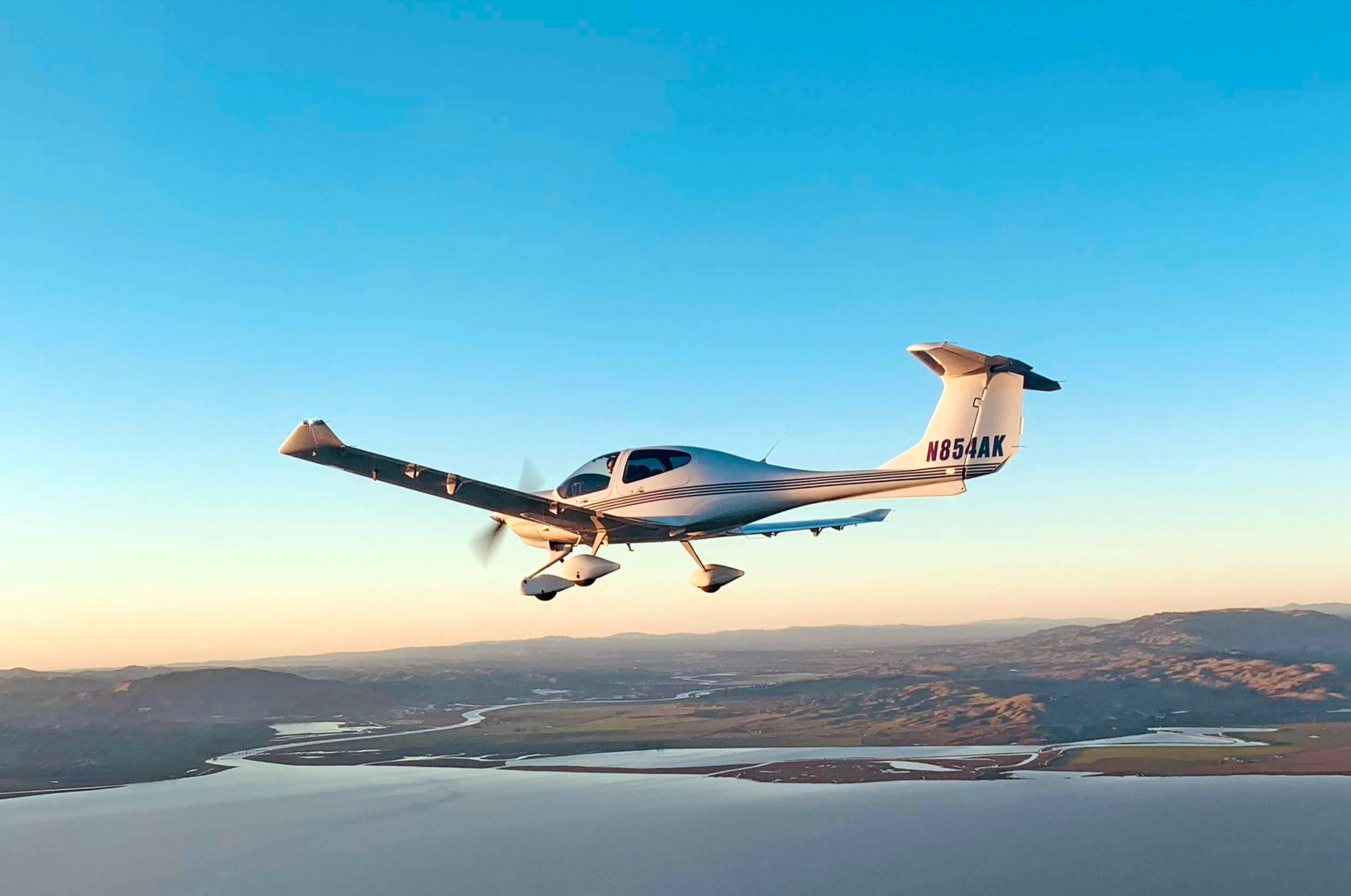
Thanks to California-based Tosh Araki for showing off his 2005 DA40. The clean lines and efficient sailplane-like wing make it one of the most satisfying light GA airplanes we’ve flown.

Thanks to California-based Tosh Araki for showing off his 2005 DA40. The clean lines and efficient sailplane-like wing make it one of the most satisfying light GA airplanes we’ve flown.

Buyers shopping the used entry-level Cirrus market might also look at Diamond Aircraft’s four-place DA40. This airplane has earned respect for crisp handling, excellent crashworthiness and a modern cockpit.

And with a familiar Lycoming IO-360, field support is good, but as with all composite models, airframe structural repairs should be left to shops that specialize in composite work. That makes it even more important to do a thorough inspection, including a close look at previous repair signoffs, before making a deal.

Since we last looked at the DA40 market a few years ago, selling prices for well-maintained DA40s are up, and later-model birds with newer avionics and high-end paint work are premium priced.

Efficient wing

There’s a reason for that. Austria-based Diamond, which started life as Dimona in the early 1980s, originally produced the model H36 motorglider for the European market and eventually got its feet wet in the U.S. when it imported the Austrian-built two-place DV20 Katana. The company changed its name to Diamond in 1996 and moved forward with plans to produce the four-place DA40, introducing prototypes at the trade show in Friedrichshafen, Germany. While these early test beds had Rotax 914 (and Continental IO-240) powerplants, Diamond quickly learned that the Star needed more power and eventually certified the airplane with a 180-HP Lycoming IO-360-M1A mill, while launching production at the company’s London, Ontario, plant.

Diamond’s experience with sailplanes certainly shows in the T-tailed DA40’s construction, starting with its long and high-aspect-ratio wing. The clean fuselage is constructed of wet layup material in two halves that are bonded together longitudinally, with the vertical stabilizer as part of the assembly and the tail and wings added separately. The cabin/cockpit has a large canopy that’s hinged at the front, while a rear pin-release hatch for back-seat occupants makes for efficient egress during emergencies. Worth mentioning is that the DA40’s fuel supply is well protected in removable aluminum cells stored inside the twin carbon layup, with little tendency to spark post-crash fires, based on our accident research over the years.

On the ground, the DA40 has spring steel landing gear and a castering nosewheel with steering via differential braking.

With its long wing and relatively high aspect ratio—reflecting its sailplane heritage—the Star is a terrific climber, even when loaded. Moreover, it leads the league in short-field capability, easily hopping off the runway in 1200 feet or less with a heavy load. At 2535 pounds (2645 for newer models) gross, the Star is light; at 14 pounds per HP, its power loading puts it in the middle of its class. The early Stars run around all day on 9.5 to 9.8 GPH at speeds up to about 140 knots. Subsequent models, say owners, are about 10 knots faster and, for the DA40-XLS, Diamond claims a 158-knot top speed with a 150-knot cruise on 10 GPH.

The Lycoming IO-360 is well-matched with the airframe for decent speed and efficiency. Gross weight in earlier models was 2535 pounds (and 2645 pounds for later ones) but check that against the typical 3050-pound Cirrus SR22 and 2450-pound Cessna 172. For a departure from the norm, there’s also the 168-HP Austro AE300 diesel that came in the 2014 DA40-NG. Still, Lycoming-powered Stars are the most common. Payload-wise, the Star is really a three-place airplane with baggage space, even at the higher gross weights. Useful loads are in the 850-pound range, although some owners report less. In early Stars, the baggage compartment was a bit of an afterthought, accessible only through the cabin by tilting the rear seats forward. The area itself was quite shallow. This was later redesigned, and now the rear seats fold forward to essentially turn the back seat into one huge baggage bay. We’ve stuffed snowboards and bicycles in, no problem.

Cabin dwelling

Thanks to a forward-folding big canopy (that makes for wonderful visibility), the DA40 is relatively passenger friendly. Step up onto the wing and step down into the well of the cabin while gripping the canopy’s tubular hinges, both for ingress and egress. It’s easy for nimble folks, not so for others.

The rear-seat passengers simply step through the hatch and into the rear cabin, which is quite spacious for a four-seater. The front seats don’t slide fore and aft, but the rudder pedals adjust. Very tall owners tell us that while it’s a little cramped, the pilot’s seat has adequate room. Rear-seat passengers enjoy adequate foot room, thanks to footwells.

The cockpit can be boiling hot in the summer, although an opaque shade along the top of the plastic bubble helps. Air conditioning is an aftermarket option in the DA40s. However, the canopy can be opened during taxi and is equipped with partial-open latches. We fitted a set of Jet Shades in an earlier DA40 and it helped tame the Florida sun. The heating and ventilation, once airborne, are good. In early models, the panel air vents emitted a noticeable and irritating howl, although some owners have found their own fixes for this. Newer models are a lot more refined.

At 3 feet 8 inches wide and 3 feet 9 inches high, the DA40’s cabin is accommodating, with good occupant protection in a crash.

Fun factor, upkeep

There’s no shortage of fun to be found in the DA40—or any Diamond, really. The pitch and roll forces are light and easy to manage with the control stick. Slow flight and stalls are nonevents and even deep into the stall, the airplane simply mushes and could probably touch down that way in a survivable impact. Flaps have little or no effect on trim condition. For landing, come into the flare faster than about 65 knots and the Star will float, and in our experience slower generally works better. “When landing with only one notch of flaps, be prepared to float quite a bit. Even with full flaps, it seems to float some unless you are right on target with speed,” owner Susan Simmons told us.

A big selling point for the Star is the Lycoming IO-360—a common mill that just works well on this airframe. Moreover, since the Lycoming IO-360 is one of the most reliable four-cylinder powerplants available, it’s no surprise that we heard no complaints from owners about it, save for a few owners who had problems with electric fuel pumps. But keep on top of the maintenance on these airplanes, and like most models, don’t expect trouble-free ownership.

“As far as maintenance goes, there were many small issues with my 2002 DA40 (bought in 2009) that added up to some pretty pricey annuals once or twice. One was due to corrosion of a bonding strip within the laminate of the pilot-side wing, plus hinges on the rear door which are prone to cracking were also re-done that year. The paint on the wings had not properly cured at the factory and was chipping away so the wings had to be repainted,” reader Charles Vaillancourt told us.

He also noted that the early DA40s also had a design flaw in the cooling air intake that required a modification to install the “Arizona baffle,” which he accomplished. “More recently, an AD requiring the replacement of the nosegear strut will incur about $7000. That’s the only significant AD that has impacted my plane so far,” he also noted. Diamond’s Mandatory Service Bulletin MSB 40-091 covers the inspection for DA40s with nose landing gear leg part number D41-3223-10-00.

The DA40 was one of the first models with Garmin’s G1000.

Early G1000-equipped airplanes are a sore subject for some owners because of lack of upgradeability compared to newer systems. Some don’t even have WAAS GPS, so keep that in mind when shopping. Others are perfectly happy doing aftermarket retrofits to round-gauge birds.

“Although I hesitated to buy a steam-gauge version of the plane given that most DA40s had the G1000, that has turned out to be a blessing. The steam gauge plane is much more flexible and cheaper when it comes to avionics upgrades. Today I have a GNS 430 WAAS navigator, an Aspen Pro MAX PFD with synthetic vision, a Bluetooth-enabled Garmin audio panel and a Garmin GTX 335 ADS-B In/Out transponder. It’s a great setup and I can do so some decent IFR work with it,” one owner told us. He also noted that round-gauge planes are lighter. “My empty weight is 1680 pounds for a max gross weight of 2535 pounds, giving me 855 pounds of useful load. Plus, I can still upgrade the main landing gear to gain another 100 pounds, bringing me close to 1000 pounds useful load,” he said. There aren’t many aftermarket mods for the Star, but there are some useful ones.

Florida-based Premier Aircraft (also a Diamond dealer) offers the Cabin Cool air conditioning system, the PowerPlus standby alternator system and a stylish and functional interior upgrade package. For better climb and extra knots in cruise, a Hartzell ASC composite propeller is available. Contact www.flypas.com.

As we reported in the May 2020 Aviation Consumer, there’s bolt-on supercharging via an STC from Forced Airmotive. It is a belt-driven (off of the accessory case) air compressor system that allows the engine to develop sea-level horsepower up to 7000 feet and 75 percent power as high as 12,000 feet. It’s offered for most Cessna 182s, Cirrus SR22s and Diamond DA40s. The owner of the modified DA40 we heard from reported climb rates of more than 800 FPM to 11,500 feet.

The Lycoming IO-360, has a 2000-hour TBO and is a near perfect match for the airframe.

Transition, market

Owners like their DA40s, and with the right training, most report an easy transition. “The center stick is fun and took about one minute to get used to. I usually fly at around 7000 feet at 65 percent power burning 7.6 GPH at 130 knots true,” John Mullen reported for his 2003 DA40.

Certainly, you’ll pay a hefty price premium for the right DA40

($200,000 to $600,000 is the general spread from old to newer models) and as the fleet ages, you should look carefully at the paperwork that tags along with composite structural repairs. We strongly suggest reading the used composite buys article in the April 2020 issue of Aviation Consumer. As a potential buyer you should question what lies beneath the glossy gel coat and whether there  is hidden damage that will surface during the next annual inspection. Plus, were all repairs done per the maintenance manual?

Andrew Moonilal, a technical support specialist at Diamond Aircraft’s London, Ontario, plant, said Diamond finds things that were (or weren’t) done to its aircraft that deviate from what it considers to be an approved status. “We have worked backward to remove repairs and recertify the airplane back to our standards,” he said of these so-called repairs.

The way we see it, those aren’t the DA40 models you want to get stuck with.