











Replacing oil thats been fouled by combustion by-products is one of the easiest and most-reliable ways to help prevent internal corrosion of your engine, thus the recommendation for frequent oil changes. Between changes, of course, we depend on frequent flights and the oil filter to help keep dirt and metal shavings from circulating and potentially damaging expensive parts. And when we change the oil, examining the used filter can help identify potential problems or confirm that all is well. Which filter to install at the next change often is determined by whats available on your mechanics shelf, or by the FBOs profit margins. Since all filters are FAA-PMA approved, theyre all pretty much the same, right? Not necessarily. To find out for ourselves, we obtained samples from the three companies manufacturing spin-on oil filters for Continental and Lycoming engines-Champion, Kelly and Tempest-cut them open and examined their construction. We found the Champion filters had more robust components, but all three have different features.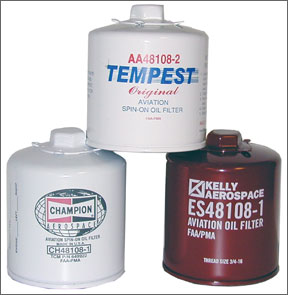
Similarities
Even though we found several differences between oil filters, the similarities far outnumbered them. For example, all of these filters are FAA-PMA approved. Additionally, they all use the same basic design-although some details may vary-and part number, while prefixes and suffixes differ among manufacturers. Theyre all the same diameter, of course, although height can vary. And they all fit the same mounting base on your engine.
When we last looked at oil filters, in 2004, we noted an SAE standard-Aviation Recommended Practices (ARP)-defines the design, manufacture and testing of oil filters used in piston aircraft engines. That standard, ARP 1400, last updated in 2007 and now in revision B, satisfies the FAA. However, and as we noted in 2004, neither Champion nor Kelly chose to meet all standards of ARP 1400. Champion, for example, tells us it elected not to get “locked into” the filter specification.
Via email, Champions Jim Liddle responded to a question about the standards: “Our filter color is different than what is specified in the ARP spec; we may make product improvements that deviate from the specification. Some of the performance requirements are controlled by the engine manufacturers and they may require other changes that will deviate from the spec requirements. … For the most part, Champions focus is on meeting the engine/airframe manufacturers requirements and not just that of the subject ARP specification.” We sought similar feedback from the other two manufacturers but they hadnt responded at our deadline.
That said, the filters all share basic characteristics. For example, they all come with a one-inch hex nut built into the filters top and safety-wire lugs. They all use a paper-like media to perform the actual filtration and their exteriors offer