











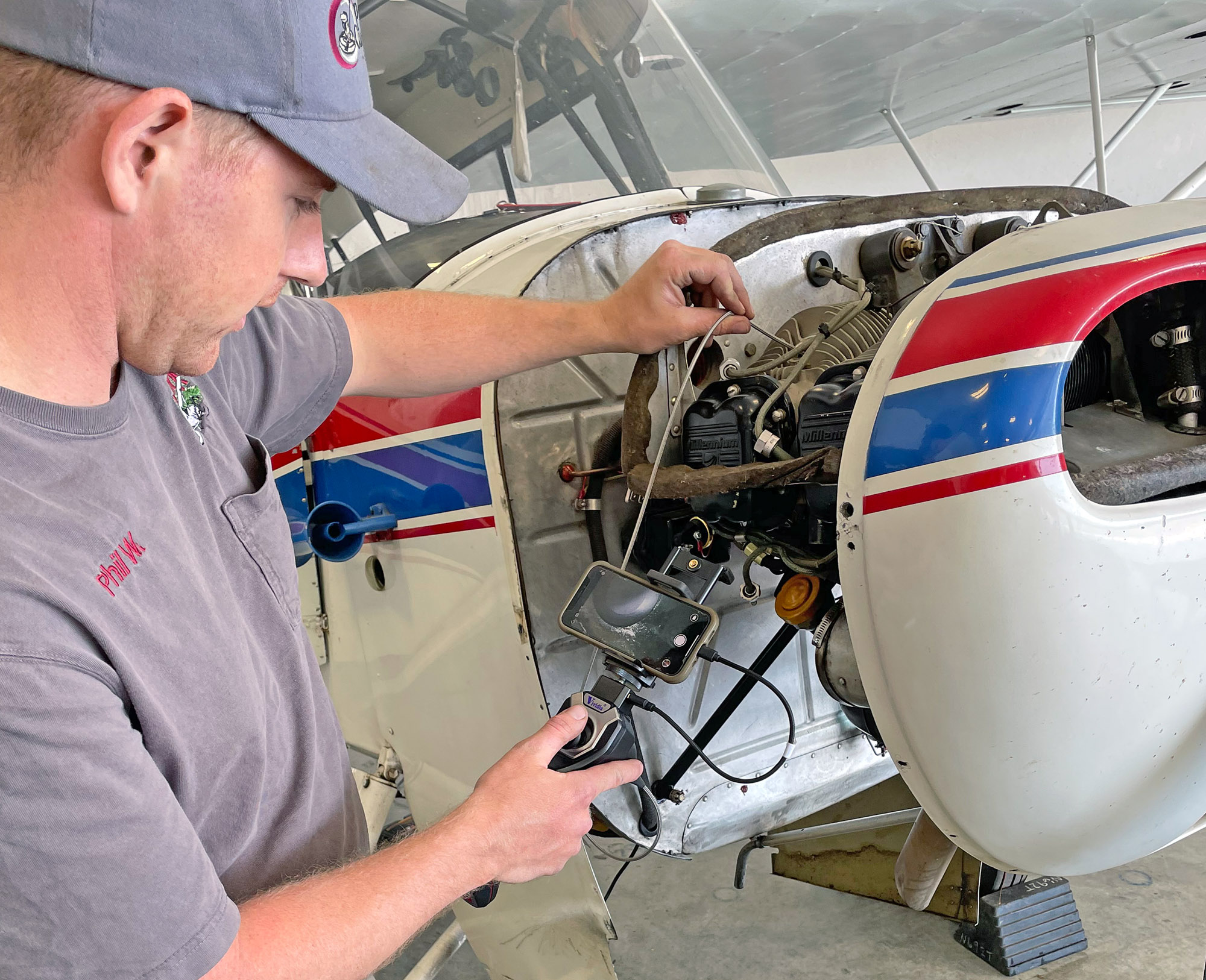
Back in the January 2024 issue of Aviation Consumer, we reported on the rollout of Savvy Aviation’s Borescope Initiative as the latest addition to its longtime engine analysis program. The goal was to add borescope imagery of engine cylinders and components taken according to a standardized protocol to its database to monitor cylinder condition. With machine learning/Artificial Intelligence (AI), the Savvy team would hone its ability to identify and diagnose cylinder issues earlier and more accurately. The two-fold goal was to reduce the number of engine failures due to burned valves and to reduce the number of perfectly good cylinders that are removed per outdated maintenance practices—of especial importance because removing and replacing a cylinder increases the risk of subsequent engine failure due to errors in cylinder installation in the field.
At no charge, Savvy provided users with a video showing how to take cylinder borescope imagery and set up a protocol stating what photos were to be taken and in what order. It also established a naming convention for the images. In doing so, it was following what has been a decades-long practice in the medical world for X-ray and other imagery. In our opinion, if nothing else, Savvy’s Borescope Initiative has established an aviation industry standard for taking and identifying piston engine cylinder borescope images that will facilitate overall sharing and analysis of such imagery. We heartily applaud that action.
Response
The response was beyond anyone’s estimates. In just over one year, more than 100,000 images were uploaded to Savvy’s database by aircraft owners and shops.
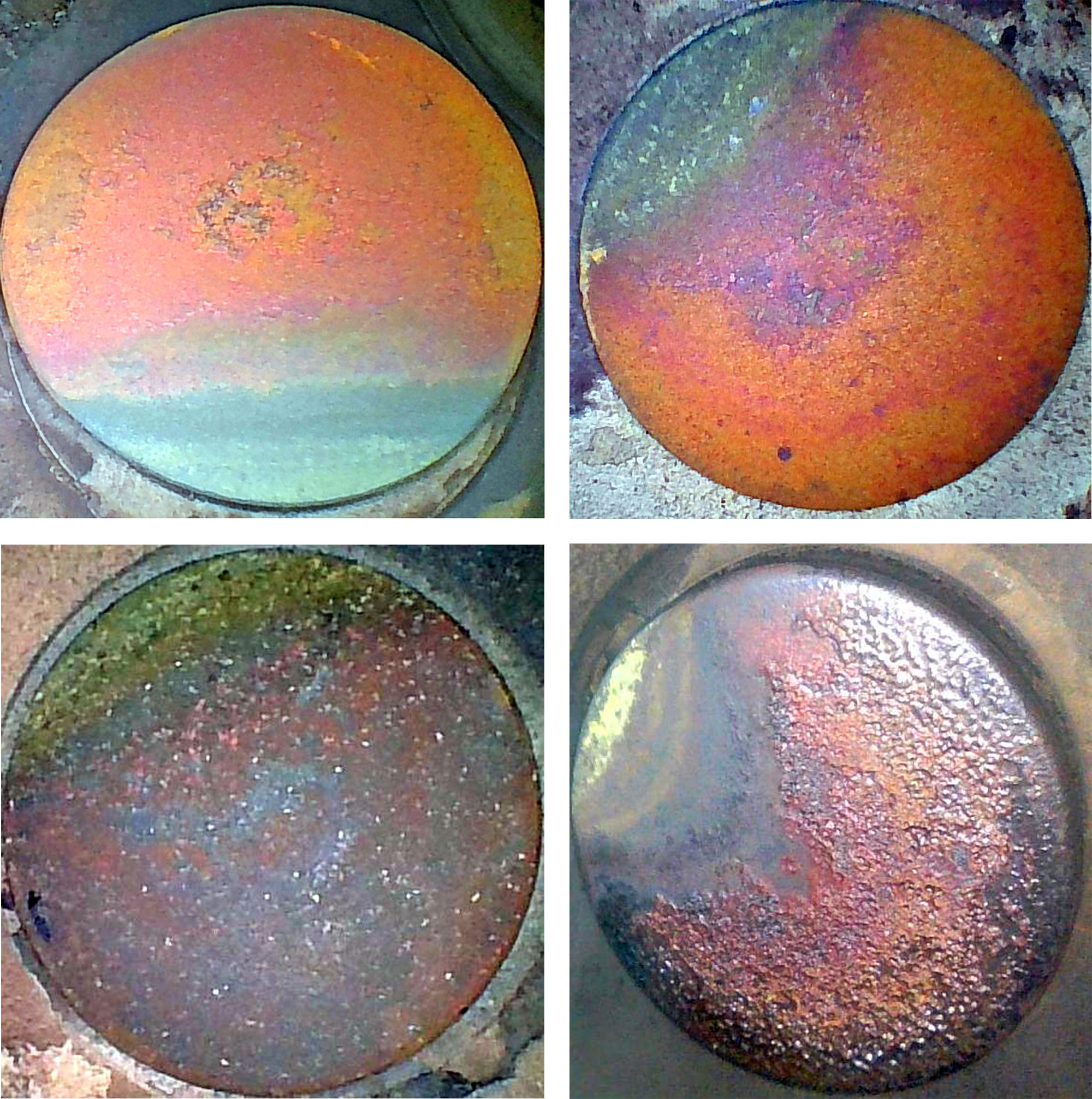
According to the owner of Savvy Aviation, Mike Busch, of the over 100,000 images uploaded, users had Savvy’s team analyze 70,000 of them. Of the images analyzed, some 7500 were of the heads of exhaust valves. (The Savvy borescope imagery protocol involves taking 11 photos inside each cylinder; one of those photos is of the head of the exhaust valve.)
The results of the analysis were a little startling: Busch told us that of those 7500 photos, between 7 and 8 percent exhibited signs of heat distress. Busch pointed out that he doesn’t think that 7 to 8 percent of exhaust valves in the field have heat distress—it’s his opinion that those who uploaded images and paid for analysis self-selected because they thought something might be wrong.
Of the image sets for the four or six cylinders of each engine, 25 percent had at least one exhaust valve with heat distress.
Heat Distress
Busch told us that, in his opinion, the data indicate to him that some 20 percent of engines in the piston-engine general aviation fleet have at least one exhaust valve in heat distress.
That’s the bad news. The good news is that Savvy rates the condition of exhaust valves as “normal,” “early stage heat distress” and “late stage heat distress.” Of the valves exhibiting heat distress, 85 percent were early stage. According to Busch, Savvy has had a nearly 100 percent success rate in fixing exhaust valves in early stage heat distress by lapping them in place.
Valve Lapping
Lapping in place is a roughly two-hour procedure that is done without removing the cylinder. It is described in detail on Savvy’s website. It costs on the order of $250.
Removing, revalving and replacing a cylinder runs between $2000 and $4000.
Older maintenance guidelines focused on the differential compression test to determine the health of a cylinder and mechanics became spring-loaded to yank a cylinder anytime the compression was below some arbitrary level. Lycoming and Continental gave guidelines for acceptable compression levels. However, those have evolved. The engine manufacturers recommend less and less reliance on compression tests.
As of today, those in the industry who are heavily involved in engine maintenance state that the compression test is more art than science, often gives wildly different results on tests taken just a few minutes apart and simply does not generate valid results.
The problem is that the word hasn’t gotten out to the piston-engine aircraft owner and maintenance community as it should. The result is that with some 20 percent of piston engines having at least one exhaust valve with heat distress, relying on compression tests means too many perfectly good cylinders are being removed, revalved and replaced. That means not only extra money spent, but an increase in risk of engine failure due to problems that develop from cylinder installation in the field.
Continental Guidelines
Continental’s service guidelines now call for a borescope inspection of cylinders anytime a compression test is done and point out that a cylinder should not be pulled for low compression alone.
Based on our review of NTSB accident reports that we have conducted monthly for over 30 years for our Used Aircraft Guide, it is our opinion that the accident data shows that removing and replacing a cylinder increases the subsequent risk of engine failure dramatically enough that a cylinder should never be pulled unless there is absolutely no other option.
Mike Busch and Savvy Aviation make the same statement about the increased risk of engine failure following cylinder removal and replacement in their website and publications.
Busch told us that more and more maintenance techs are recognizing that the old practice of routinely pulling cylinders is dangerous and that he wants to get the word out that the practice puts lives at risk. We agree.
Gold Standard
Accordingly, we are of the opinion that Savvy Aviation is correct when it says that the borescope exam is the Gold Standard of cylinder inspection and maintenance. We are of the opinion that it should always be the primary tool for assessing engine health and that the compression test should only be a distant second.
We’ll note here that a compression test usually only reflects an exhaust valve issue when it is in late stage heat distress and may be beyond saving. The borescope exam allows a problem to be caught early and repaired at what, in aviation terms, is a quite reasonable price.
That means, in our opinion, that an exhaust valve exhibiting early stage heat distress can almost certainly be repaired by lapping it in place. There is no reason to pull the cylinder and increase the risk of a subsequent engine failure.
In our conversation with Busch he mentioned that he’d worked with at least one aircraft owner who had an exhaust valve that exhibited late stage heat distress. Mike said that the valves showed no evidence of cracking so a decision was made to try lapping in place to see if the valves could be repaired. For $250 for the procedure and then a look through the borescope after a few hours of flight, it was a little like chicken soup—it can’t hurt.
In those cases lapping in place did fix the affected exhaust valves.
We note that Savvy recommends that when lapping an exhaust valve that the rotocoil or rotator cap for the valve be replaced. Those relatively inexpensive components rotate the exhaust valve slightly each time it opens to spread the heat around. Their failure often causes a valve to burn.
We think the early results of Savvy’s Borescope Initiative need to be widely circulated to let our community know not only that there is a significant proportion of exhaust valves with some level of heat distress, but that the problem can be fixed inexpensively when discovered early. Discovering it early is almost certainly not possible using only a compression check. The cylinder has to be borescoped.
What’s Involved
After expressing our support of Savvy’s Borescope Initiative, the results it has generated and the need to do borescope exams, we’ll look at exactly what’s involved for an owner or a shop that wants to take and upload borescope images to Savvy’s website.
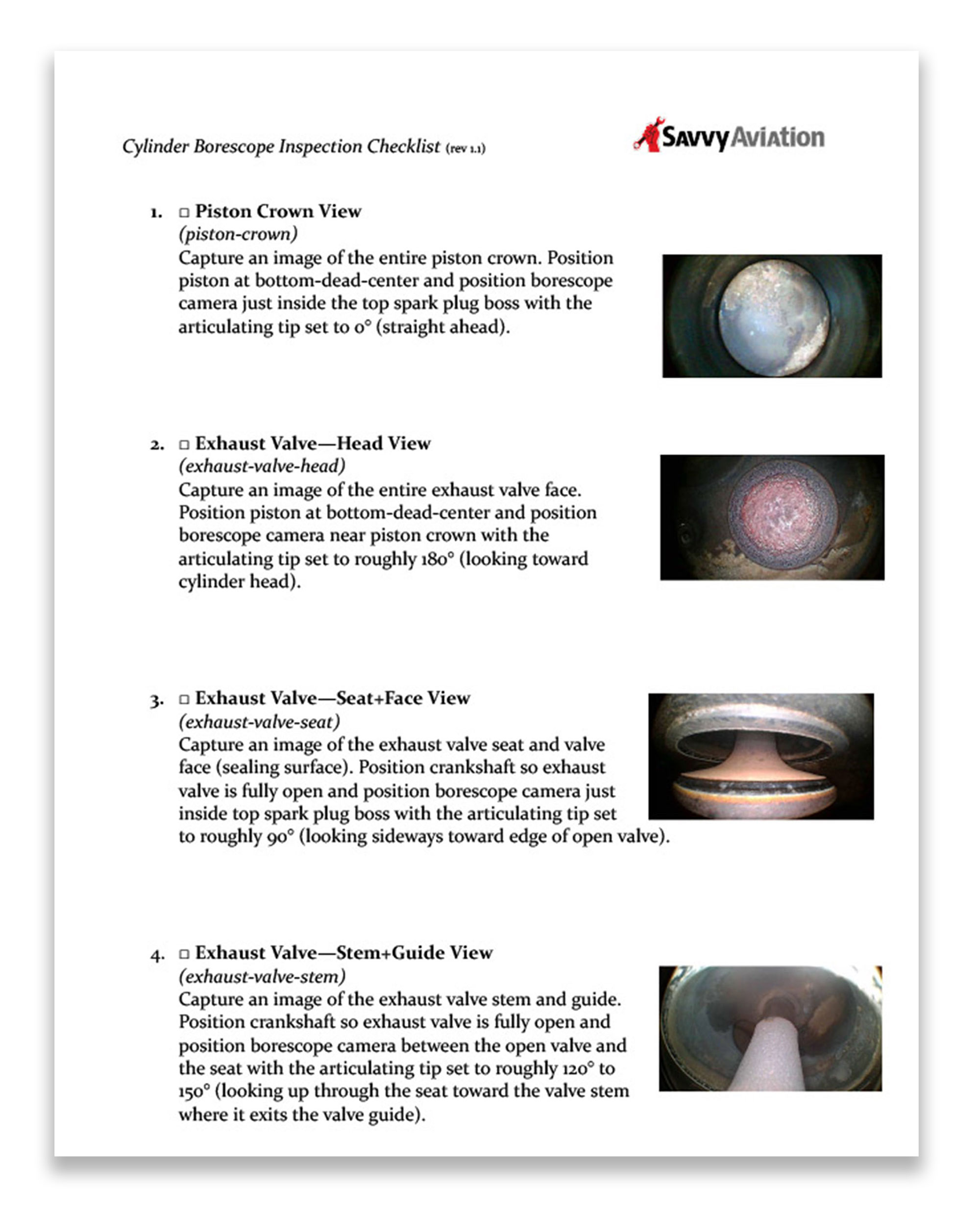
Step one is to go to the website, roll your cursor over “resources” and click on “borescope initiative.” Then download or print the Cylinder Borescope Inspection Checklist. It sets out the standard borescope inspection protocol recommended by Savvy and has good-quality sample photos showing each successive image. It then outlines the naming convention for the images and files. In our opinion, the photo succession and naming conventions are logical and easy to follow. We’ve said that we think this will become the industry standard and are glad that someone has taken the lead to create one.
After a review of the checklist, we recommend watching the half-hour video that is a clearly presented explanation as to how to do what’s on the checklist. It also gives guidance on use of the borescope, and, importantly, how to take good quality images.
The video also explains how to upload the images to Savvy’s image repository, noting that there is no charge to do so, and an owner who has a free Savvy account can upload borescope images and engine monitor data and then do his or her analysis on the website using the tools Savvy provides. The owner (or shop) can annotate the data that’s been stored for future reference.
For someone who wants more background on the value of borescope imagery for determining cylinder health and the concern over the danger presented by unnecessary removal of cylinder, the borescope webpage includes a link to a webcast entitled “Ending the War on Jugs.”
Savvy Services
Beyond the free stuff, Savvy offers a spectrum of maintenance management and analysis for what we feel are reasonable fees. In our opinion, the services are designed to provide assistance to aircraft owners at a level that is comfortable for each owner.
For the owner who is comfortable managing her or his own aircraft maintenance and analyzing engine monitor data and borescope imagery but has a desire for an expert pair of eyes to look things over, there is Savvy Basics. For $99 a year for a piston single and $149 annually (prices are current at press time) for a piston twin, Basics provides three report cards and trend reports from Savvy. It also enrolls the owner in Failing Exhaust Valve Analytics (FEVA), which looks at an owner’s uploaded digital engine monitor data, and using what Savvy has learned from data on more than 7,000,000 flights, gives an immediate heads-up to the owner if the uploaded data indicates a potential exhaust valve problem. Finally, it enrolls the owner in Savvy’s around-the-clock breakdown assistance program should something go wrong away from home.
Savvy Basics
To get analysis of data from Savvy’s analysts, at a price of $189 annually for a piston single, $289 for a piston twin, Savvy Analysis provides everything in Savvy Basics and, at your request, an analysis of the data you have uploaded.
At $449 (piston single) or $599 (piston twin) annually, Savvy QA is a consulting service that offers all of the lower-priced services as well as expert maintenance consulting with Savvy’s A&P/IAs (all of Savvy’s maintenance consultants are A&P/IAs with multiple years of service and many have run their own shops), expert second opinions on maintenance matters, shop and supplier recommendations, parts research and sourcing as well as review of work orders and invoices.
Savvy’s top-of-the-line plan, SavvyMX, is essentially concierge piston aircraft maintenance service. At $899 for piston singles and $1199 for piston twins annually (all Savvy plans are flat-rated), you get all of the previously mentioned services plus Savvy assigns you an account manager who is an experienced A&P/IA. The assignment is based on the type of aircraft as each manager has specialized knowledge by type. The manager pulls in other experts, such as avionics techs, as needed.
When you need a shop, Savvy will help you find one and then it acts as your rep and deals directly with the shop on your behalf. It arranges for the shop to inspect and troubleshoot as appropriate for routine, scheduled maintenance or a problem that has developed.
The shop then provides a written estimate for each maintenance task. Your account manager reviews this with you and makes recommendations so that you, as the owner, can make a final decision as to each task. When you make a decision, yes or no, Savvy passes that along to the shop and authorizes the shop to do only the approved maintenance tasks.
Once the work is done, Savvy reviews the invoice to ensure the charges are as promised and approves payment. The account manager also reviews the logbook entries to make sure that they are correct.
Finally, under the plan, if you are considering buying an airplane, Savvy assists with the process, reviewing maintenance records, arranging for the prebuy exam, arranging a test flight, monitoring everything and assisting you with the purchase negotiations.
Looking Forward
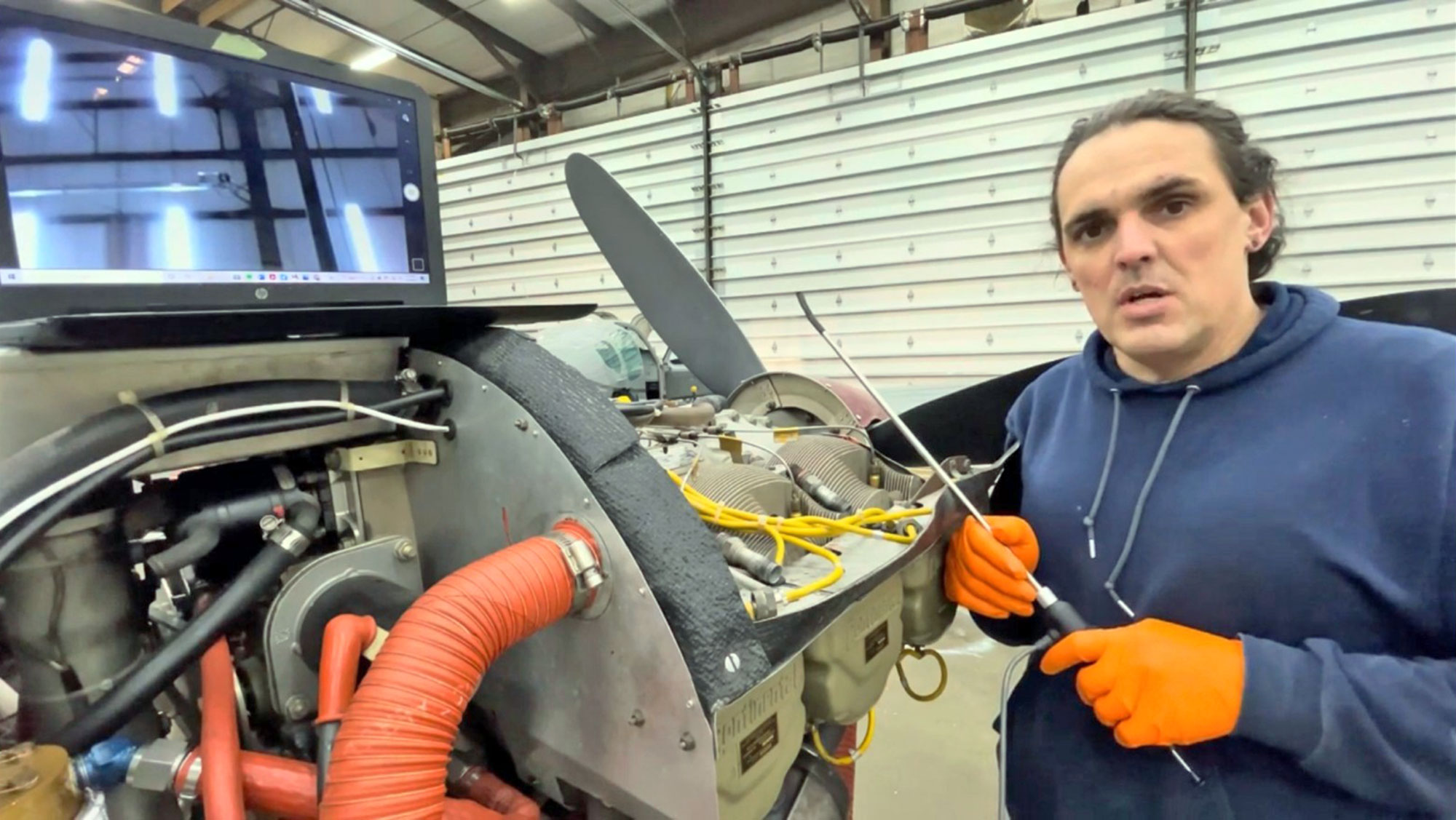
Savvy’s team has been “educating” AI to identify abnormal exhaust valves from borescope imagery. The latest iteration has a success rate of 90 percent in identifying late stage heat damage and 50 to 60 percent for early stage heat distress. That level of success should continue to increase with continued work.
AI is now flagging anomalies and sending them to human analysts. Busch says the goal is to get AI to the level that it can accurately flag late stage heat distress and directly notify owners right away (as well as notifying an analyst).
Going forward, Busch and his team are working on developing a full-fledged video borescope course, which will include how to analyze exhaust valve images and teach other areas that can be examined with a borescope.
In speaking with a tech who recently got his A&P we were told that his training did not include any borescope use. That may not be unusual.
Conclusion
We think that with current engine monitor technology combined with borescope imagery and training in how to use the tools and analyze the data, we can reduce the number of engine failures caused by failed exhaust valves and removal and replacement of perfectly good cylinders.
We also think that Savvy’s efforts to educate the general aviation community about the risks of cylinder removal should be applauded. We think they’ve already saved lives and will save more in the future.
Finally, we strongly support Savvy’s Borescope Initiative, are hoping that the protocol for borescope cylinder imagery and naming convention will become the industry standard and will be watching with great interest to see what else is learned.
We also encourage all aircraft owners to watch Savvy’s training video on borescope use as well as its webcast “Ending the War on Jugs.”