









When its time to polish a prop spinner, we have no desire to commune with the metals inner oneness. Frankly, we prefer to smear some goop on the spinner, buff it off and get on with the flying.
Lots of products purport to be the best and easiest to use metal polishes. But most are made of similar materials and measuring much performance difference between them is a prayer. In a recent test of most of the metal polishes sold for props and spinners, our preference is for one of the old standbys, Flitz. Yet any of a dozen other polishes will also chase the tarnish off a spinner.
The important distinction is this: How oxidized is the metal and how often do you polish it? If you do it once a year and the aircraft lives outside, you’ll need a more aggressive polish than if you hit it once a month with a buff and some carnauba wax.
If youre a true connoisseur of the arcane art of metal polishing and the sort of shine snob who wrinkles your nose at the merest ripple in mirrored aluminum, you’ll want a couple of polishing products. In the world of serious metal polishing, only rank amateurs squirt little dabs of goop onto rags and have at it by hand. The pros use buffing machinery and, not surprisingly, some of the polishes sold for aircraft use are designed or at least better suited for machine polishing.
That doesnt mean they wont work with hand polishing but, as we learned, they clearly don’t work as we’ll or as fast. The apparent reason for this is that polishes intended for machine use are less aggressive than those meant for the dollop-and-rag crowd. You can use either method on a spinner, but given its small size and the need to polish in places where electricity or shop air isn’t available, hand polishing has an obvious allure.
All of the polishes work in basically the same way: A mild abrasive is mixed into a slurry of paste or liquid of some sort and the two work in concert to gently remove the oxidation and crud that make the typical polished spinner look tarnished after a few months of exposure.
Just whats in this stuff seems to be a trade secret among the manufacturers. Our queries to polish makers about ingredients were generally rebuffed, so to speak. In general, the abrasives are either fine grit aluminum oxide or material similar or identical to jewelers rouge. The binding agent may be a kerosene-based paste or an ammonia extract. Some polishes-Rolite, for example-are available in both liquid and paste form. Although you cant always tell the difference between a polished aluminum and a chromed spinner, the chrome type will need less aggressive buffing less frequently than a polished aluminum spinner will.
Chrome may be more resistant to the corrosive atmosphere around the typical airport but it may also need to be renewed periodically due to pitting, peeling or cracking.
How We Tested
We tried the various products on five spinners and one prop, all of which were polished aluminum. Three of the spinners were in relatively good shape to begin with, but two needed quite a bit of attention, obviously having been neglected for awhile.
Using clean, soft rags for each polish and/or DuPont Sontara aircraft wipes, we followed the manufacturers recommendations for each product. To compare performance, we polished strips on each spinner and compared the results visually.
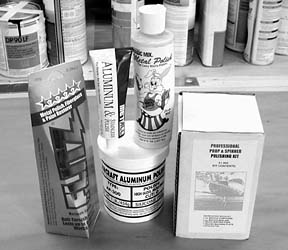
Admitting that one mans mirror is anothers thumb smudge, our estimations of gloss are purely subjective. On the oxidized spinner, using hand polishing, we thought Flitz ($19.95 for a 5.3-ounce tube), Rolites Metal Polish ($14.20 for a 1-pound can) and a product called Magic Mix performed about equally, requiring equivalent effort to obtain a serviceable shine. (Magic Mix retails for $8.50 for an 8-ounce bottle.) Flitz would top our list, as it seemed to work a bit faster.
Another product from Rolite called AP-300 is sold at trade shows ($59 for a 1-pound tub) as a high-end metal polish. Its more suited to raising a deeper shine on an already well-polished surface than clearing off a layer of tarnish with hand polishing.
Other polishes we tried include Met-All Aluminum and Stainless Polish ($4.50 for a 2.5 ounce tube) MAAS ($21.50 for 1-pound can) and Mothers, an automotive metal polish that sells for $8.50 retail. All of these worked we’ll enough but not so we’ll that we would go out of our way to recommend them.
We conclude that given enough time, effort and clean rags, any of these polishes will get the job done eventually. The quality of the shine varies somewhat, however. For example, Flitz seems to produce a mirror-like surface very quickly while Rolites AP-300 works more slowly to produce a shine with more apparent depth, but its not effective on a highly tarnished surface. (Youd have to compare them side by side to notice any difference.)
Flitz seems to work faster because it has a more aggressive abrasive in a paste composed of an ammonia extract. (The liquid version of Flitz lacks the ammonia.) Both versions contain a carnauba type wax designed to seal the surface against further oxidation.
Rolites AP-300 also contains no ammonia, although the companys standard metal polish does. AP-300 is certified for use in the commercial aircraft industry which requires ammonia-free polishes to prevent embrittlement of steel parts. (Rolite says ammonia-induced embrittlement doesnt apply to aluminum.)
Machine Buffing
Of all the products we tried, only one-the Professional Prop and Spinner Polishing Kit from Tech Labs of Waterford, Wisconsin at $34 retail-is specially intended for machine use. In fact, the kit includes a mandrel for an electric or pneumatic drill and a soft foam and wool polishing pad, along with polishing paste and sealer.