











Coded into the DNA of every aircraft owner is a grim acceptance that engine overhauls are a fact of life. But prop overhauls and replacements tend to be last-minute, kicking-and-screaming add-ons and with costs up and flight hours down, there are probably more substandard-if not dangerous-props in the field than ever. At least a couple of prop shops weve talked to report that the overhaul business is down, suggesting owners are stretching prop TBOs more than they used to. Thats bad. But the good news is that the competition in the new prop market is hotter than ever and getting even hotter, thanks to MT-Propellers aggressive push into both the OEM and STC replacement markets. This has forced the established manufacturers, Hartzell and McCauley, to respond in kind, although those two companies don’t agree on where the market will move in terms of materials choices. But at least McCauley believes that long-term-at least five to 10 years-the cost of composite props will become competitive with metal props and ultimately result in lower direct operating costs for owners because composite props can be easily renewed through more overhaul cycles.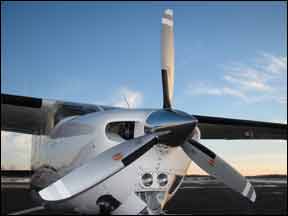
No Magic Bullet
But the overriding reality is that the old guys working with slide rules during the 1940s largely nailed down a good understanding of prop efficiency. Since then, the industry has made what can best be described as incremental gains in prop efficiency due to more sophisticated profiles and, more important, computer-aided manufacturing.
“The aero guys can work magic if they have something to play with, but if its a good design to begin with, its hard to improve that. Youre talking about playing with the margins,” says Hartzells Mike Disbrow. Even with sophisticated CAD-CAM and computer modeling, a prop is still just a way to move air to make thrust.
But what about the fancy scimitar profiles were seeing in airplanes like the Cirrus SR22 and as replacement props? Mostly cosmetic, says McCauleys Peter Wilkinson. And that applies to three-blade replacements for two-blade applications as well.
“People like to put three-blade propellers on an airplane that would be better with a two-blade because they like the way it looks on the ramp,” says Wilkinson, but none of the manufacturers make significant claims in cruise performance for a three-blade over a two-blade. Theyre happy to just keep the performance comparable.
But thats not to say three-blade or multi-blade props don’t deliver some advantages over two-blade versions. Climb performance can be better with a three-blade, although it isn’t always, and takeoff runs can be shortened. In some applications, the prop blades are shorter, improving ground clearance for back-country operations. M-T Propellers David Noad told us that if the aircraft has the available power, a three-, four- or even five-blade prop can reduce takeoff roll by as much as 15 percent, and it has the data to prove it. When M-T started making its composite-clad props for the aerobatic market, few thought these designs would ever find application in high horsepower aircraft, especially turboprops. But M-T did and has moved aggressively to develop props for such high-performance aircraft as the Socata TBM series, the Jetstream 41 and even the P-51 Mustang, the real one, not scale amateur-built versions. Its generally accepted that multi-blade-three or more-props are best suited for aircraft with the horsepower to absorb that rotational energy, otherwise youre just adding more drag for no particular benefit.
Two vs. Three
Ten years ago, there seemed to be a movement afoot for owners to convert two-blade applications to three blades. Part of this was due to favorable pricing Hartzell