











As we attempt to keep our legacy aircraft flying longer and more efficiently, more pilots look to the avionics upgrade path as a means of improving utility and safety. And while the glass-panel primary flight display and multifunction display have both earned their fair share of attention, its also correct to suggest that the combined engine monitor-shorthand for a screen that includes powerplant and airframe system monitoring-is on many owners radar. Who isn’t eager to get rid of those wiggly needles, anyway? J.P. Instruments has been a household name in add-on engine monitors, making popular the bar-graph style of EGT and CHT monitoring. Many pilots are familiar with the firms 2.25-inch gauges and while some of them can include monitoring of other engine parameters besides EGT and CHT, the limited display size reduces the number of items you can watch at once. On another end of the market are those big-screen engine monitoring systems, such as JPIs own EDM-930 and EDM-960-both roughly radio-stack width and around 5 inches tall.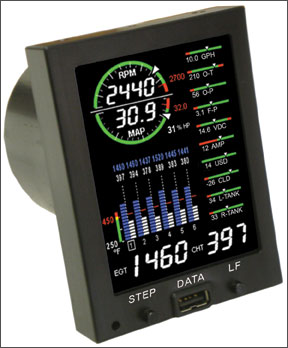
RIGHT SIZE
But what if youre upgrading a panel and don’t have that kind of open real estate? It makes sense to have an instrument in between those sizes, preferably one that fits into a 3.125-inch instrument hole-heck, you have a few of those to spare, right? Well, now there is: The EDM-730/830 monitors are designed to slide right into a large instrument hole.
Sure, thats a great idea, but you havent seen everything yet. The front of the instrument is rectangular-approximately 4.2 inches tall and 3.2 wide-with a 2-inch-deep stub on the back that fits into the instrument hole, similar to the way the Aspen Avionics EFIS takes two vertically stacked instrument holes.
Better yet, the stub is not centered on the instrument, meaning that the edge distance is different for each surface; in turn, this means that you can install the instrument with any of the four sides facing up, and the offset provides more opportunities to clear existing instruments or panel structure. To make that work, the screen can be configured, actually on the fly, to show the data in any of the four orientations.
So, whats it packing? It starts with all-cylinder CHT and EGT monitoring-either the 730 or the 830 can be configured for 4, 6, 7, 8 or 9-cylinder engines. Whats more, the instrument is self-configuring. Plug in a new probe, and at power-up the instrument recognizes it and includes it in the scan.