











The NG in Diamonds new diesel-powered DA42 NG presumably means “next generation,” but it could just as we’ll stand for never-ending guts, for thats what it took to bring this airplane to life. When, four years ago, Diamond certified the original DA42 with Thielert diesel engines, we considered it a bold move indeed. Following up that ill-starred project with a new model equipped with an engine Diamond certified itself strikes us as off-scale nervy, but thats what the DA42 NG represents. To be accurate, the diesels in the NG werent developed by Diamond, but by Austro, an independent company brought to life by Diamond principle Christian Dries. The new state-of-the-art engine factory is right next door to Diamonds Wiener-Neu-stadt factory located south of Vienna. The Austro engines exist because Dries and Diamond were unhappy with the service history of the original Thielert diesels and even more unhappy with Thielerts slow response in fixing the significant technical shortcomings those engines developed in the field. In record time, Austro certified the new AE300 and is now shipping it. The engine appears to be more efficient, it develops more power, but is also heavier than the original Thielert engines were. The large and unanswerable question is this: Will these engines deliver reasonable reliability and acceptable service history? we’ll know in a year or two; in the meantime, here are our impressions of the Austro-powered DA42 NG.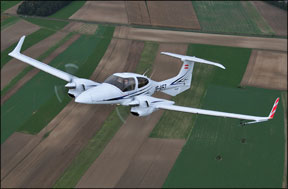
From Auto to Air
Both the Thielert-now Centurion-and Austro AE300 share a common antecedent. They are both based on the 1.6 to 2.0 litre engines Mercedes developed for its popular A-class sedan. Mercedes has sold more than a million of these cars worldwide, although not all are diesel powered. Austro worked in conjunction with a Mercedes daughter company, MBtech, to adapt a powerplant meant for the highway to one suitable for airplanes.
Converting auto engines for aircraft use has rarely been a painless process and there are no commercial examples in GA. Car engines are typically heavier than aircraft engines of equivalent power and if theyre water cooled, radiators and plumbing aggravate the weight differential.
Next to weight, a perennial sticky point in converting auto engines is the need to reduce engine RPM-typically about 3500 to 4000-to a more prop-friendly 2400 RPM. This requires a gearbox, meaning yet more weight. RPM aside, diesels have another problem: Their sharp power pulses send torsional spikes down the driveline from the crankshaft, causing all sorts of wear and fatigue issues if not tamped down.
This is where Thielert ran into trouble. To isolate the crankshaft torsionals from the gearbox and prop, it used a conventional automotive clutch design, to provide pulse-absorbing slippage between the crank and the gearbox. Although light, the clutch proved to be a maintenance headache, requiring frequent inspection and