











If youre committed to the account-draining task of a major avionics upgrade, your sights are likely set on either of the two most sought-after systems for the aftermarket: Garmins G500 and the Aspen EFD1000-series. We think buyers go into the decision-making process smitten by the G500s bigger size, and for bigger, more valuable airplanes, its easy to label the G500 a logical fit. But our experience is that Aspen wins the install bid more often than Garmin. Why? Its the install complexity that ultimately rules the decision even when a buyers heart is set on the G500 from the get-go. That said, keep in mind that to compare apples to apples, you need two Aspens to equal a single G500.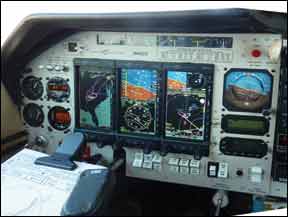
Aircraft in the 6000- to 12,500-pound category have only one choice: Garmins $30-grand G600 system. The G600s software is certified for this class and the system is sold soup-to-nuts with little in the way of add-on options. Aspens EFD1000C3 flavor is aimed at Class III applications. The a-la-cart G500 is aimed at the lighter stuff and owners can add charting, SVT synthetic vision and other options as needed to keep the total cost a bit more in check.
The G500 stands out in the marketing propaganda because it looks bigger-and it is. The Garmin has dual screens (PFD and MFD) housed in a single bezel. Each color LCD screen measures 6.5-inch diagonal with 640×480 VGA resolutions, displaying 65,536 colors. Some owners react that the machine looks smaller in the panel than they envisioned after eyeing the brochures. This could be an illusion for large panels. But, on a small panel like in a Mooney or Skylane, the G500 is dominant.
Aspens PFD is a single 760×400 32,768-color LCD screen design that measures six inches. The bezel width is such that it fits dead center in the middle of the six-pack, sliding through the existing three-inch instrument cutouts and secures to a rectangular, surface-mounted bracket. There’s a flush-mount option, but it requires chopping of metal-just like the G500. An optional second or third screen, the 1000- and 500-series MFD, can occupy the space to the left or right. A dual screen setup is called the Evolution 2000.
The Aspen display has data bars that split it into a top and bottom half. Measure the total viewable area above that data bar (which contains horizon and airspeed and altimeter tapes) and you get an area thats roughly 2.50 inches high and 2.75 inches wide. The G500 is clearly wider at four inches. Thanks to that extra screen space, the G500 on-screen nomenclature is stamped in a larger font that buyers are, not-surprisingly, drawn to. The size also makes the G500 PFD screen look less busy than the Aspen.
Aspens latest software (2.3.3) increases font size for airspeed, altitude bug, tape and drum values, baro setting, selected heading and course while also increasing the size of the values in the data bar. This is a big improvement, even for our 40-something-year-old eyes. On the topic of software, both systems have software platforms that are easily upgradeable in the field, in most cases.
Installation RealityMany of the systems flight-critical electronics live inside the EFD1000 display, which saves critical space and installation effort. It includes the AHRS and a digital air data computer that has pitot and static fittings on the back of the display chassis, an input-output processor (IOP) and of course a main system processor. A configuration module stores installation, aircraft-specific calibration, and user data settings so swapping out a display requires no reconfiguration. Housed in the rear of the display is a cooling fan and backup battery that has enough juice for 30 minutes of display life. A remote sensor module (RSM) containing a magnetometer, OAT sensor and GPS receiver is mounted on the airframe.
A complete G500 is composed of the GDU620 display and remote units: a GRS77 AHRS, GDC74A air data computer, a temperature probe and GMU44 magnetometer. There’s no backup battery.
The single-screen Aspen weighs roughly three pounds, while the G500 is closer to