









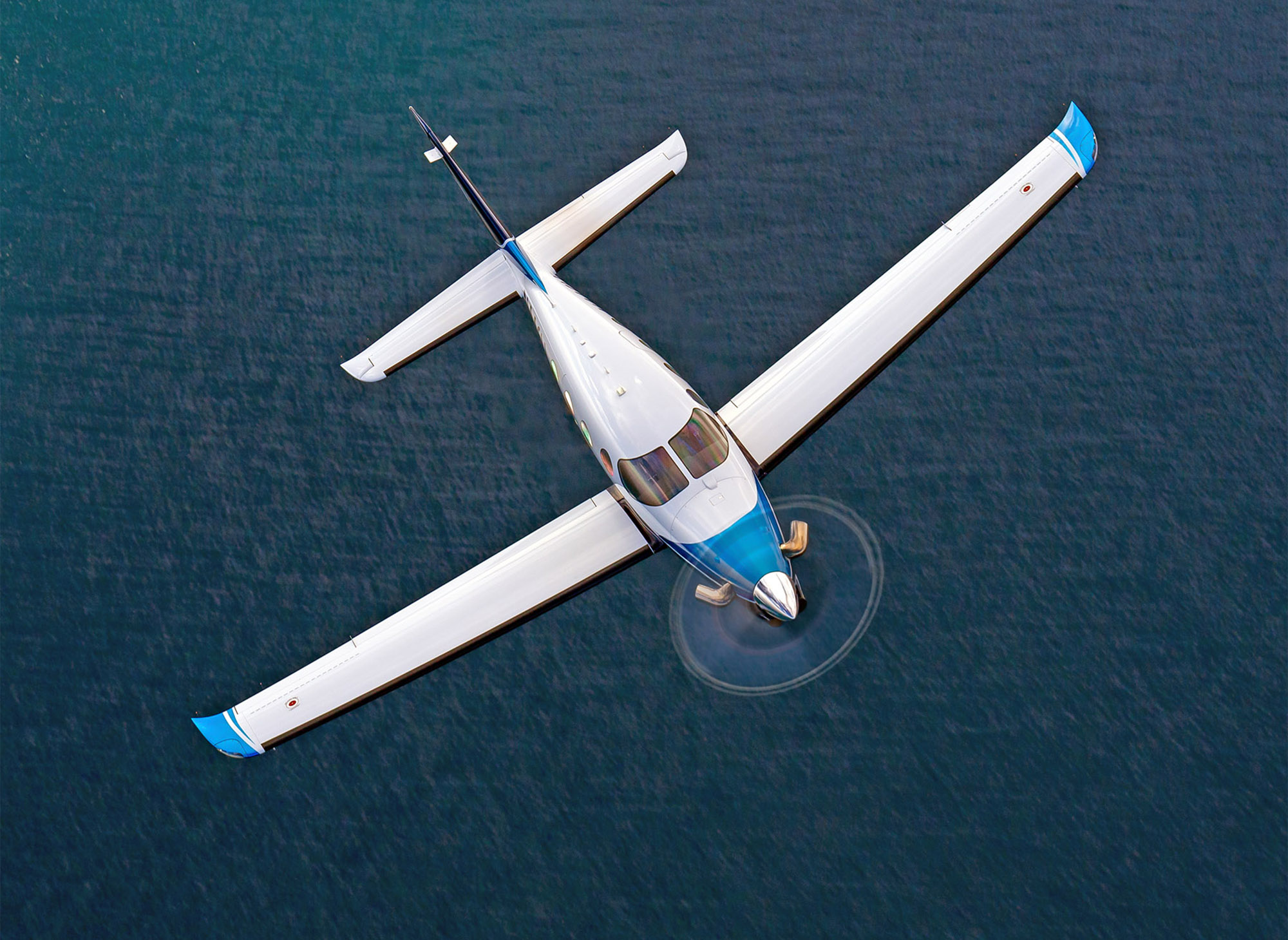
Combining big power—1200 SHP—with a 2860-pound useful load and a well-over-300-knot cruise speed, the Epic E1000 AX is the utility infielder of the single-engine turboprops. (Epic Aircraft photo)
Epic Aircraft (www.epicaircraft.com) is almost un-American. It just flat refused to follow the general aviation manufacturer’s rule book that says right up front that the earliest version of any airplane shall have a little, dinky engine and can’t carry squat or go fast enough to get out of its own way.
Then, over many years, there’s a gradual increase in power or one of the STC companies comes along and drops in a bigger engine to bump up the performance to something that causes pilots’ eyes to water and wallets to be opened. Them’s the rules, folks.
But Epic didn’t pay attention. Nope, those nonconformists went with big power and speed right from the very beginning. They took a 1200-HP Pratt & Whitney PT6A, wrapped a svelte carbon fiber fuselage around it and were looking at a well over 300-knot cruise right out of the barn.

Kit Aircraft
Further disregarding convention, Epic made the original version of the E1000 a kit airplane—selling over 50 of them—in the Experimental category before seeking FAA certification as a Part 23 airplane.
The approach paid off, as company CEO Doug King told us—gaining experience as a builder of kit airplanes, Epic learned to be an airplane company. The team learned customer service, parts supply and manufacturing.
Plus, the Experimental certification allowed using a completed kit airplane as a test bed, bringing in FAA Designated Engineering Representatives to do test flights and tell them what was needed to meet the staggeringly complex certification requirements.
Epic didn’t just get FAA certification for the E1000—taking advantage of the strength of carbon fiber, it certificated the airplane in the “Utility” category, something we can only conveniently recall being done a few times over the last 70 years.
Put simply, a Utility-category airframe will take a heck of a load before it surrenders to G forces.
Shortly after the E1000 was certificated Epic brought out the E1000 GX with fiki (flight into known icing certification) and upgraded avionics.

AX, the newest Epic E1000
Most recently, Epic introduced the Epic E1000 AX and let us fly the first one off of the production line. It includes a major avionics upgrade to the Garmin G1000 NXi flight deck suite and an increase in useful load.
Max ramp weight is 8035 pounds, with max takeoff weight of 8000. The airplane we flew had an empty weight of 5117 pounds, leaving a useful load of 2918 pounds. With 264 gallons of usable fuel, full fuel payload is 1150 pounds. Max landing weight is 7600 pounds. Impressively, there is no zero fuel weight, which often limits cabin loading. That gives the AX considerable flexibility in cabin load versus fuel.
Numbers that matter to potential owners of the E1000 AX are a 333 KTAS max cruise speed, max operating altitude of FL 340 and an NBAA range of 1560 NM. Takeoff over a 50-foot obstacle on a standard day at sea level is 2254 feet with landing under the same conditions taking a total of 2399 feet.

Systems
The engine is a Pratt & Whitney PT6A-67A developing 1200 SHP (five-minute limit, 1000 SHP max continuous). The five-bladed composite prop comes from Hartzell and is full-feathering.
Fuel is carried in wet-wing tanks in each wing with an automatic fuel selector that changes tanks every two minutes. Max fuel unbalance between tanks is 20 gallons.
The electrical system is a 28-volt DC split-bus with independent sources of power to independent avionics display systems. Power comes from a 300-amp starter/generator with a 41-amp standby alternator backed up by two True Blue Intelligent lithium-ion, 20-amp batteries. The batteries have a built-in Battery Management System (BMS) that enables and disables charging and discharging with software that provides protection from short circuit, over temperature and over discharge.

The landing gear is hydraulic; max operating and extended speed is 150 KIAS. The flaps are electric and double-slotted with VGs mounted under the wing in front of them to keep the airflow through the slotted portions attached to achieve a full flap stall speed of 68 KIAS. Max speed for takeoff and approach flaps is 180 KIAS and 130 KIAS for full flaps.
Max operating speed is 270 KIAS with a maximum Mach operating speed of 0.6 Mach.
The AX sits tall on its trailing-beam landing gear—it’s 13 feet 10 inches high as well as 35 feet 10 inches long and has a wingspan of 43 feet. We were pleasantly surprised to learn that the nosegear steering is set up to allow the airplane to pivot on one main gear—a value on tight ramps.
Avionics
As we mentioned above, the major upgrade that created the AX model is the automation—the Garmin NXi integrated flight deck. We’ll outline the long list of features that are a part of the Garmin equipment, but a conversation with Epic CEO Doug King and chief pilot Peter King stuck out in our mind as we discussed the airplane. Both emphasized that the Epic E1000 AX is very much a pilot’s airplane—in fact, during training the first time an Epic pilot flies the airplane none of the automation is used, it’s all hand flying.
Both Peter and Doug talked about the effort that went into the design of the aircraft—from location and positioning of switches, to the interface between the airplane and the automation and the pilot’s interaction with it—to make systems and automation things that assist and support the pilot in safely flying the airplane. We also got a strong between-the-lines impression that they went to a lot of work to make flying it enjoyable.

The biggest news on the avionics end is inclusion of Garmin’s Autothrottle and Autoland. We used the autothrottle during much of the time we were flying and liked its smoothness and the fact that it simply made sure that it had set the power where it should be as we had commanded.
Much has been written about Garmin’s Autoland because it’s a safety system that we think honestly deserves the superlatives thrown its way. On the E1000 AX it can be activated by a button on the instrument panel or one of the two buttons on the cabin ceiling, one between each pair of passenger seats. The reasoning, with which we agree, is that if the need arises to use the Autoland system, things may be going very badly and a person who has to unbuckle a seat belt to activate the system might get thrown about the cabin rather than push the button.
Once activated, Autoland takes over control of the airplane, returns it to level flight, then, using Garmin’s algorithm, selects the appropriate airport for a landing, consults the current NOTAMs to make sure that it isn’t trying to land on a closed runway or airport, makes calls to ATC, keeps the occupants informed as to what is going on, flies to the airport using anti-icing and deicing as necessary, extends the gear and flaps, lands, stops on the runway, shuts down and tells the passengers how to deplane. The system will automatically activate if the pilot stops interacting with the aircraft.
Once activated, the pilot can shut it off at any time with the autopilot disconnect switches.
The Garmin NXi system also includes synthetic vision, vital traffic, engine monitoring, 3D Safe Taxi and Taxiway Routing, Smart Glide and weather. The NXi flight deck couples with Garmin’s GFC 700 AFCS autopilot with flight director, envelope and overspeed/underspeed protection and automatic level feature.

Smart Glide
Smart Glide steps in should the engine go quiet. It picks the best airport to target for the existing weather conditions, holds best glide speed and glides the airplane to a position over the airport.
The glide ratio is 15.4 to 1, giving an 86-NM radius of action from FL 340 to sea level.
The philosophy behind the system is to reduce the pilot’s workload during a highly stressful situation and provide useful information to the pilot, such as automated adjustment of avionics settings like tower or CTAF frequency for the airport, and provide a shortcut to set 7700 in the transponder.
Once within 4 NM of the airport the system alerts the pilot and advises the pilot to resume control and begin maneuvering for landing. In the event of an off-airport landing, Smart Glide provides audible AGL altitude information to allow the pilot to focus on landing locations. We came away from flying the AX thinking that the avionics have been set up to support the pilot rather than be a crutch for the marginal pilot, although they are so good that there is still the problem that pilots will overrely on the automation. In our opinion, that’s where dedicated initial and recurrent training becomes of prime importance.

Training
Epic has set up a contractual arrangement with all buyers that requires them, and subsequent purchasers of the airplane, to undergo Epic’s in-house training. While we have no idea if such a contract is enforceable against downstream purchasers, we think anyone who buys this high-powered hot rod should probably be institutionalized if she or he were unwilling to go through training from the people who know the airplane best.
Chief pilot Peter King has a background that includes being an approved Cirrus Aircraft flight instructor and told me that he strongly supports the Cirrus approach to training of owners/pilots and, with his team, used it, among influences, in creating Epic’s training program. He said that he was supported by top management in the recognition that training is not a profit center for the company—it is the primary safety center for operations of the aircraft—and while budget is always an issue, he should be as free as possible to set up a program that seeks to maximize safety for Epic pilots.
As we have seen just how expensive an accident can be for a manufacturer we commented that, sadly, there is no way for a company to determine how much money it has saved by identifying accidents that didn’t happen because of good training.
Initial training begins with the Epic-pilot-to-be going through online material prior to coming to the factory in Bend, Oregon. Then it’s five days of training in the classroom, on an avionics kiosk, in a Frasca-built simulator and in the airplane.
That is followed by annual recurrent training. The first year takes three days, with subsequent years taking two days. There are Epic-approved instructors around the country to minimize the need for owners/pilots to travel for recurrent training.
Weight and balance
As discussed above, we consider the E1000 AX to be an impressive load hauler. However, the weight and balance envelope is not conventional. The gross weight is much lower at forward CG locations—it only reaches its maximum as the aft CG limit is approached. That means with full fuel and only two big folks aboard—up front—the airplane may be over gross due to the shape of the envelope. It’s easily remedied by putting something in the relatively small baggage compartment (200 pound max) behind the rear seats.
We did several weight and balance calculations on the Garmin NXi system and found that when the passenger seats were occupied there’s almost never an issue with CG, and some truly huge people—or anvils—can be carried in the cabin and still have plenty of fuel for a few hours’ trip.
Flying It
During the walkaround we noticed the close tolerance fit and finish of the composite structure—the windshield and deice boots seemed to flow into the airframe. As is the case with other composite aircraft—due to the FAA’s conservative certification airframe strength requirements—every part of the airplane just feels hell for stout, even though it’s light.
The cabin is large for this class of single-engine turboprop, 4 feet 11 inches tall and 4 feet 7 inches wide. Epic advertises the pilot seats as adjustable for pilots up to 6 feet 8 inches tall. We agree. The passenger cabin is also suitable for large folks with the club-seated passengers not required to interlace legs.
Up front, we liked the four-point restraint system and the amount of flail space from a crashworthiness point of view, but think that with a 68-KIAS stall speed, we’d like a little more impact protection for the pilots, such as standard airbag seatbelts.
As we went through the start-up procedure we opined that some good human factors engineering had gone into switch positioning. What you need is on a subpanel just below and to the left of the yoke and those switches are activated in a flow, left to right and top to bottom, leading to the start button. It’s among the best electrical panel layouts we can recall seeing.
Start-up is classic PT6, with fuel introduced at 12 percent Ng, followed by monitoring temps. Taxiing is conventional, although Beta is needed because that big engine puts out a lot of power at idle.
Part of the pre-takeoff checklist includes setting the rudder trim (all trim is electric) at least 50 percent to the right, a reminder of what’s going to be unleashed when you push the power lever up. The power to weight ratio is 6.3 pounds per horsepower. That’s better than a P-51D, something that we used for reference when flying the E1000 AX (the takeoff, landing and pattern speeds are similar). Hang on.
Acceleration to the 90-KIAS rotation speed is brisk—OK, that’s our understatement for this week. With rudder trim set, the demand for right rudder was much less than we anticipated for the power up front. Then, pitch way up to 12.5 degrees, and clean things up.
The yaw damper automatically engages at 200 feet AGL. Vy is 150 knots, which rapidly appears on the airspeed tape, and we watched the rate of climb exceed 3000 FPM.
Engaging the autopilot and autothrottle, we had a chance to look around and marvel at the inflight visibility; we could see more in all directions that we’re used to in any class of aircraft other than a helicopter or glider.

Level at FL 320 we saw a TAS of 310 knots while burning 48.7 GPH at normal cruise power. Commanding max cruise, the TAS moved up to 324 knots with a fuel burn of 52.1 GPH. In cruise, the AX beats the P-51D’s 240 KTAS and 60 GPH fuel burn at 14,000 feet quite handily. Plus, in the AX we can bring along several friends.
We had some concerns about weather on the latter part of our cross-country flight, so we pulled up the GWX 8000 weather radar in automatic mode on the MFD. During the first four sweeps it depicted six precip areas with red returns. After that, the automatic feature caused them to disappear because they were of no significance to our flight-planned route and altitudes. Having attended radar school and spent a fair part of many flights trying to adjust radar tilt and gain to figure out what we were facing ahead, we like the GWX 8000’s features and capabilities. They make weather avoidance much easier and, in our opinion, improve the level of safety in weather.
When it came time to descend, we experimented with rates of descent and power settings. What we found was tremendous flexibility. The five-bladed prop produces a great deal of drag when the power lever is pulled back so the airplane can come out of the sky with vigor. Plus, it will go down and slow down, something that can be difficult in some jets even with spoilers, which the AX doesn’t need.
At 8000 feet we spent some quality time maneuvering the AX, and liked it. It’s appropriately heavy on the controls so a pilot probably won’t be loading Gs inadvertently (and the Garmin envelope protection system will help). However, we found that, if we used the pressure necessary to deflect the ailerons, the roll rate was most satisfactory. It’s not a P-51D in terms of control response, but it also doesn’t require standing on the left rudder when the nose is pushed down nor doing the same on the right rudder when the power comes up and the nose is pitched up.
Slow flight and pattern work were solid, and, once we figured out bracing our right hand on the power quadrant to make subtle power changes, holding a desired airspeed was not difficult.
Slowing to the point of stick shaker did not reveal any vices in any axis—and stall recovery at the onset of shaker (we didn’t take it into pusher) was conventional and rapid.
The power available makes hand flying a pleasure—it’s just plain fun to do pattern work. The yaw damper automatically shuts off at 200 feet AGL. Even in our hands, the trailing link landing gear meant that we didn’t have to apologize for our landings.
Conclusion
Big power, big cabin, great loading flexibility, stunning avionics and moderate fuel consumption. We’d like to see airbag seatbelts up front, but otherwise, we walked away from the E1000 AX wanting one.
Watch the walkaround video: