











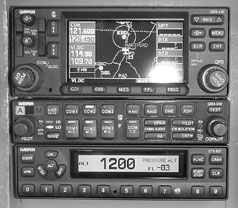
Ya gotta hate transponders.
Although theyre among the least expensive avionics to buy, they arent exactly cheap. A complete installation will cost about $2000 and when youre done, all youve got is a…transponder. No fancy map, no color, no stereo. Just some boring digits and a display on a distant ATC radar screen that you’ll never see. Nonetheless, these mundane boxes are a necessity and if you need a replacement, there are some new ones on the market. Herewith is a survey.
Garmin GTX327
Continuing on its path toward World Domination, Garmin recently added a new digital transponder to its growing line of light aircraft avionics. The 200-watt, solid state design comes as close as anything to excitement in the transponder world. When we unpacked one of the first serial numbers in circulation, we were impressed with its obvious quality. Even the packing was nice. Weighing in at 2.1 pounds with install hardware, the GTX327 is no nonsense and ruggedly built.
We see many conventional transponders on the repair bench with code knobs busted off and faceplates cracked in pieces. We don’t expect to see that with this box. Its a tank. It has good case cooling but plan to pipe in forced air from a fan.
Dimensions are 8.2 X 6.25 X 1.63 inches; relatively shallow in the transponder field. As with all of the Garmin equipment, the GTX 327 install hardware including rack and interface connectors are first class, in our view.
Under the casing, we found clean, we’ll laid out surface-mount components. We suspect factory service support only-for major items-for several years to come. As with all solid-state transponders, there’s less power draw, no warm-up time and lower heat. In short, we feel that the solid-state design equates to longer service life. Other than routine FAR inspections, Garmin says the GTX327 maintenance is on condition. Periodic maintenance is not required.
Nonetheless, the GTX327 is a computer of sorts. Garmin cautions against engine starts with the transponder power on so if your aircraft lacks an avionics master switch, you ought to consider one before installing this box.
The GTX 327 will interface to any altitude digitizer with parallel gray code and with numerous air data computers with RS232 serial altitude. Direct output to the GNS 430 for altitude interface eases installation. This is system integration at its best, reinforcing that the Garmin IFR stack is both compact and savvy.
Unit power-up initiates a self-test complete with software version info. We found the basic mode selection key cluster awkward at first. They mimic the old-fashioned dial design but buttons don’t seem to have the same effect. If you have the optional squat switch interface installed, you might not ever have to worry about ON/OFF mode functions, since its done automatically, perhaps eliminating the annoying Im not seeing your transponder ding from ATC.
Upon takeoff, the unit will transition to ALT automatically and to STBY mode after landing. Install configuration can even pre-set time delays. This interface can get costly in higher-class aircraft, but the GTX327 is a high-class box. Add remote IDENT and the GTX327 is quite automated.
A final comment on buttons: They feel GNS 430 sturdy and are a beefy size for ease-of-use in turbulence. While loading a code during a clearance, the controller changed our assigned code halfway through. We noticed that the entire code isn’t saved until the fourth digit is keyed, allowing you to back up and edit another number on the fly.
A VFR button automatically enters 1200 while storing the last entered code. This is handy while transitioning busy airspace. Foreign country codes can be preset if needed (such as the VFR 7000 code as used in many European countries). The Garmin signature DSTN LCD display is readily legible in all conditions with 14, 28 and 5-volt lighting compatibility. The keys light a comfortable glow and the software-driven display controls can fine tune contrast, along with reverse screen video for night flying. Flight information, such as the count up and count down timer-manually controlled by the user-total flight time, much like a Hobbs, altitude information as received from the altitude digitizer and altitude trend monitoring are all displayed on the right side of the screen. The altitude monitor consists of an up or down arrow figure next to the altitude advising of descents and climbs. No pre-select/alerter feature, as found on the Apollo box, is available, however. Altitude display can be measured in FL format, feet or meters.
Flight timing and pressure altitude readout cant be displayed at the same time. The function key toggles between these fields. System mode information such as ALT, ON, etc. is displayed on the left side of the display. Garmins generous one year, no questions warranty is standard. They offer rapid repair turn-around, in most cases providing loaners if needed. We expect to see new software revisions with added capabilities down the road, most likely field upgradeable. Installed price will vary widely, due to the range of interfaces. Expect all of the non-essential tricks to cost you more. As with any new transponder installation, if your altitude encoder is suspect and/ or aging, we suggest replacing it at the time of installation.
Transcal Industries makes a nice line of encoders and accessories as does Shadin. Also expect to replace the coaxial cable and antenna at installation. List price on the box is $1895. Be sure to explain to your shop your desire (or lack of) for interface options. In our view, the GTX 327 is an excellent compliment and addition to the current line of Garmin boxes. Its intuitive to operate for the first time while working busy airspace or in actual IMC. Its tough, however to get used to pushing instead of turning while doing transponder chores.
GTX 320
The Garmin GTX320, Garmins first transponder, almost seems short-lived with the recent intro of the GTX327. Get a quote on the 320 versus the 327 and its almost a no-brainer, in our estimation. The 320 is basic transponder with newer technology and will play with 12 to 28 volts without converters. We have customers asking for factory credit for their recently installed GTX 320 against a GTX327. Nice try but no cigar. The GTX320 is 200-watts of solid state surface mount design. Several users of the box have griped that the reply lamp is much too dim in flight conditions. Garmin says theyre looking into this.
What is unique of the GTX 320 is that Garmin has available an adapter board for a plug and play with older Narco and King transponders – eliminating the need for rewire. Weve never been fond of adapter plates and such. They seem to cause more grief than not. Many aircraft need rewire and face it, rewiring a transponder is not a big task compared to a full modern interface. The adapter boards add several hundred dollars to the price. We say put the money into a rewire.
The GTX 320 is lightweight-not nearly as substantial as the SL70 and GTX 327. Hardcore Garmin fans have been installing the GTX 320 as a back-up to the GTX 327. We have seen a few units go back to the factory, mostly inoperative and have found that Garmin has been helpful with loaners and replacements.
Bendix/King
First problem here is what to call these guys? Is it Bendix/King, AlliedSignal, Honeywell/AlliedSignal? Heck if we know so we’ll stick with Bendix/King.
The Bendix/King Silver Crown KT76A Mode A/C transponder (list price $1544) is as popular as transponders can get. Close to 150,000 units have been installed to date. Its design is basic and its a proven performer. Before the recent advent of computer-controlled transponding, this was the transponder to upgrade to and still is if you want basic, reliable functionality.
The units 200-watt power output is oscillator driven, meaning its not solid state. The cavity oscillator tube is a costly hit at replacement time and you may face that if you keep this unit for a long time or already have a vintage unit in the panel. The cavity is also a source of heat. The KT76A was, however, the first of its kind to utilize LSI (Large Scale Integration). LSI reduces weight and power, allowing longer service life and increased performance. Its no surprise to find this micro-chip technology in the KT76A.
As with most of the current production Silver Crown line, bench service is often simplified due to its chip design. Remove and replace the chip without the need to trace circuit paths and such. The unit opens up logically for easy service and will be familiar to most seasoned bench techs.
Weighing approximately 2.5 pounds, modern KT76As have become less substantial; we’ll avoid the term cheap. We found that the mounting racks and unit casing, for example, are much lighter and well, okay, cheaper than older production models of the KT76A.
Connectors and other hardware remain true Bendix/King and are of high quality and a pleasure to install. Other manufacturers can benefit from Bendix/Kings install kit design and manual layout. The KT76A performs best with the KA60 blade-style antenna. It will operate on 14-volt input power and on 28 volts with a 28-volt changeover kit, slightly raising the cost of 28-volt installations. Remote IDENT switching can be installed and this transponder is compatible with virtually all altitude digitizers with gray code format.
KT76C
Part of the Silver Crown Plus line of equipment, the KT76C mode A/C transponder is based almost entirely on the KT76A platform, but with a digital front end. In fact, the KT76C will drop into a KT76A mounting rack but be sure to remove the drop-down kit in 28-volt installs.
The install manual doesnt call for forced-air cooling but the mounting racks are forged with inlets for air hook-up. Using air potentially increases service life. The highly visible gas plasma display with microprocessor-controlled dimming indicates pressure altitude in FL format, mode annunciation such as ALT, STBY and so on. Reply indication is a simple R followed by the selected squawk code, which is entered by pressing the desired code entry button 0 through 7.
A VFR button allows any pre-set VFR code. Pressing and holding the VFR button causes the last active code to be recalled and displayed. A simple and familiar rotary mode selection dial controls mode of operation (OFF through ALT). Routinely installed for under $2000, we have had good results with the many KT76C units we have installed. The box is simple to operate and is easy to see in numerous viewing conditions. (List price is $1744, a good value, in our view.) The faceplate compliments the rest of the Silver Crown and Plus line of equipment and doesnt look too shabby when mixed with other manufacturers gear, as is frequently the case.
As with the KT76A, two-year factory warranty is standard and support from Bendix/King has been generally excellent. Plenty of loaners and quick turn arounds are the rule. We have found that many potential upgraders shy from the KT76C because of its oscillator design. They want newer solid-state design that the KT76A/C simply doesnt have. In our view, if you have a relatively new stack of Silver Crown, the KT76C will compliment the stack and promises many years of reliable, user-friendly operation.
Mode-S and KT70
A word here about Mode-S. If you want it, the Bendix/King KT70 is the box of choice. Frankly, we have installed exactly none of these for the simple reason that buyers have concluded that Mode-S is a loser. A decade ago, the FAA pushed Mode-S hard, the market pushed back and technology marched smartly forward. As envisioned, the Mode-S link would have been instrumental in airborne/ground-based traffic avoidance schemes and other datalink applications.
But TCAS and other systems have rendered those long-term plans obsolete. And for weather and other uplink/downlink tasks, other technologies leave Mode-S in the dust. Worth mentioning is that the KT71 has solid-state design with traditional knob squawk tuning. And at $4924 list, its more than twice as much as even the relatively expensive SL70 from Apollo. Bottom line: Why bother? There are better choices.
Apollo SL70
While a high-tech product, Apollo/UPSATs SL70 isn’t quite as exciting as Garmins GTX 327, mainly due to its feel and exterior casing. The Garmin simply looks more rugged and substantial.