










Face it, for the rest of us, dropping more than half of the aircraft’s value on a new avionics package is tough to swallow. As it is, more budget money than ever is getting squirreled away for engine reserves.
A good example of how you might freshen up an aging radio stack comes from reader Jim Conn, who got it right when it came to a bang-for-the-buck upgrade for his 1978 Cessna Cardinal.
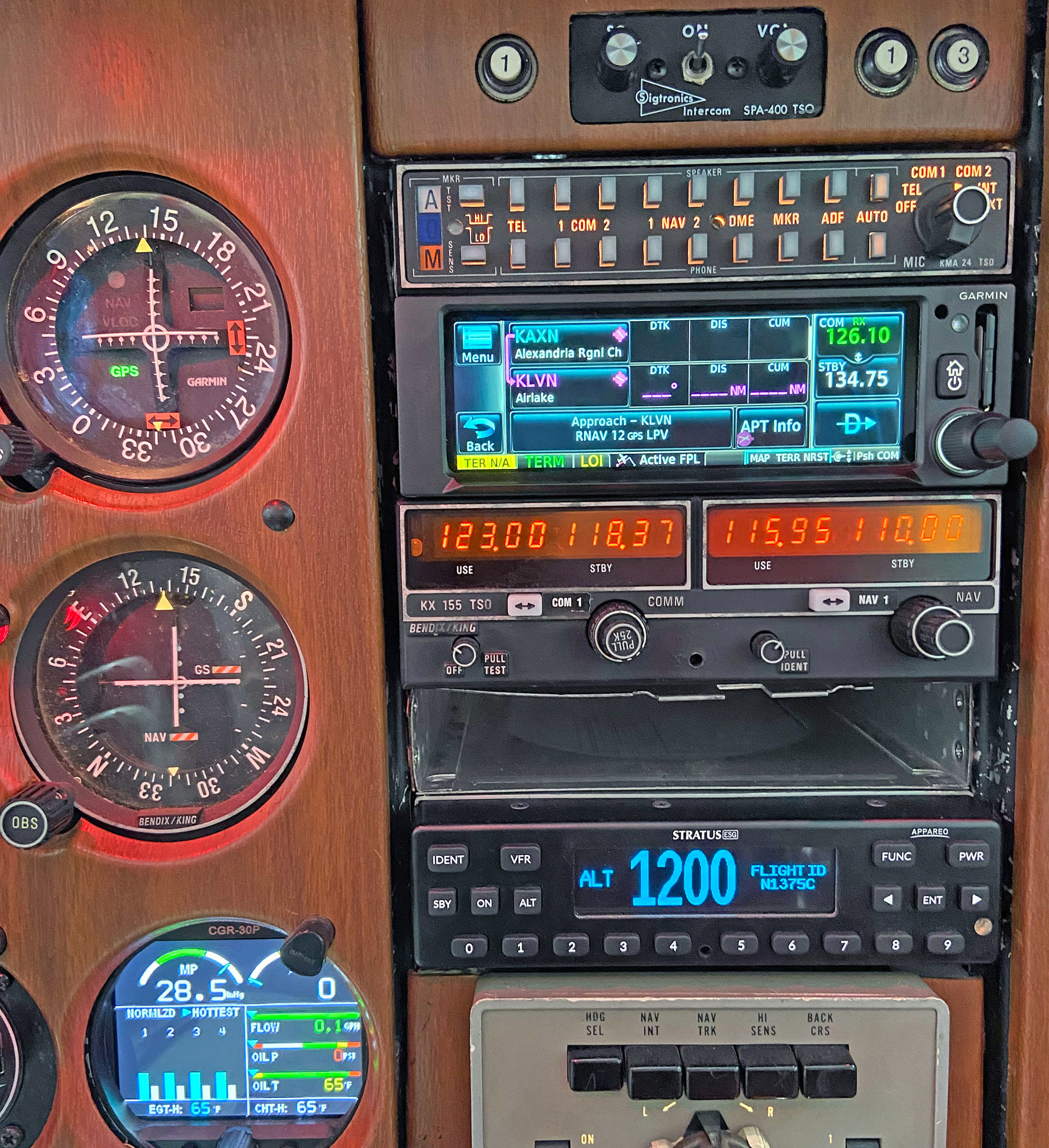
Conn’s Cardinal was equipped the way many piston singles are, sporting an IFR radio stack from the early 1990s. That’s the upgraded stack shown here. It started with dual King KX155 navcomm radios, with the primary radio having ILS/localizer capability. It was connected to a King KI-209 mechanical nav indicator. The second KX155 was paired with the KI-208 indicator, with VOR capability.
Conn said the primary KX155 was a solid performer, so the shop moved it to the number two position in the radio stack and retained the KI-209 indicator. A few words of caution when deciding to keep any King KX155 are in order.
Before committing to keeping it (or even installing a used one for backup) I strongly suggest having it bench tested by a shop that knows what it’s looking at. A common service item with these otherwise reliable workhorse radios is display failure. You’ll know when one is failing because it might have dimming problems or missing digits/segments. It used to be an easy fix on most any shop’s repair bench, with the tech swapping out the gas discharge display and maybe even the display driver ICs. But those old displays are long out of production and the new replacement is a costly upgrade—questionable for a radio of this vintage.
Since this aircraft didn’t even have IFR GPS approach capability, a good call was installing a Garmin GNC 355 IFR GPS/comm. It doesn’t have a VHF nav receiver, but that’s what the secondary King system is for.
Conn—who obviously has generous friends—was given a Garmin GI-106 mechanical CDI for connecting with the GPS. They typically sell for around $1500 on the used market, and Garmin’s latest GI-106B sells for nearly $3000. I think the better choice if paying money for one is buying a Garmin G5 or GI 275 electronic flight instrument.
“My total cost for adding RNAV approach capability, plus a reliable primary comm radio, was under $12,000,” Conn said. He could have taken the upgrade one step higher and replaced the KMA24 audio panel and Sigtronics intercom with a budget-based PS Engineering PMA7000BT Bluetooth audio panel from PS Engineering, designed to use the KMA24’s wiring.
Conn kept the old 300A autopilot, using it only as a wing leveler since he likes to hand-fly approaches. And that empty spot in the center of the stack … that’s for a King KN64 DME that’s out for repair because he still uses it.