











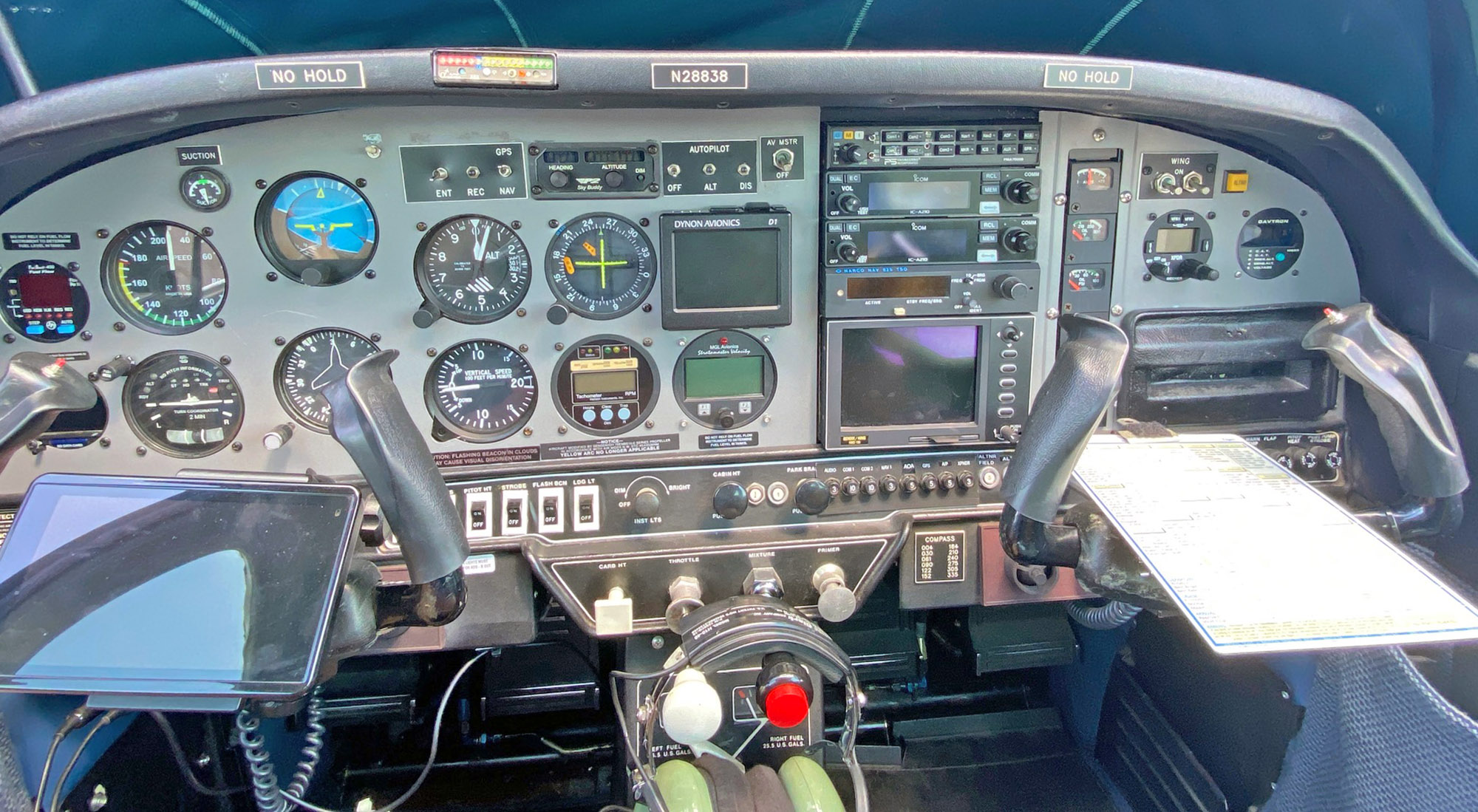
This month’s panel for planning comes from the owner of a nice Grumman Tiger who is ready to make some modest upgrades to its instrument panel. His mission with this aircraft is flying short trips—no longer than four hours—and he’s ready to start his instrument training with the goal of flying light IFR.
As with many VFR panels, the aircraft has a federated arrangement, which is a variety of avionics from different manufacturers, including a Narco Nav825 VOR/ILS radio with ID825 indicator, which is long discontinued and unsupported. Still, it’s a good platform to build upon because it has what I call essentials: a basic graphic engine monitor (an Insight G1), a Shadin FS 450 fuel computer, Mitchell engine gauges, a PS Engineering PMA7000 audio panel with built-in four-place intercom, a uAvionix tailBeacon ADS-B Out transceiver with strobe lighting, a Becker transponder and two Icom A-210 standalone comm transceivers—one of which doesn’t work. It could be a problem with the radio, the wiring, the antenna system or all of the above. It also has a turn coordinator-based S-TEC 30 dual-axis autopilot.
There are some useful accessories, too, including a semi-portable Dynon D1 EFIS display and MGL digital clock/timer. For ADS-B traffic and weather, the plane has a Garmin GDL 39. As the photo above shows, it has traditional mechanical flight instruments, a digital tachometer and an altitude warning unit.
But what’s really missing from this panel—and these days it’s essential for IFR training and flying—is an IFR GPS. The BendixKing KMD150 and Garmin GPS 795 with mount are strictly VFR units.
Utilitarian approach
It’s easy for a shop to suggest ripping all of this out and starting from scratch, but I think the best bang for the buck is to retain the existing PS Engineering audio panel, troubleshoot each of the Icom comm radios (including the antenna systems) and retain one of them.
For an IFR GPS, I might suggest Garmin’s GNC 355. It’s a touchscreen navigator with built-in comm radio that can be used as the primary GPS/comm system. It works with any of Garmin’s flight displays and even third-party standalone indicators, but a good option might be to remove the attitude indicator, the DG and the vacuum system and install dual Garmin G5 flight displays, connecting the GNC 355 with the G5 EHSI. The owner says the Narco nav system works and if that is the case, retain it for backing up the Garmin since it has an ILS receiver.
While this installation could easily top $20,000, I think it’s a reasonable investment that adds to the aircraft’s value while adding good capability for learning and flying instruments.
Got a panel for planning? Drop a line and I’ll help noodle it.