











The first thing we noticed about the SmartDeck is that its just looks great. Our flight tests proved that this beauty was more than skin deep. Subtle shading and thoughtful grouping of information meant we were rarely searching for something on the screen. This is not the case with other, more widely used integrated cockpits.
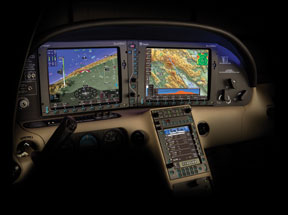
That attention to detail and the pilot interface is, perhaps, both SmartDecks greatest attribute and its greatest flaw. L3 took its time putting this thing together-perhaps too much time..
The current SmartDeck began as a clean-sheet design in 2003. It was certified for the Cirrus in May of 2008, and an improved version with synthetic vision and full, datalink weather will be released this fall. Highway-in-the-sky (HITS) and other improvements are in the works but have no committed timeline.
Meanwhile, Garmin G1000 users can upgrade to syn-vis and HITS today, and both Avidyne and Bendix-King have new glass cockpits in the ring. There’s not enough room in town for all these cowboys, and the winner may be the one with the fastest draw rather than the sharpest shot.
Its The Little Things
During our talks with engineers and on our flight tests, we kept coming across smart design decisions. For example, the system will only ship with two Air Data and Heading Reference Systems (ADHRS). This matters because loss of the ADHRS in these glass cockpits is crippling, leaving the pilot flying on a back-up attitude, airspeed and altimeter with no autopilot and, possibly, limited or no navigation (depending on the exact failure). G1000 installations on most light singles are single ADHRS.
The PFD and MFD are controlled by softkeys along the bottom, and a skinny set of buttons and knobs that sit between them. A white line snakes along these vertical controls to separate the MFD ones from the PFD ones. Wed like to see some tactile difference in the knobs that control the MFD and PFD to further prevent confusion, but the visual works acceptably. The plus of this design is that you don’t have to reach in front of your passengers lap to get full use of the MFD.
SmartDeck also calls your attention to items in, what we believe, is just the right level of awareness. Navigation messages appear in the center of the HSI, right in