











In the good old days, a big avionics installation consisted of a pair of nice nav/com radios. This was easy work for the shop when compared to todays high-speed digital interfaces. For the owner, an old-school, dual-radio upgrade meant dropping five grand or thereabouts.
Prices are twice that for new nav/coms. Shops often have to gut a rats nest of old wiring as well. The teardown-intensive task of replacing original antennas and coaxial cable means more airframe disassembly, increased downtime and a hefty addition to the owners bottom line.
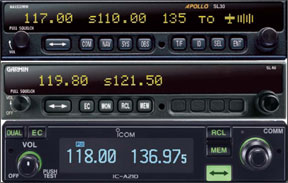
Heres a rundown of what the market has to offer in modern nav/com radios, and a review of potential gotchas that should be discussed on the front end of the project. we’ll skip integrated NMS systems and cover traditional com and nav radios. Also keep in mind that whether or not your existing OBS or HSI (or PFD) is compatible with the new radio could swing the price by over $1500.
Bendix/King
Arguably the industry standard for nav/com radios, the Silver Crown KX155 remains a popular choice for traditional nav/com upgrades. Enjoying a long production run, the KX155 and VOR/Localizer converter-equipped KX165 (for driving most analogue HSIs) has undergone several discrete design changes over the years-notably the switch to surface-mount circuit boards, which limits some field repairs. The KX155 is available in several flavors. There is a version that has an integral glideslope receiver board and one that only receives VOR and Localizer channels. A glideslope-equipped KX155 can drive a variety of nav indicators including the KI209, KI209A (for sharing GPS and nav on the single indicator), KI204 and most HSIs. Critical on all KX155/165s is the operating input voltage: 28 or 14 volts. If you installed a 14-volt unit in your 28-volt airplane, expect both the smoke show and the repair bill to be impressive.
When Cessna started building aircraft again in the late 1990s, Honeywell launched the Silver Crown Plus series and along came the KX155A and KX165A. These models only run on 28-volts, sport a more contemporary-looking bezel face and feature some features not found on legacy KX155s. But like vintage KX155s, they are available with and without integral glideslope receivers. If you have a 28-volt aircraft, the modern KX155A (or converter-equipped KX165A) is a step above a legacy KX155 and offers 32 programmable com channels, a built-in digital course deviation indicator and a feature Bendix/King calls Quick Tune-an RS232-driven interface that plucks frequencies from a KLN94 GPS database based on your position so you don’t have to search for and load them yourself.
The unit can also be connected to a yoke-mounted frequency control button so you can increment channel tuning and move standby frequencies into the active window without reaching for the unit. Further, there is a timer function with stopwatch and a bearing-to and radial-from the station feature. The KX155A/165A series output 10 watts of communications transmit power and all current production units have 760 com channels. Oddly enough, the modern KX155A equipped with glide-slope costs $4089, which is less than $4289 for the older-styled 28-volt KX155. Youll need to buy a compatible OBS indicator, too, which could add another $1000 at least.
The budget Crown series, once aimed toward homebuilt aircraft applications, includes the KX125 nav/com and standalone KY97A-series com radio. These units have LCD displays that wash out in direct sunlight and don’t view we’ll from wide angles. The KX125 has a built-in digital CDI on its display, with radial readout of the station tuned. The KX125s claim to fame is that it doesnt require a remote OBS indicator (although, it can drive one). The KY96A is for 28-volt applications.
The 14-volt KY197A and 28-volt KY196A are higher-end standalone com radios (essentially, the com portion of a KX155 packaged in a slimline case). Unlike the Crown KY97A series, they transmit 10 watts of power, have frequency memory, sport gas discharge LED displays and carry a whopping $4550 list price. For this reason, theyre hardly a popular choice in standalone coms. Similarly, the $5161 KN53 is a standalone navigational radio (the nav portion of a KX155 packaged in a small footprint). In our view, the KY197A/196A and KN53 series offer high quality, but the smarter option is to purchase the all-in-one KX155, equipped with glideslope. Youll save money and panel space.