











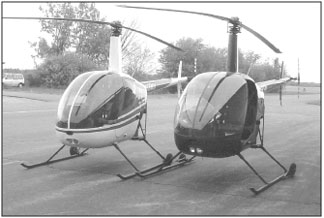
If the Bell 47 is the Piper Cub of helicopters, then the Robinson R22 must be the Cherokee, for it stands out as the most accessible, affordable and widely available light helo ever built. In fact, the fairer comparison may be to call the Cherokee the R22 of light aircraft.
In 1990 and 1991, when the industry was still reeling from the great downturn of the 1980s, Frank Robinsons peanut-sized come-from-nowhere helicopter outsold every manufacturer of general aviation aircraft in the U.S. Thats quite an accomplishment considering that helicopters are considered difficult to fly, slow and have limited range. In that context, a little one with two seats might be thought of as merely a passing toy for someone with a little money to burn.
But it hasnt worked out that way for the R22. The little helo found a huge market because it did what no other did: it offered a relatively cheap means of getting into vertical flight with a machine that had just enough performance to open up commercial applications in both training and general utility work.
Whether its easier or harder to fly than other helicopters of its class is debatable but owners and operators agree on one thing: its cheap to fly and simple to maintain. That alone may have assured its success.
Evolution
Observing a keep-it-simple dictum since the first Robinson rolled off the assembly line at the Torrance, California plant in 1979, the company has hewed to basics, making only small incremental improvements and refinements and no drastic model changes. The first R22s introduced in 1979 had 150-HP Lycoming engines de-rated to 124 HP. This is basically the same powerplant used in the old Cessna Skyhawk, since supplanted by a newer Lycoming in the current Skyhawks. When it was introduced, the Robinson engine and airframe had a phenomenal TBO of 2000 hours. That has since been inched to 2200 hours.
The HP model was introduced in 1981 with an extra 10 horsepower, up to 160 HP, in a B2C engine. Although the powerplant was still de-rated to 124 HP, the pilot could pull the extra power at any time, since there are no artificial stops. And the extra oomph provides a cushion in high-density altitude situations.
In 1983, the Alpha instrument trainer was introduced, with the gross weight boosted from 1300 to 1370 pounds to handle the extra instruments. At the same time, changes were made in the structure and control system to widen the CG range. The battery was moved from the nose to the engine compartment and the aft main strut was lengthened to give extra clearance for the tail rotor.
In 1985, the Beta model raised the engine rating from 124 HP to 131 HP. And a year later, an amphibious Mariner model was brought out with fixed floats that are attached to a special skid gear. The entire arrangement can be removed and replaced with the standard skids. The floats arent the instantly inflatable variety found on other helicopters.
Performance and Handling
As aircraft go, the R22 is not fast but as helicopters go, it more than holds its own. Although cross-country cruise speed is not something pilots of most piston-powered helicopters boast about, or even care about, the R22 can cruise at over 90 knots (max cruise is listed at 102 knots), which is quite respectable and can leave its competitors (Schweizer 300C and Enstrom F28C) in its rotor wake.
In maximum hovering altitude out of ground effect, the R22 again comes through with pretty good numbers. For the R22 Beta, HOGE is 5200 feet, compared with only 2750 feet for the Schweizer 300C. The Enstrom F28F outshines the R22 in this category, however, with a HOGE of 8700 feet. The Beta II model has a max hovering in ground effect altitude of 9400 feet.
Like most small helicopters, the R22 demands a delicate touch that will catch fixed-wing pilots and fliers of bigger choppers unawares. The flip side is that pilots who have received their training in the Robinson should be able to handle any other helicopter with ease.
The rotor blades are a low-inertia design, which means rotor speed can decay quickly if the pilot is inattentive. In the early days of the R22, this was mentioned as the probable cause of airframe breakups as the main rotor blades, in slowing down, struck the airframe. It is also generally cited as making for a more dramatic critically timed flare at the bottom of an autorotation. Naturally, it means the pilot cannot dally in lowering the collective in an actual engine power loss. In addition, it leaves less latitude for carelessness in hovering autorotations.
On the other hand, the mechanical throttle/collective coordination of the R22 is remarkably good at matching engine RPM output to collective movements. And we like the novel rotor/engine tach display on the Robinson. On top of this, Robinson has made standard an electronic throttle governor to hold a constant RPM as the collective is moved up and down. This is something every pilot who has flown turbine helicopters desires, because the nagging concern about maintaining rotor RPM throughout various maneuvers is largely eliminated with the automatic throttle response.
As noted in the safety sidebar, Robinson has aggressively addressed any design-related safety issues with a training program that should serve as a model for the industry. Pilots are trained to understand and recognize the Robbies limitations and fly accordingly. This has dramatically lowered the accident rate.
The one peculiar control arrangement on the Robinson is a teetering handlebar cyclic control. This is mounted on a single control column that sprouts from the floor at the base of the instrument pedestal. When the student has one handle and is resting his hand on his leg for stability, the other handle is teetered rather high for the instructor but is, nonetheless, reachable.
Maintenance
Pilots and operators who responded to our call for feedback almost universally reported the R22 gave them no special maintenance problems. Indeed, most emphatically said it was less of a burden than with any other helicopter in their experience and some readers own both airplanes and the R22. On top of that, the factory received bouquets for friendly, quick personal service.
To say that parts are easily available is not to say they are cheap, any more than with any helicopter. When we surveyed owners in 1990, operators told us they estimated maintenance costs at from $6 to $12 an hour, not counting reserve for overhaul. Another told us an owner could count on paying out roughly twice as much to maintain an R22 as a fixed-wing single. The latest (2004) Robinson factory estimate for periodic inspections (with labor at $55/hour) comes to $6.60 per hour, with unscheduled maintenance, parts and labor adding another $4.30 per hours, for a total of just shy of $11 an hour.
Altogether, the factory calculates that total operating costs (including fuel, oil and maintenance, plus reserve) is $77.48 per flight hour. Add insurance-about $6200 a year for a low-time pilot, according to the factory-and total per-hour cost for 150 hours a year comes to about $119 per hour. Thats roughly comparable to a high-performance single-engine aircraft.
AD, SDRs
In our first review of the R22 a decade ago, we found that the biggest number of apparent glitches involved worn or failed tail rotor pitch link and teeter hinge bearings, with a dozen instances reported. If thats still a problem, we havent seen any evidence of it in the SDRs.
In our last report on the R22, we pronounced it relatively AD-free. Thats certainly not the case now, although most of the ADs on the FAAs list-we counted a total of 27-would have been complied with when the helo was overhauled, if it has been.
The most recent AD may also be the most onerous. Emergency AD 2004-06-52 requires track and balancing of the main rotors within 10 flight hours if theyre older than five years or have 1000 hours time in service. The blades must be replaced if an abnormal increase in vibration occurs within five hours of the track-and-balance. The AD also requires immediate replacement of certain blades, whose part numbers are given in the AD.
Other ADs of note include 2000-20-51, which requires inspection for yoke cracking, AD 99-07-17 which calls for inspection/replacement of the sprag clutch; AD 99-02-02, requiring inspection and/or replacement of the flexplate; AD 98-21-09 for fuel tank vent check; AD 97-25-05 for carburetor and carb temp gauge replacement and 97-02-14, which requires an improved throttle governor, superceding and supplementing a previous AD on the subject.
A sweep of a couple of years worth of service difficulty reports revealed no patterns of concern and few issues worth remarking about. There were a couple of incidents involving loose or defective drive belts and comments on sprag clutches. But, as owners insist, the R22 is not a difficult-to-maintain aircraft.
The Big Overhaul
One unusual aspect of maintaining the R22 involves planning for a complete overhaul of engine, airframe and rotors at 2200 hours or 12 years, whichever comes first. The base price of this overhaul, including the engine, is $97,000, as of May, 2004.
However, the Robinson factory says the average actual cost is between $100,000 and $105,000. Obviously, then, something like $47 an hour has to be earmarked for the overhaul. If you fly only 50 hours a year, it will still cost the same to overhaul at the end of the 10-year period. This major overhaul can be regarded as either a sword of Damocles hanging over the owner or as a reassuring tangible event that eliminates all doubts as to both timing and cost of a major life event. When the R22 comes out of the factory overhaul, it is a completely reconditioned machine. Since key components like the main rotor blades have 2200-hour lifetimes, they are replaced. (No components on newer aircraft have lifetimes shorter than 2200 hours, incidentally, although some older models may still be under the 2000-hour limits. The Lycoming powerplant also has a 2200-hour recommended TBO, so Robinson provides an overhauled replacement, no less. The interior is replaced, too, and the rotorcraft gets a new paint job. Robinson does both the airframe and engine overhaul, having established an engine overhaul shop at Torrance.
Owners must, however, figure on flying or shipping the R22 to and from Torrance and thats a fiscal consideration some owners grip about, wishing there were other overhaul facilities around the country. Count on six to eight weeks for the overhaul to be completed. There are about 200 service centers around the world, with about 120 in this country.
Incidentally, the factory warranty is for 1000 hours or one year, parts only, no labor or shipping. Main and tail rotor gear boxes are pro-rated to 2200 hours or three years. One pilot told us the downside of the 10-year overhaul limit was the difficulty he encountered in selling his R22. He told us his R22 was 10 years old, had only 800-plus hours and was still like new. But four prospective buyers turned away because of what he called that 10-year scare. Although his factory-authorized mechanic told him theyd continue to annual his Robinson as usual, any insurance company might balk at covering a helo beyond the manufacturers recommended limits. One dealer we spoke to called operating beyond the stated 12-year limit as a gray area. It is done but not many like to talk about it.
Modifications
A cargo hook STC is available from Test Instrumentation, Inc. of Bellevue, Washington. Contact 425-641-6631. The hook is priced between $3080 to $7165 and will lift about 400 pounds. It doesnt have a winch motor but it is equipped with a cockpit-operated release mechanism and can also be used with a Bambi bucket for fire fighting work.
A New Zealand company makes external luggage and cargo pods for the R22. Contact www.helipod.co.nz. An autogas STC for the R22 can be purchased from Howard Fuller of Sterling, Massachusetts at 856-313-6362. Buy the airframe STC from Fuller and Petersen Aviation will sell you a separate and required engine STC for $1 per HP. Contact Petersen at 308-832-2050.
Robbies are popular for photo missions and for that work, a photo door is a good idea. Tech-Tool Plastics makes one. Contact them at 817-246-4694. The door costs $2195 and has a full-view plastic assembly with a vertical sliding window for photography. Tech-Tool also sells replacement glass for R22.Reader Feedback
Ive been a fixed-wing pilot for almost 40 years, but at age 65, I decided to take helicopter lessons. Like many students, I chose the R22 as a trainer because it was the least expensive. During my 50 hours of training, I was very impressed with the reliability of the Robinson. The helicopter was always on-line and ready to go, even though it was working hard for 25-plus hours per week.
After getting my rating, I bought a 1999 Beta II with only 230 TTAE from a private owner. In the past 11 months, I have put over 150 hours on the helicopter and the only unscheduled maintenance was one fouled spark plug. I figure it costs about $50/hour for fuel, oil, maintenance, and 100-hour/annual inspections. To that, $40/hour needs to be added for overhaul reserves.
For a private owner, insurance can be a deal breaker. Being a low-time pilot, the best quote I could find was almost $14,000 for hull, plus an additional $1400 for liability. As a result, I decided to self-insure the hull. Even no-rotor-turning hull insurance was quoted at over $8000, which seems completely unjustified.
We use our R22 for a combination of local flying and long cross country trips. Last year we flew from Detroit to San Diego and what a way to see the Mississippi River! We also made a round trip from San Diego to Seattle and flew the beach both directions. For relaxing travel, a helicopter is hard to beat. We mostly follow roads, rivers and beaches at 300 to 500 feet AGL and watch the world go by. Cruise speed is approximately 85 knots at 9 GPH. We find that legs up to 200 miles are comfortable, plus we sometimes stop at scenic areas for a break. The R22 has plenty of reserve power since it uses a 180-HP engine flat-rated to 131 HP. It will haul two people, 29 gallons of fuel and a small amount of baggage. We usually trade off some fuel for baggage when we travel. I made a carefully calibrated dipstick, so I know exactly how much fuel I have on board. Extra fuel stops are not a big deal in a helicopter since I usually cruise below pattern altitude anyway.
Next week, we are leaving for Texas on a wildflower photo tour. We will spend approximately three days enroute from San Diego to San Antonio, with lengthy stops along the way. I could make the trip in about 4-1/2 hours in our Mooney Bravo but we wouldnt see many wildflowers.
-Bill Barton
Encinitas, California