











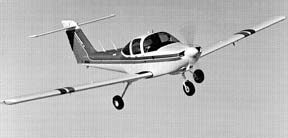
The Tomahawk, one of the last all-new designs introduced by Piper before the great general aviation slump of the 1980s, was supposed to be the ultimate primary trainer. It was billed as a design that answered the wishes of flight instructors and students everywhere.
It certainly had a few things going for it. Definitely sportier-looking than its main competition, the Cessna 152, the Tomahawk offered a reliable engine, good visibility, a hefty 30-gallon fuel capacity and we’ll thought out systems. But it was hit with a series of troubles early on; these, of course, were rectified through ADs and service bulletins, but before the PA-38s reputation could be restored production was discontinued along with most other light aircraft.
Today, a Tomahawk can be had for $10,000 to $12,000 less than a similar-vintage 152. As long as the airplanes service history is adequately accounted for, that savings makes it a pretty good deal.
History
In the late 1950s Cessna came up with an undeniable hit with the 150. Essentially an updated 140 with tricycle gear, the 150 became the archetype of the primary trainer. The basic formula was a good one: docile handling, rugged construction, and an economical engine.
Pipers answer was the Cherokee, but it was really in a different class. It was roomier, but there were some strikes against it. For one thing, the handling wasnt quite as crisp, especially in the stall. This was seen as a drawback for primary training. But the real reason that the Cherokee 140 didnt have the same success as a trainer was simple economics. With its 150 HP engine, it was far more costly to operate. The same factor stood in the way of the Beech 19.
In the mid-1970s, Piper decided it was time to go head-to-head with Cessna. Rather than come up with another variant on the amazingly versatile PA-28 airframe, the company elected to launch an all-new design. The idea was to put it squarely in the same class as the 150, but make it decidedly more modern.
Piper made much of its drive to solicit input from end users. Ten thousand experienced flight instructors have assisted us in producing the ideal learn-to-fly airplane, ran the press releases. Attention was also called to the fact that the PA-38 was an all new design, with Piper calling it the first new trainer in a generation.
The first Tomahawks appeared in late 1977, and they certainly were different. The cabin was far roomier than the Cessnas, the fuel tanks were much larger, and the overall appearance was of a much more modern airplane. Like many Pipers of the era, the Tomahawk had a T-tail. In hindsight, given the mixed results Piper experienced with other forays into high-mounted horizontal stabilizers, this was probably a mistake. However, it did serve to set the Tomahawk apart on the flight line. Oddly enough, Beech came up with a trainer of its own at the same time-the Skipper-that was nearly identical to the Tomahawk.
Production of the Tomahawk lasted only five years, and few changes were made to distinguish early models from later ones. However, because of all the flaws that emerged as the aircraft entered service, the later the model, the better, since each production year more improvements were incorporated.
The so-called Tomahawk II in 1981, therefore, boasted nearly invisible (on the outside) improvements like better soundproofing, improved door latches and a larger and more positive throttle knob. And by ducting defroster heat directly from the heat exchanger, windshield defroster effectiveness was supposed to have been improved.
Altogether, nearly 2,500 Tomahawks were built in five years or so of production, with most of those being constructed during the first two years. A relative handful (fewer than 200) rolled out of factory doors each of the last three years.
Marketplace
Caution should always be exercised when considering used trainer aircraft. Students are notoriously hard on equipment, so if a clean example of an airplane that has never been a trainer can be found, its the preferred choice. Of course, the sellers know this, so these airplanes will carry a hefty premium.
Competition for the Tomahawk basically boils down to its two-seat contemporaries: the Cessna 152 and the Grumman AA-1. All three airplanes use the Lycoming O-235 engine, and all three are roughly comparable in performance and payload. The Cessna tends to be more expensive, in our opinion because of the Pipers lingering bad reputation more than anything else. The AA-1, particularly in the earlier versions, is a much more demanding airplane to fly, though it does offer good performance, and is somewhat less expensive to buy. The latter is also a true orphan: Grumman became AGAC, which then went out of business.
Expect to pay anywhere from $15,000 to $17,500 for an average-condition Tomahawk, or far more if you insist on a really clean non-trainer.
Performance
Trainers don’t have to fly very far, very fast or carry a great deal to meet their design goals, and the Tomahawk is no exception. Differences between it and similar airplanes are not dramatic, though they are noticeable and the Tomahawk does show up fairly we’ll when compared to the 152.
When the Tomahawk first came out we did a side-by-side test between it and the 152. At cruise the two are similar-100 knots or so-but flat-out the Tomahawk was faster. We observed 114 KTAS at 85% power.
Climb rate, which on paper is almost the same, turned out to be somewhat better for the Tomahawk in real-world tests. The Tomahawk benefits from a high-aspect-ratio wing here. Even so, climb rate is not the strong suit of any airplane in this class. Standard condition gross weight climb is only 725 FPM, and it gets much worse with hot or high conditions. Poor climb rate is the biggest complaint amongst pilots, but thats not at all unusual in this class of airplane.
Handling
Handling isn’t bad, though in our opinion the control harmony could be a bit better, with a higher roll rate. Its we’ll within the expected norms for a modern trainer.