











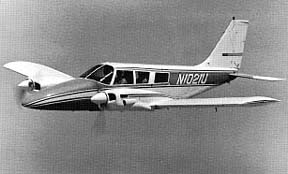
Over the years, few light aircraft manufacturers have managed to get as much mileage out of existing airframes as Piper. Vero Beach produced seemingly endless variants of the basic PA-28 Cherokee-everything from simple trainers to T-tailed turbocharged retractables to light twins, all of which were recognizably based on the same airframe. Pipers larger single, the PA-32 Cherokee Six, was also transformed into several different airplanes over the years.
History
The PA-34 Seneca is, basically, what you get when you turn a Cherokee Six into a twin, sharing the trademark Hershey-bar wing, stabilator empennage and fuselage of the Cherokee Six. The Seneca had counter-rotating Lycoming IO-360C1E6 engines producing 200 HP each.
It was introduced in 1971 at the height of the general aviation boom to serve as a less-expensive companion to Pipers successful but aging Aztec (it was about a third less costly), replacing the Twin Comanche in the lineup. The Seneca was about the same price as the Twin Comanche C/R, while sporting larger engines, a higher gross weight and a roomier cabin. Both the Seneca and the Twin Comanche were built in 1972, but the latter was discontinued afterwards, albeit in part due to the flooding of Pipers Lock Haven, Penn., factory that year. (The Seneca was built in Vero Beach, Fla.)
That first year showed that Pipers move to replace the Twin Comanche was the right one. Piper built 360 Senecas that year, more than doubling the combined production of the PA-39 Comanche for 1970, 71 and 72. The only twin of similar power on the market at the time, the Cessna Skymaster, sold only 63 units in 1972. The first three years of Seneca production totaled a healthy 933.
To Pipers credit, a lot of effort went into making the Seneca user-friendly for both pilots and mechanics. It had counter-rotating props, thereby eliminating the critical engine-a bonus for training and overall safety. Maintenance access was considerably improved over the Twin Comanche, which had been designed in the 1950s. The fuel system was simplified, with only on, off and crossfeed to deal with.
The Seneca benefited from some of the better features of the PA-32 on which it was based. The cabin was long and wide, with real seating for six, a big aft door on the left and a cockpit door on the right, making for ease of loading. That appealed to charter outfits; passengers tend to dislike climbing over wings and seatbacks to get on board. Loading, too, was easy thanks to baggage compartments fore and aft.
Piper even managed to make the airplane fairly attractive, despite the hard-edged fuselage and fat, rectangular wing.
The original Seneca was less than stellar when it came to handling in flight. The controls were decidedly heavy, partly because there were a lot of add-ons in the control system such as an aileron/rudder interconnect and a down-spring for the stabilator. The ailerons werent big enough. Pitch stability wasnt very good, either.
The result of all this, in addition to heavy handling, was a pronounced Dutch roll tendency especially in turbulence and when configured for approach.
To make it worse, the engines vibrated badly (enough so that some airplanes lost spinners in flight due to cracks), the noise level was high, and to add insult to injury there were six ADs on the airframe in the first two years of production, three of which were repetitive.
Its a tribute to Pipers marketing expertise and the airplanes good points that it was so successful in spite of the problems.
Piper acted quickly to correct the Senecas handling and noise/vibration shortcomings. The ailerons were changed to a modified Frise design and made larger. The engine mounts were changed, and more soundproofing was added. The changes helped, though the airplane was still fairly heavy.
The company also changed some of the weights to give pilots the option of carrying some more weight-or more fuel. Gross weight was increased from 4000 to 4200 pounds. The increase carried with it a price, of course (there is no free lunch, after all): Single-engine performance at the higher gross weight became marginal at best. Single-engine ROC sank from 230 FPM to 190 FPM and single-engine ceiling from 5200 feet to 3650 feet. It also introduced a new limitation: a zero fuel weight of 4000 pounds.
The airplane still wasnt as good as it could be, though, and so in 1975 Piper made some more alterations and produced the PA-34-200T Seneca II.More changes were made to the control system to improve handling. The aileron/rudder interconnect was removed. The rudder gained an anti-servo tab. The stabilator was changed, and a bobweight added. The ailerons were increased in span and balanced for lighter effort. This time, the changes worked, and no major alterations were made after that.
The big change for the Seneca II, though, was the switch to turbocharged engines. The four-cylinder normally aspirated Lycomings were replaced with six-cylinder turbocharged Continental TSIO-360-E engines with fixed waste gates. Rated at the same 200 hp at sea level, they produced 215 hp at 12000 feet.
While the new engines were good for better mission profiles due to the ability to fly higher, the biggest benefit came in engine-out performance. Single-engine ROC improved to 235 FPM and single-engine ceiling more than tripled, to 13,400 feet. Initial recommended TBO was the same 1400 hours. In 1977 this was increased to 1800 hours.
The weights were upped again by altering the landing gear and wing center section. Gross weight increased by 370 pounds to 4570; however, the zero fuel weight stayed at 4000 pounds. Another limiting weight was introduced: a maximum landing weight of 4342 pounds. So, once again, pilots were given more flexibility…and more ways to get into trouble if the loading limits were not obeyed.
Several noteworthy options were introduced with the Seneca II. Extended-range fuel tanks were offered that increased usable fuel from 93 to 123 gallons. This increased range with reserves from 575 to 820 NM (at 65 percent power at 10,000 feet).
A further attack on noise and vibration came in the form of a three-bladed prop option, which weighed 46 pounds. The popular club seating option was introduced. So was a Janitrol heater and optional fan to move heated or ambient air faster in the cabin. In later years, some system changes and options were added, such as a priming system to make engine start easier, optional, more powerful brakes, modifications to the instrument panel and air conditioning. In 1980, a built-in oxygen system was offered.
In the late 1970s and early 1980s Piper began going through its model line and making substantial changes and updates. Starting with the Warrior in 1975, Piper airplanes began sporting tapered wings and other changes. The company also went through a period when T-tails were thought to be a good idea (a debatable point): The results were the Turbo Arrow IV and T-tailed Lance.
The 1981 Seneca III was originally supposed to have the same T-tail and tapered wing as the Lance but Piper found that the flying qualities werent as good as the company had hoped. The configuration was left basically unchanged.
There were significant changes to the Seneca III, though. A different variant of the Continentals was used, with 220 HP each. These engines had a higher RPM limit (2800 vs. 2575). This, combined with fuel scheduling, resulted in maximum power of 220 HP, albeit time limited to only five minutes. Continuous rated power was still 200. Single-engine rate of climb improved marginally to 240 fpm, and all-engine rate of climb went from 1340 to 1400 fpm. However, most other performance figures, such as runway required, declined somewhat due to a further increase in allowable weights.
The new weight limits were made possible by reinforced structure. This time the zero-fuel and landing weights were raised as well. Maximum takeoff weight was now 4750 pounds, zero fuel weight 4470 and max landing weight 4513 pounds.