









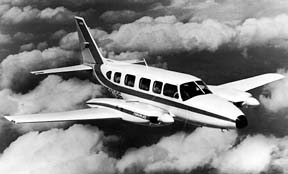
In the mid-1960s Piper, flush with success, decided it was time to enter the burgeoning commuter airline/cabin-class twin market with a brand-new airplane. The result was the PA-31 Navajo, Pipers answer to the ubiquitous Cessna 400 series twins.
It was to be based on and all-new airframe, one that was markedly different from anything the company had ever produced: much bigger, with an airstair door to keep passengers happy, and with significantly more powerful engines.
Piper stuck with the formula begun with the PA-28s: Take the same basic airframe and re-swizzle it into as many variations as possible, thus allowing one design to fit many market niches. In all, the PA-31 was produced in a half-dozen different variants spanning two fuselage sizes… and thats not counting the turboprop versions.
As one might expect, some of the airframe/powerplant combinations were (and are) real winners, while others didnt work out so well. The Navajo did suffer from its share of ADs, unfortunately, and some of the engines are short-lived, costly to overhaul and plagued with problems. Whether a given model of Navajo is a good choice for you really depends on the mission you have in mind. At the core, though, the Navajo meets its design parameters nicely.
Piper did learn a bit from field experience. The high-duty-cycle life of commuter planes was an area that the company didnt have a great deal of experience in at the time, and some lessons were learned along the way that benefited later variants.
One owner sums the airplane up very well: The Navajo is a fine aircraft, capable of performing many missions. It is comfortable and stable, straightforward to maintain and operate, reliable and cost effective. Our passengers don’t groan when boarding.
History
The Navajo first hit the market in 1967, and was we’ll received. It was certainly a departure for Piper, which only a few years earlier was building airplanes like the Apache and Tri-Pacer. Originally named the Inca, the PA-31 gestated through a relatively small (for the class; gross weight was still 1000 pounds above anything that Piper had previously produced) twin into a fairly large (for the day, and large certainly for Piper) six-to-eight-place one. Initially, there were only two windows in each side of the fuselage aft of the cockpit, but this quickly was increased to three fairly large rectangular windows with a smaller, triangular one on the aft starboard side. The basic shape and arrangement held right through the production life of the Navajo.
The prototype first flew in September 1964, powered by variants of the Lycoming O-540 family that has powered all Navajos. The first model year featured both normally aspirated and turbocharged versions.
The first model was the PA-31-300, powered by normally aspirated 300 HP IO-540-Ms with two-bladed propellers. Recommended TBO is 2000 hours. While it has the same 190-gallon standard fuel capacity as all unpressurized Navajos, gross/max takeoff weight is 6200 pounds, compared to 6500 for all the other short Navajos, while basic empty weight was only 156 pounds less than the Turbo Navajo. One caution on fuel capacity: Usable varies slightly, from 190 down to 182.
The -300 was short lived: Only 14 were built, and the model was discontinued after only two years.
The other model, the turbocharged, 310-HP version, was really the standard Navajo; its performance fit the intended mission profiles better than the normally aspirated version. It could fly 30 knots faster, its single-engine ceiling was much higher, and it could take off shorter, to boot. And thats not even counting the extra useful load. All of this extra performance cost, on an average-equipped airplane, less than $10,000 on a $130,000-odd airplane. No wonder it sold better.
While some initially were designated PA-31-310, and called the Turbo Navajo, FAA issued an AD in 1973 requiring that any called that have the data plate changed to a PA-31 model designation. Despite early problems with the turbo system, this is the second most popular version of the Navajo. Also introduced in 1967, improved B and C models were introduced in 1971 and 1975, respectively. Radar appeared during this period, along with deice systems.
As part of the concept of a working airplane, a pilot door (really, an oversized window opening) was offered from the start. This allowed executives to keep the help out of the cabin, and working pilots wouldnt have to climb over the freight or chickens or whatever in the cargo hold. An expanded main, or cargo, door option was introduced later.
A number of refinements to systems were made all along the line, and not all are identified by changes to model designation. Field experience and maintenance issues were applied in a number of ways, such as improving the electrical system, including the location of circuit breakers and isolating wiring runs from sources of chafing and other deterioration.
The cockpit was improved considerably over the years, as was the appearance, comfort and serviceability of the cabin interior. Some Navajos have interiors that are comparable to those of many corporate turbine aircraft.
A three-bladed propeller was offered as an option with the B model and made standard with the C. While many pre-1979 Navajos are equipped with some or full anti/deice equipment, approval for flight in known icing (described at the time as approval for flight in light to moderate icing) was not obtained until the 1979 model year.
Recommended TBO gradually was increased from the initial 1,500 hours to 1,800. Also, there are special conditions under which this now can be extended to 2,000 hours. The initial base price was $97,290; average equipped price was $120,000. When production ended, base price was $314,080, and average equipped prices had soared to over $419,000.
P-Navajo
The PA-31P (a/k/a the PA-31P-425, or P-Navajo) was introduced in 1970. It was the most sophisticated, highest-performing Piper ever, with a big, troublesome, geared version of the 540 series engine, the TIGO-541-E1A. The pressurized Navajo was cured of early problems with the pressurization system, but powerplant reliability has continued to plague the ambitious design.
Initial recommended TBO of the 425 HP engine was an appalling 800 hours (now it is a still-short 1200, and those babies cost a bundle to overhaul: $39,000); some still don’t get that many hours before going sour. (One hapless owner had an engine go at 800 hours on the dot. The report says: internal failure-number 3 rod bolt appeared to fail/counter weight pin sheared. Rod bolts stretched. Then, 22 hours later, the right engine failed internally. The laconic end comment was: recommend lowering TBO time.
A high-ticket, short-TBO engine is a major cost factor. Plan on spending $65 an hour just for engine reserve. Combine this with the fuel burn (mid-20s per engine) and you have a very high hourly operating cost.
Big engines also mean short range. A standard-fuel P-Navajo has an endurance in the three-hour range with IFR reserves. There was an optional fuel system available, which boosted capacity by 54 gallons.
For those stuck with a P-Navajo and dreading yet another overhaul, there is an alternative: Schafer Aircraft Mods of Waco, Texas will gladly replace those geared monsters with a shiny new pair of Pratt & Whitney PT6 turboshaft engines of 620 SHP each. The result is something like the Cheyenne II, and the cost is a mere $590,000-plus. Thats about the average cost of a used Cheyenne II, by the way.
Production of the P-Navajo ended in 1977; a total of 259 were built. Prices on the used market range from about $150,000 to maybe $200,000s. To put this in perspective, a Turbo Navajo of comparable vintage is likely to be worth a little more, despite having 115 HP less per engine and no pressurization. (Book values for 1970 P-Navajos are slightly higher than those for the Turbo, while the situation reverses for later models).
Chieftain
The largest and most successful Navajo, the PA-31-350 Chieftain, was introduced in 1972 as a 1973 model. The fuselage was stretched two feet (ahead of the wing) and the tailplane span increased. The cargo door was made standard. The power comes from counter-rotating L/TSIO-540-J2BD, 350 HP engines. The floor was beefed up and an additional window added to each side of the fuselage. Up to 10 seats could be fitted. Empty weight increased by roughly 200 pounds and maximum takeoff by 500.
Extended nacelles provide baggage capacity and/or optional fuel tanks. The option raises total usable fuel from 182 to 236 gallons. The initial TBO of 1200 hours was increased to 1600 in 1979 and then 1800 (it, too, can be stretched to 2,000 under special conditions). These engines cost about $25,000 each to overhaul.
Performance of the Chieftain is not too far off that of the P-Navajo despite having less power available. Combine this with the bigger cabin, less costly and troublesome engines, and significantly more range through higher efficiency, and its easy to see why the Chieftain was so popular despite lacking pressurization.
The Chieftain was also less expensive to buy than the P-Navajo. Initial average equipped price was a bit less than $185,000, compared to nearly $280,000 for a similar-vintage P-Navajo. The same Chieftain is now worth $173,000, while the P-Navajo has plummeted to $147,000. If resale value is important, the Chieftain is clearly the better choice.
When production was suspended in 1984, some 1,825 Chieftains had been built.
Navajo C/R
The PA-31-325 was introduced in 1975. It featured counter-rotating L/TIO-540-F2BD engines rated at 325 HP and extended nacelles similar to those on the Chieftain. The nacelle lockers could be used for additional baggage space and optional auxiliary fuel tanks. To keep things straight, remember that the C/R has the original short fuselage.
Empty weight averages 90 pounds more than the basic PA-31. Cruise speeds are marginally higher (five to six knots average), but range is marginally lower. Single-engine performance is improved a less-than-marginal degree (i.e., not noticeable when flown by the average pilot). According to the book, the basic Navajo has better takeoff and landing performance than the C/R.
The supposed advantage is more handling ease in the event of an engine failure because -the promotional literature claims-the dreaded critical engine is eliminated. That really is not a selling point. As with any other piston twin, the single-engine performance is poor to effectively zero in most critical circumstances.
In the last year that both the PA-31 and PA-31-325 were offered (1982), the biggest factor was that the latter was about $20,000 more expensive than the straight Navajo. The difference hasnt changed much over the years: The C/R is still worth more than the straight turbo PA-31, by about $12,000.
The C/R was the last of the short fuselage Navajos built. Production ended in 1983. A total of 1,771 310 and C/Rs were built.
T-1020
With a great deal of fanfare, in the early 1980s Piper introduced a new program to improve its position in the growing market for commuter airplanes. A separate division was established to deal directly with airline customers, bypassing the dealer network. It offered 24-hour attention and expedited delivery of parts, among other benefits. (Some regular Piper customers were miffed that the company would not offer the same level of support to them.)
It also worked to improve products-building on the basic Chieftain-for the airline market. The T-1020 (model designation PA-31-350-T-1020) was the first. Called by some a stripped Chieftain, the powerplants were the same. It featured beefier components where experience showed weaknesses, especially elements affected by high cycles, such as doors, landing gear and gear doors, and interior. The fuel system was simplified and capacity reduced to 106 gallons. Basic empty weight increased by nearly 450 pounds compared to the Chieftain, but maximum takeoff was kept at 7,000. Up to 11 seats could be installed. Introduced in 1982, a total of 21 T-1020s were manufactured, making it a pretty rare airplane; we found no cost data on it.
Mojave
What do you get if you combine the good idea of the P-Navajo (pressurization) with the superior (supposedly…) engines and airframe of the Chieftain? A non-Navajo Navajo.
The last Navajo wasnt even called one. The PA-31P-350 was dubbed Mojave. It was a hybrid that reflected a lot of lessons learned over the life cycle of the extended Navajo family (including some hard ones that came from the Cheyenne turboprop), with a touch of Aerostar influence thrown in.
The Mojave has a lot of appealing features, including a dual-bus electrical system, an O-540 variant engine supposedly designed specifically for high-altitude operation that included intercooling and pressurized mags from the factory, and thicker fuselage skins.
The L/TIO-540-V2AD engines are counter rotating, rated at 350 HP at 2575 RPM and have a recommended TBO of 2000 hours. Overhaul cost is $25,000.
Structurally, the wing is based on the Chieftains. Span is four feet wider to improve climb and high-altitude cruise performance. The fuselage, nose gear and fuel system were basic Cheyenne. The basically Chieftain empennage featured dual trim tab actuators of different dimensions to avoid harmonic vibration problems. The flaps incorporated a trim-in-motion monitor to help avoid asymmetric deployment.
The Mojave, the last twin Piper built in Lock Haven, Pa., didnt last a year. Introduced in 1983, the 50th and last rolled out the door in June, 1984. With so much going for it, what happened? The Mojave had its own problems both with powerplants and performance.
The old P-Navajo bugaboo-engine problems-struck early on. There was a rash of cylinder failures despite the fact that they were low-profile designs that were to match the conditions of flight in high, thin and cold air (and, theoretically, the effects of descending, too). The notion of turboprop performance at a piston price was appealing, except that piston price approached three quarters of a million, and turboprops were bountiful at less than that.
Cynics maintain the only reason Piper revived a pressurized Navajo was because Cessna was covering the world with its family of pressurized twins. The P-337 was no longer in production, but the 340, 414 and 421 were still being offered in the early 1980s. Beech was a factor with the 58P. Pipers marketing whiz-kids figured they were losing customers to the competition, even on unpressurized twins when the family of models factor was added.
The concept seems flawed. More important, performance wasnt all it was supposed to be. High-density altitude performance was sluggish. It is a heavy airplane-standard empty weight was initially called 4,729, but grew to 5,070 pounds. Payload with full fuel for the average airplane is 500 pounds or less.
Of course, a lot of other things were going on to influence the entire Navajo line. The general aviation industry was in the early stages of what has proven to be an apparently intractable recession, and Piper was once again changing hands and management.
Which is the best?
It depends. If you need maximum payload and maximum cubic inches of space (and the roomiest cockpit, to boot), the Navajo the market clearly voted best is still the winner: the Chieftain.