









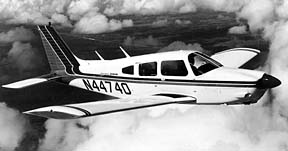
The Piper Arrow is, in a way, like a Ford Taurus. Not the fastest, not the roomiest, not the most stylish… but it has enough of all of those qualities to give it enduring popularity. For those unable to afford a Mooney or Bonanza, it offers a less expensive, though still reasonably capable, cross-country machine. It also has the advantage of not being an orphan – the Arrow is still being made.
The Arrow, since its really just a retractable Cherokee (or Archer), is a logical step-up airplane for pilots who now fly fixed-gear Pipers. Everything will be familiar, from gauge placement to handling and procedures. And that, of course, was the basic marketing model for all of the major manufacturers in the 1960s and 1970s: train pilots in two-seaters, graduate them to similar four-place, fixed-gear models, then to retractables from the same blood line.
History
The ubiquitous Piper PA-28 has been folded, stapled and extruded into an almost unbelievable number of variants over the years, from the modest Cherokee 140 trainer all the way through the T-tailed Turbo Arrow IV – including the Warrior, Cherokee 180, Archer, Cherokee 235, Dakota, Challenger, Charger, Pathfinder, Cherokee 150,. Cherokee 160, Arrow, Arrow II, Arrow III… and a few turbocharged models in there for good measure. The PA-32 series also shares the same basic design, and, by extension, the Seneca. The PA-28 airframe, too, was made into a twin, in the form of the Seminole.
The various descendants of the original Cherokee are so similar, in fact, that the FAA doesnt even distinguish between them. For purposes of the census and activity surveys, all PA-28s are the same.
The original PA-28 owes its existence to John Thorpe, who designed an all-metal homebuilt that, after some modifications, became the first Cherokee. Introduced in 1962 as the Cherokee 150 and 160, the PA-28 gave Piper a badly needed shot in the arm in the low-end market. Cessna had a runaway success on its hands with the 172, and Pipers competition – the Tri-Pacer – was downright dowdy by comparison. In the retractable market, Piper did have the sleek and handsome Comanche to sell, however.
The Cherokee did well, and was soon joined by the 180 and 235, giving Piper a strong lineup of fixed-gear singles suitable for a variety of missions. Since all Cherokees shared the same basic airframe, the company was also able to realize some manufacturing economies.
By the mid-1960s, Piper began considering the PA-28 as a candidate for penetration into the light four-place retractable market. At the time, Mooney effectively owned that niche. Beechs least expensive retractable was the Debonair, which cost a third again as much as a Mooney, and Cessna had no comparable airplane at all.
Piper outfitted the Cherokee 180 with folding legs, and in 1967 unveiled the first Arrow. It was every bit a Cherokee, from the fat, constant-chord Hershey Bar wing to the stabilator. The base price was $16,900, some $1,350 less than the Mooney M20C Mark 21 (according to the Aircraft Bluebook Price Digest, however, the average equipped price of an Arrow as delivered was actually about $2,000 more than the Mooney). A Cherokee 180 from the same year had a base price of a mere $12,900.
The PA-28R-180 came with a constant-speed prop attached to a Lycoming IO-360-B1E engine. The new retractable gear was electromechanical (compared to Mooneys distinctive manual arrangement), and had a unique feature: an auto-extension mechanism that would lower the gear if the airplane slowed below a certain airspeed. It was intended as a safety feature, and Piper touted the Arrow as the perfect airplane for pilots transitioning to high-performance, retractable-gear airplanes. Many pilots and insurance underwriters loved the foolproof gear system. Some insurers even assigned lower rates to pilots without much retractable time. It was hoped that the automatic extension system would end aviations most common, embarrassing and preventable mishap-the gear-up landing.
The original Arrow compared we’ll with the Mooney in some departments, such as roominess and cost. However, it fell short in terms of speed… but then, nearly all airplanes do. Cruise was pegged at 141 knots, compared to 158 for the Mooney. Still, the Arrow was considerably faster than the carbureted, fixed-gear, fixed-prop (but otherwise identical) Cherokee 180.
After two years and sales of almost 1100 airplanes, Piper came out with a 200-HP version of the Arrow. The extra $500 it cost gave pilots a Lycoming IO-360-C1C engine, a few knots, and a 100-pound boost in gross weight, though that was eaten into by a 79-pound increase in empty weight. The C1C engine was more costly in other ways, too – it had a 1200-hour TBO, compared to 2000 for the 180. That has since been remedied through the retrofit of new exhaust valves, and its unlikely that any of the 1200-hour mills are left. The TBO for the 200 is now also 2000 hours.
The 200-HP Arrow was sufficiently more popular than the 180 that the latter was dropped in 1971. Starting with the 1972 model year, the airplane was redesignated Arrow II. Its fuselage was stretched five inches, providing more rear-seat room; its wingspan was increased 26 inches, and the stabilator was lengthened in span. This allowed 50 pounds more gross weight, and the addition of the long-awaited manual gear-extension override. Thanks to larger bearing dowels, the old 1200-hour TBO was boosted to 1400 hours. The next year marked the development of a redesigned camshaft and another TBO increase-to 1600 hours.
In the mid-1970s, Piper revamped its line of metal singles (leaving the Super Cub alone), starting with the bottom of the PA-28 line. The airplane that had been the Cherokee 140 became the Warrior, sporting a new, semi-tapered wing of higher aspect ratio than the familiar Hershey Bar. This new wing found its way onto the Arrow in 1977, creating the Arrow III. In that same year, Piper made a turbocharged version of the Arrow.The new wing improved performance somewhat, most notably in terms of glide. It also gave pilots a 24-gallon increase in fuel capacity.
The Arrow III lasted only two model years. In 1979, Piper made a controversial design decision, opting to equip many of its airplanes with trendy, fashionable T-tails. The Arrow was no exception, and the resulting machine was dubbed Arrow IV. Predictably, performance suffered. Like many T-tail airplanes, the Arrow IV flies differently than Arrows with conventional tail feathers. The T-tail, depending on airspeed, is either very effective or far less effective than a conventional tail (which isn’t as prone to abrupt transitions between different flying regimes). This is due to the fact that the stabilator sits up out of the propwash, and so is less effective at low airspeeds. Many pilots complain that the Arrow IV has squirelly low-speed performance, with a tendency to over-rotate on takeoff. Others, who don’t try to fly the Arrow IV like the earlier models, look more favorably upon the T-tail.
As a result of the general aviation slump, the normally aspirated Arrow IV was not built for a few years, from 1984 through 1988. In 1989, 27 were delivered. In 1990, Piper finally dropped the T-tail and went back to the conventional arrangement. Eight were built that year, none in 1991, six in 1992, and only one in 1994. This was also the time when Piper was on the rocks, and searching for a buyer.
When Piper emerged from bankruptcy several years ago, the Arrow was promptly back in production. Its essentially the same airplane as the conventional-tail Arrow IV, with a 2001 base price of $249,700, which includes a good instrument package but no autopilot.
Marketplace
When the Arrow was introduced, its only real competition came from Mooneys early M20s. Other manufacturers soon realized the viability of the market segment, however, and it wasnt long before other competitors appeared. Beechs offering was the rather lackluster (though roomy) Sierra, while Cessna weighed in first with the Cardinal RG, then the Cutlass. Rockwell got into the small retractable business with the Commander 112, and Mooney upped the ante with the landmark 201.