











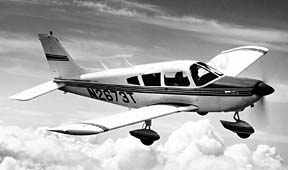
Big-engined four-place tricycle singles are an interesting – and small – class of airplane. Its almost always possible to go faster for less money and fuel, and often possible to get more utility than is afforded by sticking a bigger engine on a relatively small airframe. Nevertheless, muscular four-place singles have proven reasonably popular in the marketplace over the years; popular enough, at least, to support two significant entries. These are the Cessna 182 and Piper PA-28-235/236.
There’s another class of big-engined singles, exemplified by the Cessna 185 and Maule. They are more in the line of working bushplanes, however. The 182 and the Piper entry are more mainstream in their design.
The 182 has been, by any measure, a success. It features a good combination of utility, roominess and performance. The Piper entry, however, never quite matched the 182 in terms of popularity. Nevertheless it has a lot going for it: decent performance, simplicity, and common, proven components. If your needs include a big dose of horsepower coupled to a simple airframe, the biggest Cherokee is certainly a valid candidate.
History
Starting in the 1960s, Piper proved to be the absolute master of taking a single design and turning it into a bewildering variety of airplanes. The PA-28 Cherokee started life as a basic four-place, fixed-gear single with a 160-HP engine, positioned opposite the Cessna Skyhawk. Before all was said and done, the PA-28 had been mutated into everything from the lowly Cherokee 140 up to the Turbo Arrow IV.
The Cherokee 235 represented the top end of the fixed-gear PA-28 line, with a derated Lycoming O-540 engine mated to the basic Cherokee airframe. It was brought to market less than three years after the original Cherokee hit the scene. Aside from the engine, the only significant difference between the Cherokee 235 and its less-powerful siblings was an extra two feet of wingspan. The extended wingtips housed fuel tanks, boosting the total fuel capacity to 84 gallons.
The original 1964-65 model came equipped with a fixed-pitch two-bladed propeller mated to a 235-HP Lycoming O-540-B2B5 engine having a TBO of only 1200 hours. Plane spotters can identify this, along with the follow-on B model, by the presence of only two side windows. The B model also had an optional constant-speed propeller. It was produced from 1966-68. The 1968 model boasted an increased TBO of 2000 hours: the improvement was retrofittable, and by now there should be none of the 1200-hour engines left in service.
The 1969 C model boasted a third side window, new instrument panel and power controls. Few other significant changes were made for this, the D, E or F models. This first PA-28-235 series finished up in 1972, with the F.
The 235s second decade began with the 1973-74 Charger. It was still a PA-28, but with enough differences to be significant. For one thing, the constant-speed prop was made standard. The follow-on model dubbed Pathfinder was produced from 1975-1978. During the reign of these two models several alterations were made, the most notable being a five-inch fuselage stretch coupled with a 100-pound boost in takeoff weight and a corresponding a 59-pound increase in empty weight. There were other, minor alterations, like the provision of standard shoulder harnesses for the front seats, and a stall horn to replace the stall light.
The final variant, the PA-28-236 Dakota, was introduced in 1979. This airplane boasted the new semi-tapered wing planform that had first turned up on the Warrior in 1975. It was larger in a couple of critical dimensions, with another fuselage stretch of 7.5 inches and a span increase of 3.4 feet.
Also new was a different engine variant, the Lycoming O-540-J3A5D, still of 235 HP. It offered better fuel efficiency, less noise and vibration. It was also designed to use 100/130 avgas instead of 80 octane. The Dakota also had a new cowling and Pipers new-style wheel pants.
Along with the new wing came new ailerons and a new fuel system that decreased capacity from 84 to 77 gallons (73 usable). Despite the drop in fuel capacity, range didnt suffer as much as one might expect. This can be attributed to better engine efficiency and improved aerodynamics thanks to the long, semi-tapered wing.
By the time the Dakota came out, general aviation sales were beginning to drop dramatically. Few changes were made to the model, and production slowed to a trickle. The last produced came off the line in 1994.
Turbo
We did leave one Dakota out of the history detailed above. This is not a mistake, its intentional, because its really a different airplane: the PA-28-201T Turbo Dakota, with a turbocharged 200-HP Continental TSIO-360-FB powerplant. Aside from the questionable move of putting a significantly less powerful engine into an airplane that people buy because of horsepower, the execution left a great deal to be desired in the areas of induction, cooling and exhaust air flow.
The result was a bundle of mechanical trouble. The 201T has historically proven to be far less reliable than the more powerful, normally aspirated Dakotas, with trouble and accident rates four times higher than one would expect, based on the proportion of 201Ts in the population. (Its impossible to be precise, since FAA lumps all PA-28s together in the activity surveys.) An unusually large percentage of accidents, incidents and SDRs are directly related to the powerplant and accessories.
The non-Dakota Dakota was made for one year, 1979, and only 91 were built. Some of these were sold as 1980 models. Suffice it to say that everybody makes mistakes, and this was one of Pipers big ones. Oddly enough, some owners love them.
If you can find one that you just cant resist, be certain it has a solid-gold pedigree, with documented proof of meticulous maintenance before you consider purchasing it. Otherwise, run the other way. Fast.
Marketplace
The big PA-28 of choice is the PA-28-236 Dakota. The enhanced performance provided by the new wing makes a real difference, and its reflected in the prices they bring. According to a recent Aircraft Bluebook Price Digest, the earliest Dakota retails for $97,000, versus $72,000 for the last Pathfinder. As a side note, the Turbo Dakota goes for only $80,000, some $17,000 less than the same year real Dakota.
The Cessna 182 enjoys much higher prices in the marketplace. A 1979 model currently fetches some $106,000 versus the Dakotas $97,000. There are similar differentials between the Cherokee 235 and earlier 182s.
If youre in the market for a big Piper, wed opt for the nicest Dakota we could find. If money is more of an issue, there’s an interesting trade-off that can be made. As noted below, the pre-Charger and Pathfinder PA-28-235s actually perform better than the Charger/Pathfinder do, though not as we’ll as the Dakota. The trade-off comes in the extra useful load and interior space afforded by the Charger and Pathfinder. As noted above, its wise to avoid the Turbo Dakota unless youre very, very sure its right for you.
Handling
Most PA-28s handle about the same, and the 236/236 is no exception. There’s more difference between early Hershey-bar models and later, taper-wing versions than there is between the different models with the same wing. The Hershey-bar-equipped versions are quite stable in all but the most turbulent air (at which point they become very high workload if you want to fight rather than accommodate conditions). Many pilots term them truck-like. The taper-wing Dakota is more responsive and requires a lower level of effort.A well-known feature of PA-28 handling is also present in the 235/236, and is caused by the fact that the nose gear is not self-centering and is connected full-time to the rudder pedals. When the rudder is deflected in flight, the nose gear is, too. The effect is compounded with larger fairings and wheel pants. (Having trouble maintaining desired heading in cruise? See if you are inadvertently putting some pressure on one of the rudder pedals, or kick the pedals left and right to see if the nosewheel is centered.) There’s an obvious hazard if the pilot has the rudder deflected when the nose wheel touches down.
Its not really a problem, but something for new Piper pilots to remain aware of. Still, for all the years these characteristics have been known, the long-term damage caused by improper stress, and loss of control and gear collapse accidents occur with high frequency.
There is a particular handling quirk found in this biggest of Cherokees that you wont find in an airplane like the Warrior, however. That big engine weighs a lot, and it affects the way the airplane handles in the flare.
The 235 is an easy-flying airplane (and many owners praise its stability in IFR operations), but the greater weight of the engine/propeller combination out front-while contributing to a generous CG envelope-increases the tendency to under flare in landing and even during takeoff. Lightly loaded, the 235 can be difficult to flare properly during landing, especially if speed control is not good and airspeed is high and full flaps are used. The same trick that works so we’ll in PA-32s and PA-34s-using the first or, at most, second notch of flaps-helps the pilot to hold the nose gear off.
Performance
Unlike some airplanes, the performance of the early Cherokee 235s was better than that of the later models. This is due, in part, to the fact that many designs start out underpowered; not so the 235, which had plenty of horses from the outset.
Cruise speed, rate of climb, range, service ceiling and landing performance all decreased to some extent. One of the most notable performance losses was the comparably poor altitude performance of the Charger/Pathfinder, which can be attributed to the same engine hauling around more airplane. Even the official figures reflect this (late-model 235s with constant-speed props have a service ceiling of 16,500 feet. The Chargers official top is a dismal 12,000 feet, and even getting to 10,000 in the summer is a trial).
The new, longer wing on the Dakota brought much better performance to the design. The service ceiling went back up to a very respectable 17,900 feet, which assures adequate density-altitude performance and ability to cruise with relative efficiency at the middle altitudes (14,000-16,000 feet). Only takeoff ground run performance declines, compared to the Charger (886 to 850 feet), although performance to cross a 50-foot barrier improves (1,216 versus 1,410 feet).
Climb performance in the Dakota is also markedly improved, again because of the longer wing. These are the characteristics that attract people to big-engined singles – an airplane with a smaller engine simply cant hold its own in a hot-high-heavy situation the way a Dakota can. In its own way, the Dakota shows what aircraft development within a model line should be but rarely is: improved utility, improved performance.
The Dakotas wing also pays off in improved roll response, due to the taper and new aileron design.
Systems
There are a few things to be aware of about the PA-28-235/236s systems, some of which are potential problems for the uninitiated.
The brakes come in for routine castigation. Especially in the later models, pilots complain there is too little braking power available and that pedal feel is too spongy. This may be a perception rather than a fact. Brake power may be properly modulated to the airplanes performance and wheel and tire size. Too much brake power puts the expense elsewhere, in replacing flat-spotted tires.
The fuel system in earlier airplanes deserves mention as well. The original four-tank fuel supply requires constant attention to fuel management. Accidents continue to occur because of failure to switch tanks or because a tank with no fuel or low fuel is selected. This occurs despite the location of the fuel gauges and selector on the 235s in the center of the cockpit, below the engine controls. In the Dakota, the fuel system is simpler but the selector is in the usual out-of-sight, out-of-mind PA-28 position on the left side wall.
Another potential problem area is the pitot/static system design. With the pitot tube (or blade in this case) mounted on the bottom of the port wing, the system is very susceptible to water contamination and bug blockage. It is nearly impossible to inspect properly, and frequently the only indication is the lack of or clearly erratic indication of airspeed during the takeoff run.
Interior
In later models, with more seat adjustments in both the front and rear, and better attention to seat shape, the 235 is better than the average lightplane over long stage lengths. A number of owners have commented on seat design as a plus. We agree, and not only for comfort reasons. Piper is one of the only manufacturers to pay attention to crashworthiness of their seats: The S shaped seat frame deforms on impact, absorbing energy.