











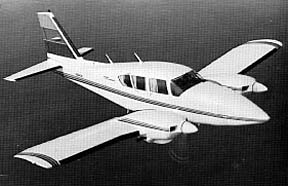
The PA-23 is one of those airplane designs that stayed in production so long that the final versions were almost unrecognizable derivations of the original. In this case, the original was small, all-metal, and underpowered to the point that single-engine operations can be extremely hazardous…just like other twins with small powerplants. The last versions, by contrast, are capable load-haulers with very good short-field performance.
History
The precursor of the PA-23 was the Twin Stinson, which not only had two engines (125-HP Lycomings) but two vertical tails, as well. The design originated at Consolidated Vultees Stinson Division, which was acquired by Piper Aircraft in 1948. This design formed the basis for the PA-23. Piper installed larger engines, changed to a single vertical fin and covered the airframe in metal, and the Apache was born, hitting the market in 1954. The PA-23 retained the steel-tube fuselage frame of the Twin Stinson, and had a fat, constant chord wing that helped its short-field performance, but not its speed.
The PA-23 was a notable departure for Piper. At the time of its introduction, the company was building only three other models, all tube-and-fabric singles: the Pacer, Tri-Pacer, and Super Cub. The Apache was the companys first twin, first all-metal airplane, and first to bear a Native American-inspired name. It was also something new in the marketplace-a light-light twin, economical to buy and operate. There was nothing else like it.
The original Apache had five seats, Lycoming O-320-A1A engines of 150 HP each, swinging two-bladed props. Maximum gross weight was 3500 pounds (to put this in perspective, its only 100 lbs. more than a V35 Bonanza and less than most of the big six-place singles), with a 1320-pound useful load. Top speed was 157 knots, with a recommended cruise of 148. Average equipped retail price was $36,235.
Three years later Piper put 160-HP versions of the O-320 on the airplane, and equipped it with full-feather props. The primary benefit of the change was a 300-pound boost in gross weight. Other specs remained much the same, though single-engine performance actually suffered quite a bit due to the higher allowable weight. Minor refinements a few years later increased the gear and flap speeds.
In 1960, Piper introduced the Aztec, basically a PA-23 airframe with 250-HP Lycoming O-540-A1B5 engines, a larger tail with stabilator, and a longer fuselage. Max gross weight was 4800 pounds, a far cry from the original Apache. The Aztec was sold side-by-side with the Apache, and hurt the lighter airplanes sales badly. In 1959, 368 Apaches were built. In 1960, only 141 Apaches rolled off the line, compared with 363 Aztecs. In 1961 Apache production had fallen to 28 airplanes.
In a questionable attempt to resurrect sales of the Apache, Piper hung low-compression, 80-octane versions of the O-540 on the Apache in 1962, calling it the Apache 235. It hung on through 1965, with a total production run of 114.
Also in 1962, Piper added a longer nose to the Aztec, housing a baggage compartment. This airplane, the Aztec B, came with six seats, a pop-out emergency exit window, and was available with optional fuel injection and AiResearch turbochargers.
In 1964 with the Aztec C fuel injection became standard, and there was another boost in gross weight, to 5200 pounds. 1966 saw the turbo option become a full-fledged model, with a standard oxygen system. During the run of the Aztec C the engine TBO went from 1200 to 2000 hours, a benefit retrofittable to the older engines with the installation of half-inch exhaust valves.
The D models had minor improvements, including a standard instrument arrangement. The E models, introduced in 1971, had another fuselage stretch and an even bigger nose with a larger baggage compartment and room for radar. The final refinement, the Aztec F, came out in 1976 with a one-piece windshield, square wingtips with optional aux tanks, and a revised stabilator. The stabilator proved troublesome, and was changed again in 1981.
The big changes in the PA-23 all happened in the early sixties; after the Aztec C, the alterations were mostly refinements. During its 26-year history, the PA-23 proved quite popular. All told, 2036 small-engined Apaches were built, of which maybe half remain. As noted, 114 Apache 235s were built, and approximately 5500 Aztecs were built.
Used market
The PA-23 can really be thought of as two different airplanes, the Apache and the Aztec. With such a variety of power, weight and age, a buyer can find a PA-23 to fit almost any budget. Original Apaches in average condition carry price tags around $30000, and its not hard to find one for much less.