











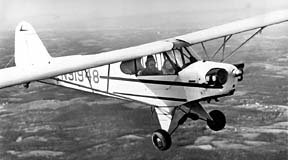
Although long since outclassed by generations of faster, sleeker airplanes, nothing quite symbolizes general aviation like a yellow Piper Cub.
To this day, the general public often thinks of all small airplanes as Piper Cubs, despite the fact that these airplanes are, in reality, a relative rarity at many big city airports. And if they are there, theyre likely hangared and kept pristine by owners who consider their J-3 a flying pride and joy.
The venerable Cub was the first airplane to bring general aviation to the masses and it continues to enjoy somewhat of a revival, as new pilots brought up on the mundane handling of nosewheel trainers discover the pure fun of stick-and-rudder flying in a ragwing airplane.
And lets face it, as older Yuppies mature into upper middle age, their bank accounts can easily finance a Saturday afternoon fun flyer in addition to the workaday traveling airplane. (And Cubs arent exactly cheap these days.)
Cub History
The first airplane to carry the Cub name wasnt a Piper at all but a Taylor E-2 model, powered by a Salmson radial engine. It was first rolled out in the early 1930s with moderate success in the market.Pipers version, the J-3, didnt appear until 1937 and was an offshoot of the Taylor design. By modern standards, the first J-3 wasnt much more than an ultralight, although it had the same tube and rag construction carried through to every Cub ever made.
The 1937 J-3 was powered by a tiny 40 HP Continental A-40 and had a fuel capacity of nine gallons. The following year, Piper offered a 50 HP Continental as an option and a year later, in 1939, a steerable tailwheel and a 12-gallon fuel tank became standard. At that point, the 50 HP Franklin engine appeared as an option, in addition to an engine of similar horsepower made by Lycoming, whose plant was eventually just down the road a few miles in Williamsport, Pennsylvania.
Incredibly, more than 1300 J-3s were sold in 1939, despite the fact the Great Depression still hadnt been sent packing by the outbreak of World War II. (Interestingly, thats about the same number of GA airplanes as were sold in 1998.)
With war on the horizon, 1940 saw the evolution of the J-3 into the classic form in which most models survive today, with a Continental 65 HP up front and, in fewer cases, the Lycoming or Franklin variants. Most had wood props, although those converted to Continental 85s-and many have been converted to metal props.
Piper continued to pour Cubs out of its factory through 1941, until the Pearl Harbor attack sent the J-3 into uniform. Piper met the challenge for military aircraft, building some 5000 L-4 versions of the J-3, slightly modified with olive drab paint jobs (no more yellow), electrical systems and heaters, the barest of creature comforts for an airplane known for its Spartan appointments.
A Piper publication from the early days of World War II trumpeted the L-4s patriotic versatility thusly: There is no reason why Piper L-4s couldnt set down American Commandos behind enemy lines. And, when the boys completed their missions of destruction, these planes could get them back with speed and comparative safety.
Piper even claimed the L-4 could carry light bombs. Whether that ever happened, were not sure, but the L-4 did earn its stripes carrying artillery observers, couriers and, from time to time, a general or two.
Thanks to its wartime production level, Piper was ready when the war ended in 1945 and transitioned quickly into building airplanes for thousands of returning military pilots. The year after the war ended, an astounding 6320 Cubs were built, with production reaching 50 a day at one point, or one every 10 minutes.
But as a harbinger of things to come, that couldnt last. The market collapsed in 1947 and production plummeted to 720 Cubs; respectable by modern standards but considered a bust in the heady days of late 1940s. In 1948, the J-3 was supplanted by PA-11, which had a larger engine, a bigger cockpit and a full cowling. But by the end of its production run, 14,125 J-3s had been built and many fly yet today.
Prices
Looking at what J-3s sold for when new, some of those old military jocks probably slap their foreheads in regret for not picking up a couple of dozen. In its heyday, the Cub sold new for $1595; the price of a high-end portable GPS now.
Even through the 1970s, Cubs were quite a bargain, averaging about $2500 or so. Since then, however, theyve gone nowhere but up. The price of a good Cub began inching upward in the late 1970s and today, a pristine will command as much as $24,000. Price increases have been steep during the past five years, probably due to strong demand.
A newly restored showpiece with a zero-time engine and original equipment and instruments can bring $35,000 or more. Even a barely flyable hangar queen will bring a nice piece of change. A recent issue of Trade-A-Plane showed J-3 without engine or prop for $18,000 and one basket-case restoration project for nearly $10,000.
Value wise, for what a Cub can do, these arent especially good deals. Consider that a Taylorcraft of a much newer vintage-say mid-1970s-sells for $10,000 less and an Aeronca Champion (circa late 40s) for $4000 to $5000 less. Ah, but we arent buying a Cub for what it can do but what it is. A classic with undeniable ramp appeal that the others lack.
Only the Cub can attract the really top dollar, one rebuilder told us. It has that cachet. Clearly, the Cub has an appeal that transcends its objective characteristics.
Does that mean that its a good investment airplane? Yes and no. No because in the context of 1990s investment returns, airplanes remain dark cash sinks.
However, the J-3 is a little brighter than most. In a recent Aviation Consumer study of appreciation rates, ragwing classics-specifically the Aeronca and Cub-lead the league in overall appreciation.
That means if you play your cards right, you can buy a good one and sell it for a bit more than you paid or at least break even. This doesnt apply to restoration jobs, however.
Power Plants
Although the Continental 65 was the standard Cub engine, many have been refurbished with 75-, 85- and 90 HP Continentals. There’s little difference between the 65 and 75-HP models, but the 85s and 90s provide extra climb rate, especially for high-attitude or float operations, where the Cub may otherwise be a marginal performer.
The larger engines may raise a Cubs value by $500 to $1,000. But the 65 HP engine is perfectly adequate for most Cub flying and is preferred for ultra-original restorations in which any variation from original configuration is considered a drawback. But don’t expect exceptional performance from the 65s.
The Lycoming and Franklin 65s are somewhat rare these days and carry a price penalty of $2000. The Lycoming actually puts out something like 50 to 55 HP (with less fuel consumption), while the Franklin suffers from a parts scarcity. Franklin engines are supposedly coming back into current manufacture but we don’t know how or if the 65s will be impacted.
Performance
Speed is relative, of course, and the Cub isn’t relatively slow. Its very slow. Typical cruise speed is about 70 MPH with the 65 HP and 75 HP engines while those sporting the 85 horse motors can streak along at 80 MPH. Then again, Cubs arent cross -country airplanes.
With only 12 gallons aboard, they arent continent spanners, either. Or even state spanners, for that matter. Practical unrefuled range is about 150 miles, after which you’ll want to get out a stretch anyway. An Aviation Consumer editor once flew a Cub coast-to-coast in nine days, with 42 stops for gas.
One leg was 32 miles, because the next airport was 110 miles away and headwinds kept groundspeed below 50 MPH. Thats the way it works with old ragwings.
The Cub comes into its own not in long-distance cruising but in operations off country airports with grass runways. At light weights, the Cub is an excellent short-field performer, particularly with the 85- and 90-HP engines. The fat wing delivers stall speeds somewhere around 40 MPH range.
Into a nice breeze, a lightly loaded Cub can leap into the air within a few airplane lengths. But watch it if the airplane is heavy and there’s no wind on a hot day.
The airplane will still lift off in a short distance, but climbs over nearby obstacles can be sporty, given the airplanes high drag and lack of surplus thrust.
Stick and Rudder
The Cub has a reputation as a docile, easy-to-handle airplane that just anyone can fly. Its considered a big teddy bear, ever forgiving of ham-fisted pilots.
The reality is somewhat harsher. On the runway, the Cub can be a ditch lover and like any other taildragger, it will groundloop if given the chance, although its considered one of the better handling taildraggers. For pilots used to toe brakes, the Cubs heel brakes are weak and awkward and many a pilot has gotten to them a split second too late to stop a groundloop. Some models have been fitted with more aggressive Cleveland brakes but stomp on these with abandon and you dump the little Cubbie on its nose.
In everyday flying, the Cub has very sluggish ailerons that, like most older aircraft, require a good deal of rudder coordination to counteract adverse yaw. Even a mild turn will require a goodly stab at the rudder, something most pilots trained on nosegear airplanes have to learn.
With the drag of a tapered anvil, the Cub will stall and spin easily compared to later training aircraft such as the Cherokee 140. But conventional anti-spin control inputs will recover it easily, making the Cub a first-rate spin trainer. That said, however, the Cub has a very high stall/spin fatality rate, probably because it invites pilots to horse around at low altitude, where recovery is unlikely.
The soft bungee cord suspension absorbs bounces we’ll and the big rudder gives excellent directional control. From the coddled nosewheel pilots perspective, however, the Cub can be humbling to land, requiring deft footwork to maintain directional stability, especially in all but the lightest crosswinds.
The placement of the main wheels ahead of the center of gravity also means that a less-than-gentle touchdown can result in a huge ballooning bounce. To a nosewheel pilot, the phrase flies like a Cub must seem puzzling; the Cherokee 140 is a cinch to land by comparison.
Another Cub handling foible is its light wing loading, which makes it a kite in gusty conditions. Throw in the low landing speed, and a 15-knot crosswind can present a major challenge. New Cub owners are we’ll advised to seek competent instruction before soloing. (The insurance company will probably insist on it.)
Creature Comforts? None
The word ergonomics evidently hadnt been invented when the Cub was designed. Or maybe people were just tougher and a lot smaller in the 1930s. The cockpit is absurdly small for anyone taller than 5-feet 10 inches or so.