











uyers of light sport airplanes say they want cheap, basic models, but when the check is to be written, what they really buy are upscale airframes with glass panels and whatever creature comforts can be gotten into the airplane. Thats why the top LSA sellers arent the lowest priced models, but nearer the highest. The Paradise P1 fits this mold, more or less living up to what the companys sales manager, Chris Regis, calls the Lexus of LSAs. Hes not far off the mark, given the airplanes detailing, price point and the degree to which you can customize the panel. But we would make another comparison: Its a modern Cessna 150. we’ll get to why in a moment.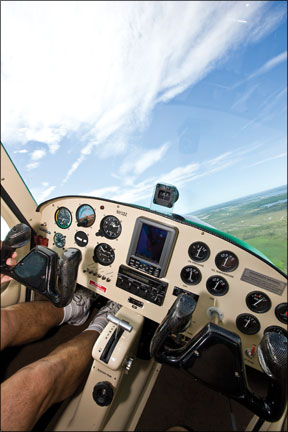
Brazilian Roots
Like the majority of current LSAs, the P1 is an import, but from south of the border, not Europe. The airplane emerges from Brazils lively aircraft market and was designed before the ASTM light sport rules were put in place. It was conceived originally intended as a small, inexpensive utility airplane for the Brazilian outback. It first flew in 1999 and more than 130 are flying in Brazil.
In the world of LSAs, this makes it an odd duck: It was originally designed with a maximum gross weight of 1650 pounds, so it theoretically has a useful load of about 800 pounds. Since the LSA limit is 1320 pounds, its real useful load is about the same as everything else, around 500 pounds, depending on equipment.
But at the higher weight in its original form, it has the weight and rough size of a Cessna 150. (The wingspan is 31 feet, compared to the 150s 33 feet and its about 3 feet shorter than the Cessna.) But the P1 kills the Cessna in overall performance, cruising at 110 to 115 knots and out climbing the 150 by a couple of hundred feet a minute. That puts it in the same league as many of the other LSAs-faster than some, slower than others. But what it gives up in speed, it makes up in range. The P1 sports a prodigious 38 gallons of gas capacity, giving it seven hours of endurance, depending on engine choice and power setting. Even if you don’t plan long cross countries in an LSA-and many owners don’t-this gives you the option of either tankering cheap fuel where you find it, or just not having