











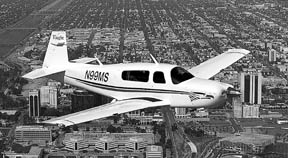
Is it about to get ugly out there?
Were talking about competition in the four-place, high-performance single-engine market, which has essentially been owned by Mooney for most of the last decade.
With Beechcraft concentrating on six-placers, Cessna in hibernation until recently, Piper mostly building Malibus and Saratogas, Commander dribbling out airframes at boutique production rates and the French being, well, French with the Socata line, Mooney has continued to dominate in the U.S., building right around 100 airframes a year, give or take.
Now that both Cirrus and Lancair are poised to enter the four-place market with what will pass as moderately priced high-performance airframes, Mooney may soon see the stiffest competition it has had since the mid-1980s. And there isn’t a marketing suit walking who can predict if Cirrus and Lancair will expand the market, boldly going where no airplane companies have gone before, or steal from the status quo.
Even if its a little of each, thats not good news for Mooney, whose durable but high-cost airframes have been steady if not spectacular sellers. Over the years, Mooney has occasionally shot itself in the foot with baffling business decisions, not the least of which was taking on what the company now says was near ruinously unprofitable outside contract work.
Yet except for a brief production hiatus in the 1970s, the company has always survived by retooling and advancing something new into the market. The latest version of this periodic re-invention is the Mooney M20S Eagle, the companys new entry-level airplane and, in our view, the product designed to blunt the assault from Cirrus and Lancair.
Son Of Ovation
Give Mooney credit for one thing: The grass doesnt grow under the certification team in Kerrville. Even though the Eagle is a mere engine tweak of the Ovation, Mooney jollied it through the certification process in just a few months. When we visited Kerrville in mid-January, the type certificate was having its Is and Ts tended to but was essentially complete. When we first heard of the Eagle project at Oshkosh last year, our impression was that it would be a stripped down Ovation. To a certain extent, thats true, except that its not that stripped down.
At $319,000, the Eagle emerges fully IFR equipped, with GPS and autopilot, but a single navcom and no Stormscope. Add those latter must-have items and the invoice will top $335,000.
The Eagle springs from the very same long-body fuselage used in the Ovation and the Bravo/TLS, thus the factory is now turning out essentially one airframe but with different accessories and engines to fill out the three models: Eagle, Ovation and Bravo. The short body J-model (201/MSE/Allegro) and K-model (231/252/Encore) were discontinued after a long but recently unprofitable run as the workhorse airframes.
Mooneys idea is that by de-tuning the Ovations Continental IO-550 G, offering a less grandiose avionics package and scaling back the fuel and payload a bit-but not the speed-it can establish price point differentiation and offer an entry-level airplane that still cruises with the big dogs.
If this sounds like pulling the rabbit out of the hat, it is and, to a degree, Mooney has. The Eagle cruises with the Ovation, shy just a handful of knots, so its in the same basic performance range. Will that price-point thing work in the market? we’ll see.
Which brings to mind the obvious question: What was wrong with the venerable J-model as an entry-level airplane? At 155 to 160 knots, its no slouch and has consistently sold nearly as we’ll as the Ovation and better than the Bravo/TLS. But Mooney President Chris Dopp told us the model had reached the end of its marketable life. Even at prices approaching $300,000, which recent J-models have, the airplane was unprofitable and without the realistic option of squeezing out more speed or payload or adding de-icing or air conditioning, the company saw it as a dead-end product.
The Eagle, on the other hand, goes faster than the J-model, but has similar range and payload profiles. Actually, by dint of its higher speed, the Eagle enjoys a slight potential range margin and, with the longer cabin, promises to be more comfortable.
Mooney sees the Eagle as a platform airframe, suitable for upgrading with niceties such as leather upholstery, advanced avionics and de-icing. Because of this upgradeability, Dopp predicts the Eagle will have greater value to potential entry-level buyers than the J-model ever could.
What Its Got
Well bottom line it for you: The Eagle has the very same IO-550 G found in the Ovation, but de-tuned to 244 horsepower by dint of limiting RPM to 2400 strictly via a prop governor adjustment. The Ovation sports 280 HP at 2500 RPM, which is itself a de-rate from the engines 300 HP maximum.
In place of the Ovations three-blade McCauley prop, the Eagle has a two-blade McCauley with a noticeably fatter and more constant chord than the typical two-blader.
This prop was developed specifically for the Eagle and Mooneys chief Engineer Tom Bowen tells us its responsible for about a 6 percent efficiency gain, which, in part, explains why the Eagle is but a shade slower than the Ovation.
Otherwise, the engine and systems are identical. The Eagle carries 75 gallons of fuel, the Ovation has 89 gallons. Both have dual 10-amp batteries and a 100-amp alternator. Overall sizes-interior and exterior-are identical, but the Ovations gross weight is 3368 pounds while the Eagle tops at 3200 pounds. Since the empty weights are nearly identical-really, were talking about the same airplane here-the Ovations gross weight advantage is exactly one FAA person.
Typically, the Eagle will have about 980 pounds of useful load, meaning with full fuel, it will just carry three people but little or no bags; about the same as the J-model. By comparison, the Ovations useful load averages between 1025 and 1100 pounds or 500 to 575 pounds of payload with topped off tanks. Best case, thats three people and modest baggage.
With the cabin full of people and bags in either of these airplanes, youre not going far without stopping. In the Ovation, youd have room for 45 to 55 gallons of fuel or about 500 miles of still-air range. In the Eagle, its more like 30 gallons for a range of barely 400 miles and not much reserve at that.
According to Mooneys preliminary marketing boilerplate, the Eagles max cruise is 175 knots versus 188 knots for the Ovation but based on flying both, our guess is that real-world cruise numbers will be a bit closer, on the order of a 5 to 7 knot spread. (The horsepower delta is only 36, which seems more likely to show up as increased climb than a huge cruise gain, especially given the Eagles purpose-designed cruise prop.)
Panel, Accessories
Obviously, you cant expect a $319,000 airplane to have the same accessories and avionics as one costing $80,000 more and the Eagle doesnt. Originally, it was supposed to have a turn-key avionics package from Terra/Trimble but now that Trimble has bailed out of the GA market, Mooney has reverted to a basic Bendix/King package consisting of a KX 155A navcom, KT76C transponder, KLN 89B IFR GPS and a PS Engineering PMA 7000 audio panel. The autopilot is an S-TEC System 30, two-axis, with altitude hold.
If that seems chintzy in a $319,000 airplane, we didnt find it so, although two items the airplane definitely needs are a Stormscope and a second navcom, which will add $15,500 to the basic $319,000 invoice price.
Rick Pitner, Mooneys new marketing director, told us one standard option might be even-up swapping of the navcom and KLN 89B for a single Garmin GNS 430 color mapcom. (That would be our preference.)
In flying the Eagle, we thought this sparse panel had an advantage over other new airplanes weve flown. Its simpler and more integrated; there are enough boxes to do the job without an overwhelming wall of switches and displays. The right side panel is blessedly free of buttons and displays.
We were particularly impressed with the S-TEC System 30, a terrific autopilot whose control head is contained in the turn coordinator; no separate annunciator panel. It does require manual trimming via a prompting light but one button engages it and it has either nav or heading mode plus altitude hold. Sweet, simple and inexpensive.
An Ovation owner will immediately notice where Mooney shaved costs by eliminating other accessories. Speed brakes arent standard on the Eagle; they are on the Ovation. Were not sure theyre a must have, but theyll cost $6800 extra if you want them.
The overhead cabin lighting is limited to the pilots side and there’s only one sun visor, also on the pilots side. The Ovation has leather-wrapped yokes, the Eagle doesnt. Rudder trim-a nice leg reliever-is standard in the Ovation but not available in the Eagle. (We could get by without it.)
Basic panel and exterior lighting are similar, but the Eagle lacks the Ovations standard recognition lighting and rotating beacon, which cant be had on the Eagle.
On the plus side, the Eagle and Mooneys other models will be equipped with Moritz Analog/Digital engine instrumentation of the sort Piper has been using for awhile.
We have mixed feelings about this. In our view, the gauges are a tad too large and out of scale with the Mooneys relatively small panel. Further, they stand 1/4-inch or so proud of the panel surface, rather than being flush, as the previous instrumentation was.
The fuel gauges are digital only (plus sight gauges in the tanks, visible from the cockpit) and we much prefer analog for the gas. We suspect a pilot would get used to these quirks but on first blush, we found the gauges somewhat off-putting.
The panel does have a redesigned annunciator group and a master warning light, which are improvements over the previous design.
Flight Trial
We took a few turns around the Kerrville area to gain some sense of the Eagles mettle. Yup, it looks like an Ovation, smells like an Ovation-except perhaps for the lack of leather-and flies like an Ovation.
Pitner explained that with the two-blade prop instead of the three-blade, there’s 16 fewer pounds forward, thus the ballast aft has been reduced by a like amount.
Theoretically, reducing the polar moment ought to lighten the perceived pitch loads but we cant say we noticed. The Ovation takes a little tug to get airborne and so does the Eagle. In flight, the pitch forces seem comparable to the Ovation.
One thing is immediately noticeable on climbout: The two blade prop is not nearly as smooth as the Ovations three-blade, at least in the demonstrator we flew. There’s a noticeable vibe in the floorboards-not a rattle-your-teeth-blur-the-instruments Lycoming buzz, but not the engine-over-the-horizon smoothness of the typical IO-550, either.
Mooney chief engineer Tom Bowen told us this will probably be correctable with careful prop balancing but ultimately, we suspect the three-blade will still be perceptively smoother.
Preliminary specs call for a max sea-level climb rate of 1050 FPM at gross weight and we have no doubt the Eagle will easily do that. At a weight 300 pounds below gross, we noted brisk initial climbs in the 1200-foot range and could easily maintain 900 to 1000 FPM at 110 knots, providing plenty of visibility over the nose. With the extra horsepower, the Ovations posted climb rate is 1200 FPM.
The Eagle has the Ovations rakish cowl with no cowl flaps, making for one less thing to fuss with when leveling out of the climb. The Ovation doesnt have an overtemp problem and neither does the Eagle; CHTs remain middle-of-the-green through all flight regimes, including a high-pitch climb. (If anything, early Ovations ran a little too cool, requiring a redesigned oil cooler.) Kudos to Mooney for paying attention to cowl design, baffling and cooling drag, a trend we applaud.