











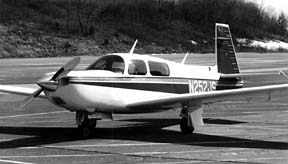
Mooneys have always been associated with efficient cross-country transportation. Speed is the priority, and Mooney owners tend to view utility in terms of getting from Point A to Point B ASAP rather than load lifting or roomy accommodations.
Non-turbo cross-country usefulness is hampered, however, by an inability to get up high and avoid some of the weather, and the only way to do that is with turbocharging. Get a slick airframe like the Mooney up in the flight levels, and it can really show its stuff.
It wasnt until fairly late in the game that Mooney offered a viable turbocharged airplane. That aircraft, the M20K, overcame some initial teething troubles to evolve into the 252TSE, which some regard as the best Mooney ever made; as one owner has put it, maximum speed for minimum money.
History
Cessna tapped the high-altitude market first, with the successful T210 in 1966. Mooney tried to address the demand the following year with the M22 Mustang, a big, 310-HP pressurized single that never caught on with buyers. It was axed in 1970. By the late 1970s, the Mooney line was showing its age. Stiff competition was coming from the other manufacturers in the form of updated designs, and Mooney was scrambling to keep up. Mooney was doing small things like updating instrument panels and making a big deal out of its new throttle quadrant, but Piper was doing big things like putting new wings on the PA-28.
Mooneys big breakthrough came in 1977, when the M20J 201 was introduced. The result of a significant Roy LoPresti-led aerodynamic cleanup of the venerable, but virtuous, M20 airframe, the M20J (aka 201, for its speed in MPH), the airplane marked a major turning point for Mooney. It remains a classic.
The 201 proved very successful, with more than 750 being built in its first two years; more than four and a half times the sales of the previous two years. Clearly, Mooney was back with a winner on its hands.
But it didnt win the war. Mooney still had no turbocharged airplane. Cessna was still turning out T210s, but they were much larger airplanes aimed at a different market. In 1977, though, Piper came out with a turbocharged Arrow and created a real threat. Mooney had to deliver a high-altitude ship or risk loss of market share.
The result appeared in 1979 as the first follow-on to the 201. Dubbed 231 (again, for its top speed), the 231 carried the official designation M20K. It was, essentially, a 201 with a six-cylinder, 210-HP Continental TSIO-360-GB hung out front in place of the 201s 200-HP, four-cylinder Lycoming IO-360. Far less ambitious a project than the Mustang of a decade earlier, it also had far greater potential.
The 201s good reception, combined with the appealing idea of being able to fly high in one, was a powerful draw. Mooney sold 246 the first year; not nearly up to the pace of the Turbo Arrow III, but not bad for the smaller company. Pent-up demand for the 231 was so great that it outsold the 201 nearly two to one in that first year; helped, no doubt, by the fact that the price was only about $5,000 higher.
Differences between the 231 and 201 are few; the cowl is longer and there are some minor aerodynamic refinements. The fuel capacity is eight gallons greater and both gross and empty weights are 160 pounds higher. Design-wise, the 231 was exactly what the buyers were looking for: a turbo 201.
Unfortunately, there were problems with the engine installation that soon hurt the 231s reputation. The problems stemmed from several factors: The new cowling wasnt cooling the engine adequately; the fixed-wastegate turbo required constant attention, was easy to mismanage, put undue stress on the engine and was prone to cracking after less than 1000 hours; the connecting rods were prone to failure; the original magnetos were unpressurized and unreliable; and the cylinders tended to display a variety of problems caused by poor cooling and turbo distress. On top of that, the TBO of the first engines was only 1400 hours (later upped to 1800).
Obsessive attention to operating technique and maintenance could easily avoid these problems, but out in the real world they were proving to be a real headache for owners. Similar problems were affecting the owners of Turbo Arrows, which had a different variant of the Continental TSIO-360. Basically, as good an idea as a turboed single is, the stresses placed on the engine by operating practices and environment make it far more prone to failure than its normally aspirated counterpart.
As word of the engines problems got around, sales started to fall off. Mooney responded in 1982 and 1984 with some fixes and improvements. In 1982, the entire line-M20Ks includes-got the split rear cargo seat while in 1984, a new variant of the engine (the -LB1B, which is approved as a replacement for the -GB) with better cooling and overboost protection was introduced.
Mooney also added some aerodynamic tweaks that added 3 to 5 knots: sealed nose gear doors, a belly pan, a more streamlined tailcone, and removal of one of the vent intakes. There was also an improved alternate air intake system, to address reports of icing-induced power loss.
The fixes helped, but Mooney decided to completely revamp the M20K for the 1986 model year. The changes were significant enough that the airplane got a new name: 252TSE (for Turbo Special Edition). Aside from the higher top speed justifying the new model name, its possible that Mooney was trying to get as far away as possible from the 231s initial bad reputation. The 252, while still an M20K through and through, is significantly different from the 231. Another variant of the engine was fitted, the -MB1. The induction and cooling systems were completely reworked, and a new intercooled, density-controlled, variable wastegate AiResearch turbocharger replaced the original, fixed wastegate Rajay/Rotomaster unit and a tuned induction system.
Other changes included an infinitely adjustable electric cowl flap to replace the original dual, three-position manual flaps. There was a vernier throttle control, a little more elbow room, and new-look radiused windows.
The 231s original 60-amp, 14 volt electrical system was upgraded to a 70-amp, 28 volt system. This was a welcome change, since a fully tricked-out 231 could really push the limits of its electrics. In addition, a dual alternator system was made available and a load meter was added to the panel. An electrically driven backup vacuum pump was made standard equipment.
The 252 also got further aerodynamic tweaking in the form of gear doors that fully enclose the wheels when retracted, and cover the wells when the gear is extended. The 252 also got an increase in gear-extension speed to 140 KIAS, up from 132. Maximum speed with gear extended is 165 knots.
In all, 889 231s were produced between its introduction in 1979 and 1985. The 252, introduced in the middle of the GA slump of the 1980s, is somewhat rarer: production totaled, ironically, 231 by the time it was discontinued. The follow-on airplane, the more powerful M20M TLS, was introduced in 1989 and proved popular enough that the 252 was discontinued after the 1990 model year. Its a real shame, because the 252 was, in a way, the epitome of what makes Mooneys so attractive to so many: maximum performance on minimum power and fuel. The TLS is a fine airplane, but it gets its performance in large part from its far larger (and thirstier… and more expensive to overhaul) engine.
Performance
The only other directly competing, commonly available airplanes (four-place turbo retractable) are the Piper Turbo Arrow and Cessna Turbo Skylane RG. Of those two, comparisons to the Arrow are more fair, since it has essentially the same engine. The Cessna has a Lycoming 540 under the cowl, and enjoys a 25-HP advantage over the M20K. In terms of get up and go, the M20K leaves both of them in the dust in every category.
At cruise, the 231 outstrips both of its competitors by roughly 20 knots, despite the fact that the 231-MPH top speed is not really reachable under real-world conditions. Realistic max cruise is about 220 MPH (191 knots). The 252 is about ten knots faster. Both M20Ks win the altitude battle as well, with a maximum operating altitude of 24,000 feet for the 231 and 28,000 for the 252, versus 20,000 for the Cessna and Piper. The Mooneys also outclimb the others by about 150 FPM. These performance figures are impressive, and right up there with the 300-HP Turbo 210. However, in actual use, nobody flies 231s at those speeds and altitudes while the 252 will comfort ably cruise at 22,000 to 24,000 feet. At the lower altitudes, turbocharged airplanes arent that much faster than their normally aspirated siblings: The 231 is only a bit faster than a 201 at these altitudes, and is actually slower below 8,000 feet, due to its draggier cooling system.
At altitude, the 252s cruise performance is competitive with most turbocharged twins (except in fuel consumption, which the book lists as 12.7 GPH at maximum cruise power and which most owners say is 13.5 GPH or lower). It is the hands-down winner in fuel efficiency.
Most owners operate a 252 a bit more conservatively. For instance, one says that 65 percent power results in speed averages of 170 knots at 10,000 feet and 200 at FL210, burning 11.5 GPH. Another says that the book fuel burn yields speeds of 210 to 215 knots at and above FL240; and another, a bit more conservative on altitude, averages 175 knots at 6000 feet or below and 185 at 12,000 feet. The 231s numbers are proportionately lower at high altitudes, though the difference lessens the lower one goes.
With 75.6 gallons of usable fuel, the 252 can climb to FL280 and operate a total of 4.9 hours, or just under 990 nautical miles still air range, with legal 45 minute IFR reserve. The 231 has comparable range and endurance, but cannot fly as high.
231/252 differences
The improved powerplant installation makes for a significant operational difference between the 231 and 252. The engine still produces 210 HP, but it does so at a markedly lower manifold pressure: 36 inches for the 252 versus 40 inches for the 231, thanks to the improvements in the tunded induction, cooling and turbo systems.