











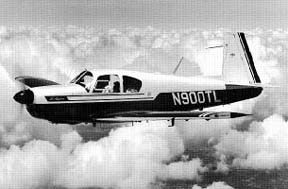
The Mooney M20 is a remarkable airplane, if for no other reason than its enduring popularity. Introduced in 1955, its still being manufactured, albeit in a rather different form than the original. While the newest Mooneys are a far cry from the original wood and metal hybrids, certain aspects of the design and construction have remained constant over the past 43 years. Among these are the distinctive backwards tail (no, it doesnt sweep forward: its vertical), all-moving empennage trim system, steel-tube cabin frame, rubber donut shock absorbers on the trailing-link gear, steel-tube cabin frame, slick skins with lots of flush rivets, pushrod control systems, and so on.
In fact, the earliest all-metal Mooneys (the M20Bs, introduced in 1961) are remarkably similar to those rolling off the production line today-considering the age of the design, that is.
History
While the name Mooney and the M20 design are virtually synonymous, there have been other Mooneys in the past. Predating the M20 was the Mite, a tiny single-place machine sporting that trademark tail design and sharing the wooden wing and tail construction of the first M20s.
In the 60s, Mooney even bought the rights to the Ercoupe, giving it a single vertical fin and conventional control systems, and renaming it the Cadet. Needless to say, that experiment did not succeed in the marketplace. There was also an attempt to create a pressurized Mooney, a big machine called the M22 Mustang that was the first pressurized single. That, too, passed quietly from the scene in short order. (Owning one must be a maintenance adventure: its rare Lycoming TIO-541-A1A is reputed to cost $35,000 to overhaul, and it has a TBO of only 1300 hours.)
But the M20 has been a perennial favorite. Like other popular airplanes (the Skyhawk, for example), the machine was so we’ll matched to its mission that its design has remained largely unchanged over the years. Most alterations from year to year were more in the nature of refinements. As the ownership of the design has been passed around from company to company, so too has the name been altered. The resultant bewildering variety of names is so confusing that most simply refer to these airplanes by their type certificate designations (M20A, -B, -C and so forth).
The biggest single change in the line came in 1977, when the hugely popular 201 (M20J) came out. The result of an aerodynamic cleanup campaign headed by design whiz Roy LoPresti, the M20J has been known as the 201, 205, 205SE, 201 Lean Machine, AT, and MSE (see what we mean about names?). The M20J and later Mooneys are different enough from the earlier machines that its introduction serves as a convenient marker to divide the Mooneys into two groups-those before the 201, and those after. Here, we’ll discuss only the earlier group. we’ll take it by the numbers:
M20 and M20A (Mark 20) – The first Mooney had a 150 HP Lycoming, constant-speed prop, and both wooden wing and tail. It was produced for two years. The M20A came out in 1958, sporting a metal tail and 180 HP Lycoming O-360-A1A engine, but retaining the wooden wing of the original. These two airplanes are less expensive than later Mooneys, and for good reason: the wooden components make them something to avoid. These airplanes racked up a frightening in-flight breakup record (the worst of any small airplane), and there are costly ADs calling for inspections of the wings and tail. Then, of course, there’s the problem of finding a mechanic whos intimately familiar with wooden construction and the problems it poses.
M20B (Mark 21) – Introduced in 1961, the M20B lasted only one year. It shared the 180 HP engine of the M20A, but was all-metal. Its wing, largely unchanged, and the design is still in production on new Mooneys.
M20C (Mark 21, Ranger) – The year 1962 brought the M20C, with a different variant of the Lycoming O-360 and a boost in gross weight. This airplane is the most common of the pre-201 Mooneys, and remained in production right up until the 201 killed it.
M20D (Master) – The M20D Master was an attempt to make a more economical airplane by fitting a fixed gear onto the M20C. It bombed, and most were converted to retractables. This variant was produced in 1963 and 64.
M20E (Super 21, Chaparral) – The year 1964 also saw the introduction of the M20E Super 21, with a 200 HP fuel-injected Lycoming up front. Except for the extra 20 horses, it was much the same as the M20C.
M20F (Executive) – In 1967 the first notable airframe change came along. Twelve years of production had made it plain that pilots found the Mooneys quite cramped, particularly in the rear. The M20F Executive was an answer to those complaints, sporting a stretch of 10 inches. It was otherwise the same as the M20E. It proved so popular that the M20E was discontinued for a time in its favor, only to return a year later. The longer fuselage used on the M20F and M20G is marked by a third side window.
M20G (Statesman) – In 1968 the M20G Statesman, with the smaller powerplant of the M20C but the larger fuselage of the -F, completed the lineup. The -G wasnt nearly as popular as the more powerful -F, and was dropped after the 1970 model year.
So, to summarize: There were two sizes of fuselage, short (M20 through M20E) and long (M20F Executive and M20G Statesman), with varying powerplants ranging from 150 to 200 HP.
For most of the pre-201 production run, the M20C (ultimately called the Ranger), -E (dubbed the Chaparral), and -F Executive made up the largest part of the Mooney fleet. About 4000 pre-201 Mooneys were built. In all that time, only four engines were used: the 150 HP Lycoming O-320-A (original M20) 180 HP Lycoming O-360-A1A (M20A and -B), the O-360-A1D and the 200 HP Lycoming IO-360-A1A.
While the design stayed fairly uniform over the 20-odd years of pre-201 production, the company changed hands several times. The original Mooney Aircraft Corporation was dragged down by the disastrous M22 Mustang program in 1968, and it was purchased by American Electronics Corp. It promptly sold the line again in 1969, to Butler Aviation, just in time for an economic downturn that killed production entirely in 1971. In 1974, Republic Steel bought the line and held on to it until 1984, when it was purchased by the French, who still own the company.
Construction
Mooneys are structurally unusual in a number of ways. First and foremost, unlike Brand B, C, G or P airplanes, Mooneys have a combination of steel-tube and aluminum monocoque construction in the fuselage. Combined with the wood and fabric found on the earliest M20s, one could say that these are truly composite airplanes! The steel-tube fuselage is a good feature, we feel, because of the structural strength it adds to the cabin. It is, in effect, a roll cage that surrounds the occupants, contributing to crashworthiness.
The steel frame is also a source of trouble, however. It has proven prone to corrosion in the past, and Mooney went after the problem with a vengeance several years ago. The inspection called for by the factory never made it to AD status, but most airplanes should have had it done by now. Be sure to check the logs. Older airplanes seem less troublesome, at least in part because of the lack of moisture-trapping insulation in contact with the tubes. Be careful of the Butler and American Electronics airplanes, though; both of those companies embarked on cost-cutting programs, which in part included less rustproofing.
An annoying aspect of the tubes is the effect they can have on the airplanes magnetic compass. Our own M20J had a seemingly endless stream of mag compass troubles, which were attributed to its being mounted on a steel tube.
Another unusual aspect of the design is the trim mechanism. Rather than using a servo tab, springs, bungees or some other method of deflecting the elevator, Mooneys have a jackscrew in the tailcone that moves the entire empennage from about the leading edge of the horizontal stabilizer aft. Its certainly not the simplest method of trimming an airplane ever devised, but it has proven to be largely trouble-free.
Mooneys have been shown to be very strong, and the metal ones have a very low in-flight breakup rate. There’s a story (possibly apocryphal) that before Republic Steel bought the design the company tried an ultimate load test on a wing-that is, seeing what it would take to break it. Supposedly, the test rig broke instead-at a loading of 11 Gs.
Systems
Older Mooneys have a number of systems that are, in many ways, models of simplicity. Foremost among these is the famous Johnson bar manual landing gear. This system is so highly prized by Mooney buffs that there’s little or no difference in price between a manual-gear airplane and one with electric legs.
The manual gear is activated by a hefty metal handle that is hinged on the floor directly under the center of the panel. To raise the gear, a safety catch is flipped up with the thumb, and the handle is pushed down to the floor between the seats. Lowering the gear is the reverse. No motors, no microswitches, no green lights to burn out, and no manual backup needed. Simple and effective. (It does take a bit of muscle to shove that handle around, though. And, there have been instances of the handle breaking off at the weld.)
One thing to be aware of with the Johnson Bar gear system is that when the pilot shoves the handle down to the floor there’s a natural tendency to brace against something so that a bit more leverage can be applied. That something is often the control wheel and/or rudder pedals. Watch an older Mooney at takeoff sometime…you’ll occasionally see a bit of a waggle as the gear comes up for this very reason.
Later airplanes have electric gear, with the switch located high up in the center of the panel, and we’ll away from the flaps. We think this is a good idea. More than one pilot transitioning into a Beechcraft with the backwards gear and flap switches has come to grief by making the obvious mistake.
The gear, itself, is also very simple. No oleo struts-instead, there are stacks of shock-absorbing rubber donuts sandwiched between a trailing link axle and the gear leg. Cant leak, wont go flat, and almost literally only need replacement every decade or so. For whatever reason, this design works well, while the similar one in the Beech Sierra causes handling problems.
Another unique Mooney feature is the Positive Control (PC) system, found on many of the older airplanes. This was a wing leveler made by Brittain that was unusual in that it was always on: the pilot has to hold a button down to disengage it for maneuvering.
Owners seem split in their opinion of it. For some its a pain, and various methods are used to keep it disabled. The most common is to use a rubber band to keep the button pressed, but one owner reported that it can also be disabled by pulling the button out a quarter inch.
Many owners like having it there, however, viewing it as a valuable safety feature. We agree.
Handling
Trucklike is how some describe the handling of the Mooney in the air, and its pushrod control linkages do indeed lend a solid, stately feel to the airplane. Roll rate is nothing to write home about. However, those are qualities that are good to find in an airplane used for IFR flight, and Mooneys are widely regarded as good instrument platforms. Mooneys also have a reputation of being hard to land.
There is a definite tendency to float if the approach airspeed is not kept nailed down, but the airplane is not as difficult to get on the ground as its reputation might suggest. Short field operations are not easy, however, and the crosswind capabilities (particularly of early models) are not very good.Volumes could be written about approaches in Mooneys. The airplane does not like to slow down in a hurry, and the gear and flap speeds are quite low. Descents are best planned and started very early, and many owners highly recommend retrofitting Precise Flights speed brakes to help the process. The flaps are not particularly effective, and do add a pitching moment to the airplane. There’s a neat trick that can be used in those airplanes equipped with both electric trim and flaps, however: the trim motor and flap motor run at about the same speed, and one can be run against the other to keep the airplane trimmed.
The airplanes stall behavior is not docile. Stalls are abrupt, with a sharp wing drop that responds we’ll to rudder. Spins are a really bad idea-the airplane will lose a minimum of 1,000 feet in a spin.
Handling on the ground is a short suit. The turn radius is very large, and there’s a special problem with towing limits on the nose gear. It can be very easily damaged by line personnel who arent paying attention, and owners report that replacement parts sometimes arent marked with the proper limit lines. It pays to be certain anyone who moves the plane on the ground knows about it.
Performance
What owners love about their Mooneys is the airplanes efficiency. For the size of the engine, the airplane is about the fastest thing around. The cruise speed numbers quoted in the book are very optimistic; however, quite respectable speeds are the norm. The Mooney can easily outrun much of the more powerful (read fuel-hungry) competition. The earliest models are said to be rather underpowered, but the 180 and 200 HP versions display good performance.
Reports vary concerning load-carrying ability, but most owners find it adequate for the airplanes mission. Most agree, however, that its hard to load the airplane out of the CG range. Many Mooneys are fully equipped for IFR, and all those radios can take a serious bite out of the airplanes useful load.
Comfort (or lack thereof)
That efficiency does not come without a price, though, and that price is cramped quarters. While all versions of the airplane are okay for two adults in the front, only the longer -F and -G are really suitable for four grown people. The cabin is not overly wide, but is adequate. The front seats force one into the proverbial sports car stretch-theyre very low to the floor.
That stretched-out position can accommodate tall pilots fairly easily, and the airplane (in front) seems better tailored for tall people than short ones. Those of below-average height might have some trouble reaching the rudder pedals.
Hot-rodding
While many light aircraft have a wide variety of aftermarket add-ons available, the record for the greatest number has got to go to the Mooney. The unchanging nature of the design means that its possible to retrofit many newer parts onto the older Mooney airframe. Its possible to make an old Mooney into an airplane thats virtually indistinguishable from the latest 201-er, MSE (those darned names again!).
Of course, the work does not come cheap, and a full makeover will result in an airplane that costs as much, or more, than an equivalent used 201. However, judicious selection of some mods can result in modest increases in performance, and more importantly, long-term savings in maintenance costs. One of the worthwhile mods, we feel, is a new-style panel. The last of the pre-201 Mooneys had fairly good panel layouts, but the early examples were just dismal. A retrofit will give a standard instrument layout and more room for avionics, to boot.
Many owners do the panel mod in conjunction with a windshield and (sometimes) a cowling swap, which goes with a new spinner. These two components are what gives a Mooney that distinctive 201 look, but aside from style, the retrofit has a practical advantage.
Old Mooneys have terrible access to the back of the instrument panel and radio stack. Its necessary for some operations to go in through an access plate located ahead of the windshield. Not only does this complicate matters (and drive up labor costs), it can also leak, wreaking havoc on those expensive black boxes. The new-style windshield solves this problem, and reportedly makes the cabin a bit quieter as well.
Another noteworthy mod is the retrofit of bladders for the fuel tanks. This job, done by O&N Aircraft Modifications, theoretically eliminates the bugaboo of deteriorating fuel tank sealant. Resealing of the fuel tanks is expensive, difficult to do right, and needs to be redone periodically. There are indications that the bladders will last longer than the sealant will. Also, they can add fuel capacity to some older airplanes.
An informal survey of Mooney owners was conducted by MAPA, the Mooney owners organization, asking about aerodynamic mods, their cost and effectiveness. By far, the most popular mod was sealing the flap gap, with more than half of the respondents reporting that the job had been done. This reportedly gave the most speed increase for the money.
The second-most popular mod was the windshield swap, followed by a variety of seals and fairings, and the 201 cowl change. Of particular note was that most owners did not see the maximum speed increases promised by the mod shops. On the other hand, most also indicated that they were happy with the results and would do it again. The three most popular shops were Lake Aero Styling, Mod Works, and Southwest Texas Aviation.
Maintenance
Aside from the cabin tube corrosion problem, the most noteworthy problem Mooney owners must contend with is deteriorating fuel tank sealant. The tanks were not originally intended to hold 100LL, and over the years it (along with the aromatics in auto fuel) has contributed to the deterioration of the sealant in many of the Mooney tanks. There is a 1985 AD that covers them.
One maintenance item almost universally complained about is the huge number of screws that must be removed at annual time to get all the inspection plates off.
A review of SDRs for a typical six-year period turned up 250 reports concerning pre-201 Mooneys. Of these, the lions share (59 reports) had to do with the landing gear, in particular various aspects of the retraction mechanism, which was the target of 24 of those reports. There was no real trend among the various reports, which dealt with everything from misrigged gear to corroded parts (the gear is welded tubular steel) and a smattering of problems with the gear motor in electric-gear airplanes.
The next most troublesome part was, predictably, the engine. Thirty-two of the total number of reports concerned it, of which 19 were related to the engine core. This is not at all unusual, and in fact speaks we’ll of the Lycomings used in Mooneys. The number of engine-related SDRs is only about 13 percent of the total: proportions exceeding 20-25 percent are really not uncommon in general aviation.
There were a large number of reports of corrosion in the wings, particularly near the main gear wells and attachments (18 reports). Spars and attach plates showed up most often. The magnetos also showed up often. Again, this is not surprising: 16 reports concerned them.
The fuselage structure, generator, and engine mounts also came in for their share of trouble. Its notable that there were relatively few reports of corrosion in the fuselage tubes.
Safety
A survey of NTSB records for a two-year period uncovered a total of 147 accidents, of which 102 involved pre-201 Mooneys. Of these, 19 were fatal. One of the striking things about the 19 fatal accidents is that five of them ended in a stall and/or spin.
Four of those five had a different root cause (like engine failure, which was the initiator of three of the five), but the airplane proved to be too much to handle after the onset of the emergency.
Looking at the accident picture as a whole, 24 of the 102 involved power loss due to engine failure of one sort or another, which is about average for small airplanes.
For a retractable, the Mooneys have a very low rate of gear-related accidents. Only six were caused by failure to either extend the gear or make sure it was locked down. There were seven malfunctions, including two that were traced to failure of the Johnson bar. One of the malfunctions was actually an overinflated nose gear tire that jammed in the well. Lastly, there was one gear-related accident in which a high-time pilot was in too much of a hurry to get the wheels up, and retracted them prematurely on takeoff.
The airplanes sensitivity to proper approach speeds is reflected in the relatively large number of landing accidents: 19 of the total. Only one of these, however, was a hard landing, compared to six overshoots and seven obstacle strikes.
Organization
Hook up with the Mooney Aircraft Pilots Assn., 210 525-8008.
Owner Comments
Ive been averaging approximately 100 hours a year for more than a dozen years on a 180 HP 1963 M20C. On business trips shes taken me safely and comfortably into everything from sod crop-duster strips to large metropolitan airports.
A round-trip cross-country in loose formation with a 235 HP 1981 Cessna 182 recently added perspective to my ever-increasing infatuation with my Mooney. With both aircraft close to gross weight, the C-182 could slightly outclimb us and would be able to fly an hour-plus longer before dry tanks.
But, with both of us at 65 percent power we were burning 8.25 GPH vs. his 11.5 to 12 GPH, had 48 pounds more useful load-and pulled away with a one- to maybe a three-knot speed advantage.
Depending on altitude, heat, and load, I generally average between 148 and 156 MPH at 65 percent power. Fuel burn often edges under 8 GPH, although I flight plan for 8.5 GPH.
At 100 hours a year, my cost is $68.56 an hour. At 150 hours it drops to $54.18. This includes hangar at $60 a month, $6 per hour for engine reserve, $2 per hour for avionics reserve, and the $1,338 the annual has been averaging for the last three years.
Over the years Ive been a partner in or flown several airplanes at some length: Cherokee 150 and 180, and Cessna 150s, 172s and 182s. Only the Cherokee 180 could begin to approach the feeling of dependability I get with the Mooney.
Its like sitting in my living room chair…and more fun to fly, too. Compared to the Mooneys smooth, solid feel of pushrod controls even the best-rigged pulley-and-cable Cessna feels loose and sloppy.
Most everything you read about Mooneys says that theyre difficult to land smoothly. Baloney. Fly 90 MPH downwind and base, 80 MPH final, and 70 MPH over the fence keeping on a little power and a majority of landings will be greasers.
Speed control at landing is vital. Otherwise, with even a couple of extra MPH that long wing will just keep on trucking while the runway gets shorter and the tendency to plop it down grows.
Regarding the gear…well, okay, so my right arm is a little longer than my left by this time. Still, that Johnson bar gear is great: Virtually no upkeep, positively either up or down once you develop the knack, and much faster than any other gear system.
My engine went 2,480 hours before overhaul. The only major components Ive had to replace in all this time have been one vacuum pump, artificial horizon, and oil gauge.
Whats bad about the mature Mooneys? My experience has been that the fuel tanks either leak or will some day. This is an expensive repair. The corrosion AD was also costly. If youre thinking of buying a Mooney be sure you check both of these first.
I also sometimes think the flaps were put on more for decorative purposes. Maximum gear-down speed is only 120 MPH and maximum flaps down speed is 100 MPH. You have to plan your let-downs carefully in a Mooney unless you want the airspeed needle in the yellow arc. The retrofit spoilers would be ideal if they werent so expensive.
The baggage door is only 1/128-inch larger than my suitcase, and set quite high. You soon learn how to pack in smaller containers.
Due to parallax, its difficult to set the tach accurately. The fuel gauges continue to be of an independent mind-the may work or they decide not to. No amount of fiddling has ever found a cure. And finally, if you have a six-foot four-inch fellow pilot ride along you know youre going to hear umpteen comments about little airplanes you have to put on to fly.
We feel very much at home in our Mooney. So much so, in fact, that with the aid of an intercom and a willing preacher in the back seat my wife and I got married in it!
-Chet Peterson
Lindsborg, Kan.
I owned and flew a Mooney Ranger M20C several years ago. It had the Johnson bar gear. It also had the PC wing-leveler, which, not being a macho pilot, I found to be a life saver, especially in IFR conditions.
The airplane was a joy to fly and the smoothest, easiest plane to land. The only trick was to use the flaps to help settle the airplane on landing. The flaps on my airplane were hydraulically activated with a hand pump. Flip off the pump valve just as you were flaring, and you get a guaranteed squeaker every time, the airplane literally landing itself when in ground effect. It was steady as a rock in a crosswind when held in a crab just before straightening for the flare.
The amount maintenance was reasonable, provided you had a mechanic who didnt find the tight cowling too demanding. The airplane was no speed demon and would cruise at about 140 MPH.
I used to pick up hitchhikers while driving to my home airport at White Plains, NY. One day I gave a lift to a young man going to the University of Rhode Island. We got in the car and I explained that I was offering a plane ride to his destination he burst into laughter. It seems that his roommate had been one of my previous passengers, and as roommates tend to do, he didnt believe a word of the story.
Although the cockpit is tight, like a sports car that you put on, once in it is comfortable. Learning to use the Johnson bar was fun and when you got the hang of it, it was automatic, although once I did get the dogs tail caught when up and locked!
-Bernard Kane
Ardsley, N.Y.
Also With This Article
Click here to view charts for Resale Values, Payload Compared and Prices Compared.
Click here to view the Mooney M20 features guide.