










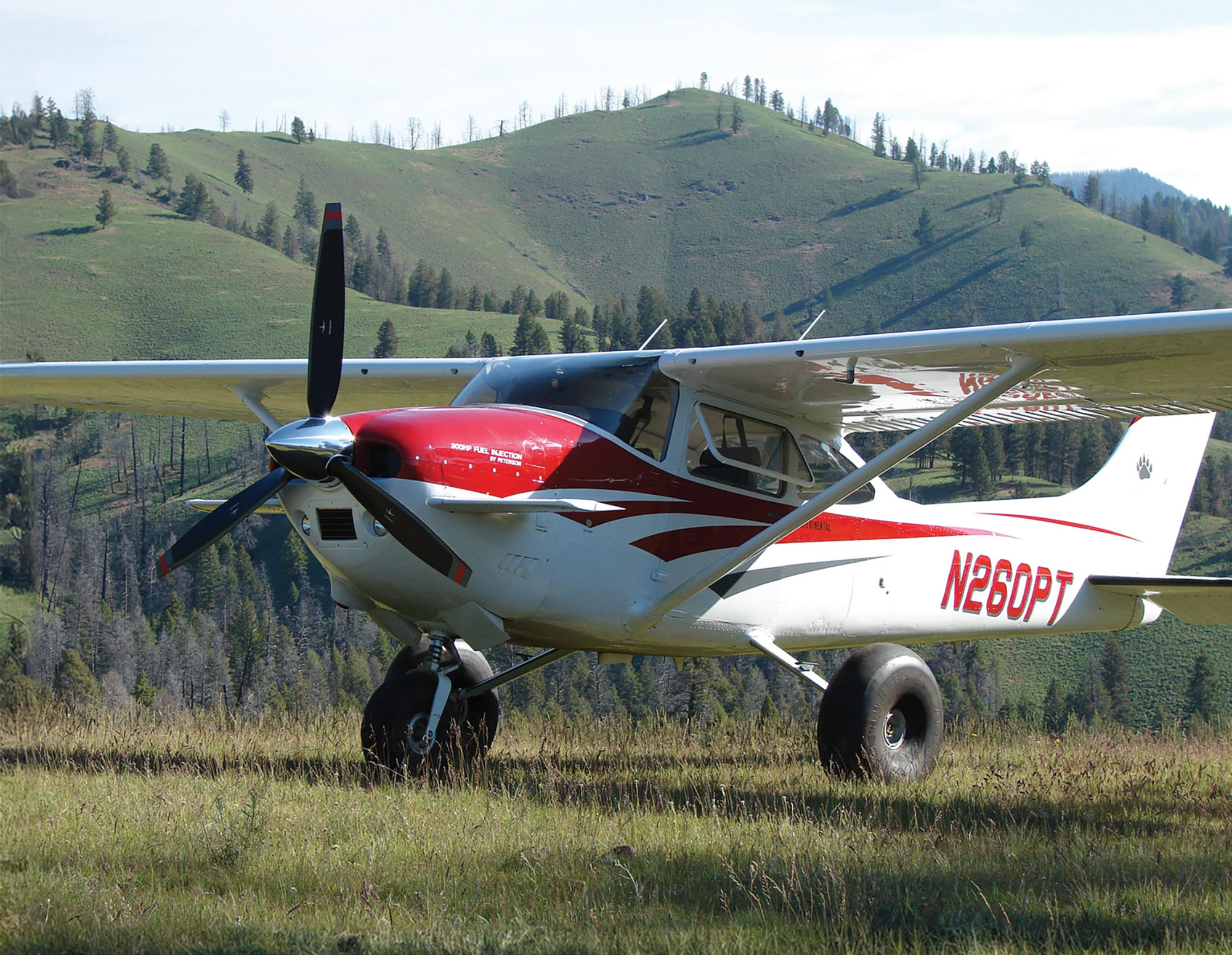
That’s a Peterson King Katmai-modded Cessna 182 pictured above in the environment the modification was made for. It’s a descendant of the Wren 460, which was an airplane with a stunning 27-knot stall speed. The King Katmai has a stall speed that’s 4 knots faster, but, as a tradeoff, has twice the rate of climb and a few hundred pounds more useful load.
STOL kits for general aviation airplanes have been around for over 60 years because of two favorable circumstances: 1) They work, and 2) Manufacturers could have invested the money to lower the stall speeds of their airplanes, but at some point further improvements become too expensive for the expected demand and they stopped.
With the uptick of interest in STOL aircraft generally and with STOL competitions becoming increasingly popular, it seems that there is some form of STOL kit for a huge proportion of general aviation airplanes.
That being the case, what’s out there? Can I reduce the stall speed on my airplane without slowing the cruise speed? What will a kit and installation cost? Is it worth it?

We’ll address the last question first—we think STOL kits are the second best safety devices for general aviation airplanes after shoulder harnesses. When things go south and you have to plant the airplane somewhere you really don’t want to, touching down at a lower speed means less energy to dissipate in the crash. Energy is a squared function—so reducing the impact speed, even a few knots, pays big dividends.
We’ll point out that stalling the airplane before touchdown in a forced landing is a very bad thing as it is then out of control and usually develops a high vertical speed vector, so lowering the stall speed allows a slower touchdown without stalling.
For twins, one of the STOL kits, VGs, also reduces Vmc. That means reducing the risk of an uncontrolled roll following engine failure. A crash with the airplane right side up is far more survivable than one inverted.
Accordingly, while we cannot second guess an individual’s willingness to pay for safety, we are of the opinion that reducing the stall speed of your airplane by 5 knots or so is worth at least $20,000 on an airplane valued north of $100,000.

Stall Speed Reduction
Yes, a STOL kit will reduce the stall speed of your airplane in all configurations. As a rule of thumb our experience has been that the kits differ slightly in their effectiveness, as do the claims made by the manufacturers. However, we have generally seen stall speed reductions on the order of 5 to 8 knots.
Approach Speeds
Reduced stall speeds mean the ability to approach at slower airspeeds. However, slower approach speeds mean increased drag, and when taking advantage of being able to fly more slowly on the approach it’s almost certain that the airplane won’t have enough energy to flare and land power-off. That means learning the technique of adding a burst of power just before or during the flare to break the descent and then getting rid of it so that the airplane touches down promptly.
In addition, we’ve noticed with some STOL kits that carrying any extra speed on final—above what is necessary to flare power-off—will result in floating, sometimes an impressive distance. In our opinion, a careful checkout with a STOL-experienced instructor and learning precise speed control is wise if you install a STOL kit on your airplane.

Climbout
With a reduced stall speed it’s possible to climb out after liftoff at a speed lower than Vx to clear an obstacle in a shorter distance. Some of the STOL kits have recommended obstacle-clearance climb speeds.
We recommend caution when exploring this flight regime. Published Vx for a lot of airplanes is slightly faster than the true best angle of climb speed because at Vx in those it is not possible to get the nose down fast enough to maintain enough energy to flare and land following an engine failure.

Climbing out below published Vx may mean a stall and loss of control should the engine fail. In any event, the pilot should be spring-loaded to aggressively push the nose down if the engine decides to take the day off.
Before getting into individual kits, we’ll mention cruise speed. Some kits, such as Robertson and Horton, advertise cruise speed increases of 1 or 2 MPH. We think that is within measurement error and are skeptical of cruise speed gain claims. The kits that include aileron gap seals, Horton and Robertson, will in our experience, increase the rate of roll and improve roll handling. They may provide some minor increase in rate of climb.
Some of the older STOL kits, such as Bush (no longer on the market) had an adverse effect on cruise speed. We have heard varying reports on VGs, with some owners reporting a slight loss of cruise speed but most reporting no change. We put VGs on a Piper Aztec and Cessna 150 and saw no change in cruise speed. We added them to a Cessna 182 that already had a Bush STOL kit and observed a cruise speed loss of 2 MPH.

Sportsman
With a reputation as one of the simplest and most effective STOL kits, the Sportsman kit manufactured by Stene Aviation (www.stene-aviation.com) of Polson, Montana, consists of an aggressive leading edge cuff that adds 4 square feet to the wing area.
The various STCs approve installation on virtually all single-engine Cessnas—the website has details. Price for the kit is just under $2700 and installation takes 35-50 hours depending on the experience of the installer. Weight of the kit is 15 pounds.
One shop told us that they prefer to use CherryMAX rivets rather than the rivets that come with the kit in order to get a smoother surface—the kit rivets stick up slightly.
Wing-X STOL
Stene Aviation is also a dealer for the Wing-X STOL conversion that adds 18 inches to each wingtip of many of the bigger Cessna singles. They increase gross weight (except for the Cessna 206) while retaining the same stall speed at the new gross weight. There are two STCs, one held by Air Research Technology (www.wingxstol.com) of Montreal, Canada and one by Wipaire (www.wipaire.com) of South St. Paul, Minnesota. Prices range from $5395 to $5595 for the kits and installation takes 40-50 hours.
VGs
At the top of our list for STOL kits due to a combination of weight and performance are VGs, offered by Micro AeroDynamics (www.microaero.com) of Anacortes, Washington, and Boundary Layer Research (www.blraerospace.com) of Everett, Washington.
VGs are small shaped bits of metal that create what are sometimes called horizontal tornadoes that keep the airflow attached to the airfoil and control surfaces at higher angles of attack. Many kits include VGs for the rudder and elevator to keep them effective at low speeds. We like that they help with rudder authority at low speeds in crosswinds.
VGs have been around since the 1930s. Boeing and Learjet were some of the early adopters for airplanes because they worked.
VGs also reduce Vmc on twins and in many cases increase gross weight. The big news is that most kits weigh about a pound installed.
The kit includes the VGs, glue, templates and instructions. A few extra VGs are included as there is a limit as to how many can be missing and the airplane still flown. In 30 years of flying with VGs on dozens of airplanes, we’ve only seen one VG come off.
VGs do not affect deicing and, according to Anni Brogan, president of Micro AeroDynamics, they don’t stick far up enough to affect cruise speed.
Kits start at $750 for the smallest airplanes—and are available for just about any airplane—and go up to $8500 for turboprops.
We noticed that Micro AeroDynamics prices were slightly lower than Boundary Layer Research. Installation depends on the size and complexity of the airplane but starts at about eight hours.

Robertson
Robertson (www.skyway-mro.com) was a pioneer in general aviation STOL kits. Currently, they are only available for Cessnas. They include a new cambered leading edge for singles built before 1973, a stall fence to help keep the stalled airflow from propagating outboard on the wing, drooped ailerons that move with the flaps, aileron gap seals and a flap-trim interconnect system that moves the trim with flap deflection.
According to Robertson’s Pete Conrad, installation must be done at SkyWay MRO Services, the owner of the STC, at its facility in Uvalde, Texas. Conrad pointed out that because of the complexity, cost of the kit installed is $47,000 so the demand tends to be for installation on newer aircraft.
Horton
The Horton STOL STC is now owned by Curry Aviation (www.curryaviationparts.com) in Leesburg, Florida. The kit includes a cambered leading edge, conical cambered wingtips, stall fences and aileron gap seals.
The website does not provide pricing information and Curry Aviation did not answer phone calls or emails.
Conclusion
We like STOL kits from the standpoint of increased safety and the increased level of comfort pilots report feeling when flying at lower airspeeds.
VGs are available for an amazing variety of airplanes and, from a weight and cost standpoint, provide the best value, in our opinion.
For conventional STOL kits, we like Sportsman.
Yes, you can add VGs to a STOL kit. We did it on a 182, and reduced the flaps-down stall speed by 4 MPH.