











The only production four-seat or side-by-side taildragger still being built in the U.S., the Maule is a one-of-a-kind airplane. Its fans can verge on the cultish.
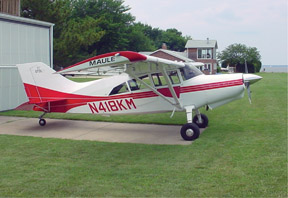
Its easy and forgiving to fly, they say, despite its rap as a groundlooper. Its simple to fix, good at going slow yet capable of respectable cruise speeds. Baggage access is spectacular with up to four doors. The useful load is okay but don’t tell that to bush pilots who, according to legend, carry 1500 to 1800 pounds-about double the legal limit -and get away with it. There just arent any Maule accident reports in the past decade that scream “over gross.”
People do get into trouble with Maules. Some pilots do not take the time to get enough good tailwheel training, according to West Coast Maule dealer Jeremy Ainsworth and other Maule fans. He asserts that many of the Maules runway mishaps come on hard surfaces, not grass, where there is more friction to prevent them, and that many are first landings by new owners taking their airplanes home.
Model HistoryInventor B.D. Maule started coming up with airplane designs when he was in the Army assigned to a dirigible base. He formed his first airplane company in 1941 but it didnt last. The family business dates back to the 1950s, when Maule developed the basic design of the current series. A stubby-winged, round-ruddered fabric taildragger with a welded steel tube truss fuselage and a metal spar wing, it won an EAA prize at Oshkosh. Maule obtained FAA type certification in 1961, calling the airplane the Bee Dee M-4. It was powered by a 145-HP Continental O-300-A.
Mr. Maule has passed on but his company hums along after decades spent tweaking the design to create new models that arent much different from each other except for their engine options (from that first fixed-pitch Continental to 160, 180, 210, 235 and 260-HP Lycomings, a 210-HP Continental and a 220-HP Franklin) and landing gear choices (oleo struts or heavy-duty spring gear). On some models, there also have been constant-speed and fixed-pitch options and a choice between fuel injection or a carburetor. There’s a tri-gear model and even a turboprop model that has been coming out of the factory since 1984. A new one is priced at about $183,000 with standard VFR equipment. Rising like a Phoenix to join the M-7 now is the round-tailed M-4, available brand new in a 180-HP two-seat version for about $105,000, $10,000 more for a constant-speed prop.
As for the earlier models, they evolved from the first M-4 Jetasen into the M-4 Rocket, which had a 210-HP Continental, into the heavier 2300-pound Strata Rocket with a 220-HP Franklin. In 1973, the Lunar Rocket replaced it with a return to the 210-HP Continental. The Astro Rocket, meanwhile, had joined the fleet in 1970 with a 180-HP Franklin. It lasted two years but 180-HP versions reappeared as one of the M-5 variations in 1979, morphing in 1985 into both the M-6-180 and MX-7-180, which had the M-7s longer fuselage and wings and longer ailerons to maintain roll response. A 160-HP Lycoming version was offered from 1995 to 2004.
The M-5 first appeared in 1974 with either a Franklin 220-HP or Continental 210-HP as options. It had a larger tail area and the choice of 63-gallon tanks instead of 40. The demise of Franklin Engine Co. brought Continentals 235-HP O-540 into the picture in 1977. Since 1998, a 260-HP version of the Lycoming O-540 also has been offered.
The M-6 appeared in 1981 with structural changes that increased gross weight to 2500 pounds, including wings that were two feet longer than the M-5s. It offered more flap settings, up from two positions (20 and 40 degrees) to four: 24, 40 and 48 degrees and minus seven degrees for reduced drag in cruise.
M-5s were made until 1988; the last new M-6 was made in 1991. There was an M-8 briefly (1993) but the company seems to have had second thoughts about ever-rising model numbers.
Market ScanMaules are considered a bargain, even new. A long-of-tooth Cessna 180 can cost more than a newer Maule. The Bluebook puts a 1967 180 at $80,500; a 1977 M-5-235C is priced at about $46,000.
The Bluebook shows an average retail price for the earliest M-4 of $23,000. Prices range up to $39,000 for a 1973 M-4-220C. The first M-5s run from around $40,000 with the first Lycoming O-540 variant, as mentioned, about $46,000. Prices rise for various models through the mid-1980s range above $50,000 and $60,000 with the 0-540 variants the priciest. The first 180-HP models (1979-1981 M-5s) fetch $43,000 to $45,000; later versions run in the $50,000-plus range up to around $100,000 for recent editions.
M-7s run from $62,000 average retail for the oldest to $150,000 for a 2005 model, according to the Bluebook.
PerformanceThere’s a famous photo of B.D. Maule taking off out of a hangar and zooming into a steep climb within a few feet of the hangar doors. The message is this baby gets off the gravel bar and climbs away over the ridgeline like a rocket. The Maule wing does love to fly and the higher-powered models can leave the ground in somewhere around 250 feet (a couple of hundred more for the 160 and 180-HP models). At Vx with 20 degrees of flaps, they climb away at a pitch that will make a Cherokee pilot blanche. The combination of high power loading (plenty of horsepower for the weight hauled) and low wing loading (lots of wing area for the weight) do the trick.
Some years back, however, Aviation Consumer loaded up a Dakota and an M-5-235C to compare them. In cruise, with both engines firewalled, the monocoque-hulled Dakota was 5 MPH faster. It also climbed better despite book numbers that would have given the steel-tubed Maule the edge.
Readers report leaving the ground in the 235-HP version within 500 feet and climbing out at better than 1000 FPM every time. As for a 180-HP model, the Bluebooks specs give an M-5 a 900 FPM climb.
Reported cruise speeds are all over the place, from 140 to 165 MPH for the 235-HP versions. One reason, in part, is that earlier models had highly variable airspeed indications because static ports were affected by small differences in the cowling caused by manufacturing variations and wear. The ports were in the aft part of the cowling and an ice pick was the tool of choice for adjusting them by creating a lip on one side of the hole or the other to eliminate high or low readings.
Readers say 120 to 125 knots and a 12 to 13 GPH burn at cruise are typical for the 235-HP Maule at 65 percent power. That would be about 10 knots slower than a 182Q burning about the same amount of fuel. A 210-HP M-5 owner said 120 MPH (a lot of Maules have airspeed indicators marked in MPH)at 60 percent was standard.
While the two rear doors and removable rear-seat option make it easy to throw a lot of big stuff in the back, some well-equipped Maules can be left with a useful load down around 800 pounds. The legend is that the airplane easily outperforms its book load limits, however.
The low wing loading translates into low stall speeds on the Maule (33 knots for an M-5 with 40 degrees of flaps, 30 knots on an M-6 or M-7 with 48 degrees) and low takeoff and approach speeds.
That means a crosswind will be that much more of a factor than it is in a faster airplane. A slideslip to prevent drift and firm, quick rudder inputs to keep the nose straight are vital to avoiding groundloops, as they are in any taildragger. Maules with the bigger rudders are good slippers, according to some, but the Maules short-field capabilities will have to be sacrificed for a higher approach speed to maintain greater control if the crosswind component is more than a few knots.
Another issue is getting enough drag when landing to allow a steep descent over obstacles without building up speed. The post-1981 Maules with the greater range of flap settings address this concern – but watch out for the flare. Like any airplane approaching the runway steeply, slowly and with a lot of drag, timing will be critical and power may be necessary to prevent a pancake or hard landing.