











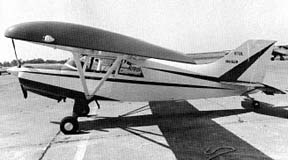
Though not exactly a household name, Maules have been around seemingly forever, having found a niche that they fill pretty well: if you want a new four-place taildragger, there arent too many choices any more. While the big manufacturers were dropping like flies in the 1980s, Maule stuck with it, chugging along and producing airplanes at relative bargain prices.
First and foremost, the Maule is a busHPlane, meant to be operated out of extreme airfields while requiring little maintenance. Maules as a group fulfill that mission well. History shows a high accident rate, but given the environment in which these airplanes are typically used, that shouldnt be too much of a surprise.
Maules are a bit like Saabs in that they are decidedly unlike the mainstream, are reliable, and engender great owner loyalty. But, like a Saab, they can have some idiosyncrasies.
History
There are four basic variations of the Maule, but all are similar enough to cover together: the M-4, M-5, M-6 and M-7, equipped at various times with a variety of powerplants. Construction of all is much the same, with all-metal wings (fabric covered on early M-4s) and a fabric-covered steel-tube fuselage. All are taildraggers except the MXT-7, which is covered in a separate report.
The current model, the M-7, has been in production since 1983. Available with engines ranging from 160 to 235 HP, prices for new ones are anywhere from about $120,000 to roughly $175,000.
The basic round-tailed M-4 Jetasen was born in Michigan in 1962, powered by a 145-HP Continental O-300. 1965 brought the Rocket, a version with a 210-HP Continental IO-360A and constant-speed prop, giving the buyer two airplanes to choose from. The 1967 model year brought with it another choice, the Strata Rocket, with a 220-HP Franklin 6A-350-C1. During these model changes gross weight was raised to 2,300 lbs., and serial production began in Moultrie, Georgia, where the company remains today. The Rocket was dropped for the 1970-72 model years, returning in 1973 as the Lunar Rocket. Also in 1970, a 180-HP version (the Astro Rocket) appeared, with a Franklin 6A-335-B1 and a constant-speed prop; it lasted only two years. The M-4 series stayed in production through 1973.
The M-5 series, which made its appearance in 1974, had the same gross weight, but added quite a bit more tail area, increasing longitudinal and directional stability, while keeping about the same control power. Fuel capacity went from 40 to 70 gallons with the addition of optional tip fuel tanks.
With the demise of the Franklin Engine Co. (and its sale to Poland), the 220-HP version was discontinued after the 1975 model year, leaving only the 210-HP version. To replace it, the Lycoming O-540 series of 235 HP was added to the eligible engine list in 1977, and in 1979 a 180-HP mill was brought back, this time a Lycoming O-360-C1F. 1980 brought a third powerplant choice, a 210-HP turbocharged Lycoming TO-360-C1A6D.
The M-6 came along in 1981 as a companion to the M-5. It bumped the gross weight to 2,500 pounds and lengthened the wings two feet. The flaps were redesigned from the M-5s two-position mode (20 and 40 degrees) to have four positions: 24, 40 and 48 degrees with seven degrees negative to improve cruise drag. Initially, only the big 235-HP Lycoming 540 engine was available on the M-6; in 1985, the 180-HP Lycoming was put on it. The empty weight was raised because of the structural changes, so useful load didnt increase by the full 200 pounds.
In 1984 the M-7 added another nine inches to the wing span thanks to modified wingtips. Since the roll rate of the M-6 was degraded when the plane got its longer span, the M-7 was given new ailerons with more span, and the roll rate was restored.
During the mid-1980s, Maules lineup consisted of the three variants – M-5, M-6 and M-7 – each available with either a 180-HP or 235-HP engine. The M-5 was dropped after 1988, and the M-6 disappeared a couple of years later.
A tricycle gear 180-HP version was added in 1990. Longer ailerons came in with the tri-gear model. The early 1990s saw a variant that didnt catch on, the M-8-235. The latest price guides indicate that there are now no fewer than twelve different versions of the M-7 (the only remaining variant) available, with a choice of three engines (160-HP Lycoming, 180-HP Lycoming, 235-HP Lycoming), fixed or constant-speed props, and conventional or tricycle gear.
Despite the bewildering variety of variations, though, all are still basically Maules. The only significant differences (aside from the gear) lie in the propulsion packages.
Performance
The Maule manuals are modest to a fault (though one loyal owner went so far as to excuse this by saying the company was in the airplane manufacturing business, not the publishing business) with no performance figures. Pilots reported such a wide spread of cruise speeds, we hesitate to pass them along. But for the 235-HP versions they ranged from 140 to 165 MPH.
For what its worth, The Aviation Consumer some years ago raced an M-5C 235-HP Maule against an almost equally loaded Piper Dakota to see which was faster. The Dakota walked away from the Maule, flying at least five MPH faster in level flight with both engines firewalled. No surprise here, given the Dakotas all-metal, semi-monococque design that it aerodynamically superior to anything possible with tube and fabric. The 235-HP Dakota also climbed better, though, which was a surprise given the Maules hefty STOL reputation.
One note about cruise performance: the pitot-static system in the early airplanes had a weakness. The static ports were located in the aft part of the engine cowling, and manufacturing tolerances and service wear on the cowling could result in large airspeed errors (and reasonably large altimeter errors, too). By and large, consider this: a good, legal Maule system had the characteristic of being five knots in error at approach speed (reads five knots slow) and five knots fast in cruise.
Those are the limits for FAA certification, and the cowling static port location was just barely able to fit these limits if it was tuned right. It doesnt take much deviation in cowling shape to get this error curve shifted 5-10 knots one way or the other, resulting either in completely unrealistic perceived stall speeds, or seemingly phenomenal cruise performance, but not both at once.
Production tuning was accomplished by first determining the error for each individual airplane in flight test, then jamming an ice pick into the static hole and twisting either forward or backwards, depending on which way the error curve needed to be shifted. Creating a lip of about 0.5 mm on the aft side of the static hole could shift the airspeed curve about five knots toward slower indicated stall and cruise speeds, while twisting the other way could move the curve the other direction. Now, about the probability that this tuning could survive decades of service….
The later aft-fuselage-mounted static ports were much more stable, and the likelihood of service-induced error much less, although they still had the characteristic of indicating about 3-5 knots slow for stall and 3-4 knots fast for cruise. In both types of systems (as in most airplanes), the error at slow speed with big power gets terribly large.
Loading
Another note about the Maules legendary weight hauling capability: Way up North, where Maules are popular for easy maintenance, easy starting, and high power loading, you often hear stories of people in the boonies flying out with 1,000 pounds or more of moose in the back. (Who really knows? There arent any scales around.)