











According to seaplane instructors, the most commonly uttered phrase by a landplane pilot following the first seaplane lesson is: “My Gawd, this is fun. Why didnt I do it sooner?” The second is often, “I want one of these things.”
With the hook firmly set, lets look at what the truly smitten goes through in determining how much fun he or she can afford and what kind of seaplane to buy.
We strongly suggest that the first step in such a process is to join the Seaplane Pilots Association. Its an excellent organization for those who want to have anything to do with seaplanes. Its forums contain a wealth of information on specifics of seaplane ownership and operation.
What constitutes a fun seaplane? We consider fun seaplanes as ones where the idea is to fly purely for pleasure; in which the owner wants to knock around the sky and explore the waterways that are suitable and legal for seaplanes to alight; to take at least one passenger and enough stuff for a picnic or to go fishing or maybe stay overnight at a remote cabin or campsite on the shore. Fun seaplanes are for
the aeronautical version of the sailors “gunkholing.”
The airplane is not going to work for a living, need to haul a lot of stuff, travel great distances or handle particularly rough water or weather. We opine that fun seaplanes have but one engine that develops less than 200 HP, but we recognize that such a cutoff is arbitrary. The 145-HP Aeronca Sedan and 150- to 180-HP Piper Super Cubs and 180-HP Huskies are often serious, working seaplanes hauling cargo and people on a day-to-day basis.
More Options on Floats
A seaplane has come to be a generic name for any kind of airplane that can land on the water and then take off. It includes floatplanes, which are airplanes that are supported above the water by a float or floats, and flying boats, where the fuselage of the airplane functions as a boat hull with sponsons, usually on the wings, keep it from tipping over when in the water. Flying boats are usually amphibious, being able to alight on land or water. Floatplanes may or may not be amphibious.
With the exception of the Colonial Skimmer (which begat the Lake Amphibian series and are quite rare), all of our fun birds are floatplanes.
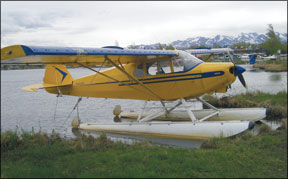
Floatplanes nearly always use two floats separated by spreader bars and attached to the fuselage by struts. The airplane has to have either been built or modified to accept floats, which means attach points at or near the landing gear attach points and any needed beefup of the airframe to handle the pounding transferred to it as the float structure does not include shock absorbers. The floats also have rigging that allows them to be aligned appropriately in all three dimensions. Float and airplane combinations must be certified by the FAA, usually through the Supplemental Type Certification process. Floats are destabilizing in yaw and may require some vertical stabilizer modification.
The first decision a prospective buyer must make is not what airplane, but which type of floats. That inquiry is generally determined by the sort of water access that is available. Can the seaplane be based along a shoreline where fuel is available, and it can be docked or beached to be worked on? Is it possible to get a mechanic to the floatplane for those times when something breaks? If so, then an airplane on straight (non-amphibious) floats are an option. Straight floats mean more useful load and lower operating costs by avoiding landing gear.