










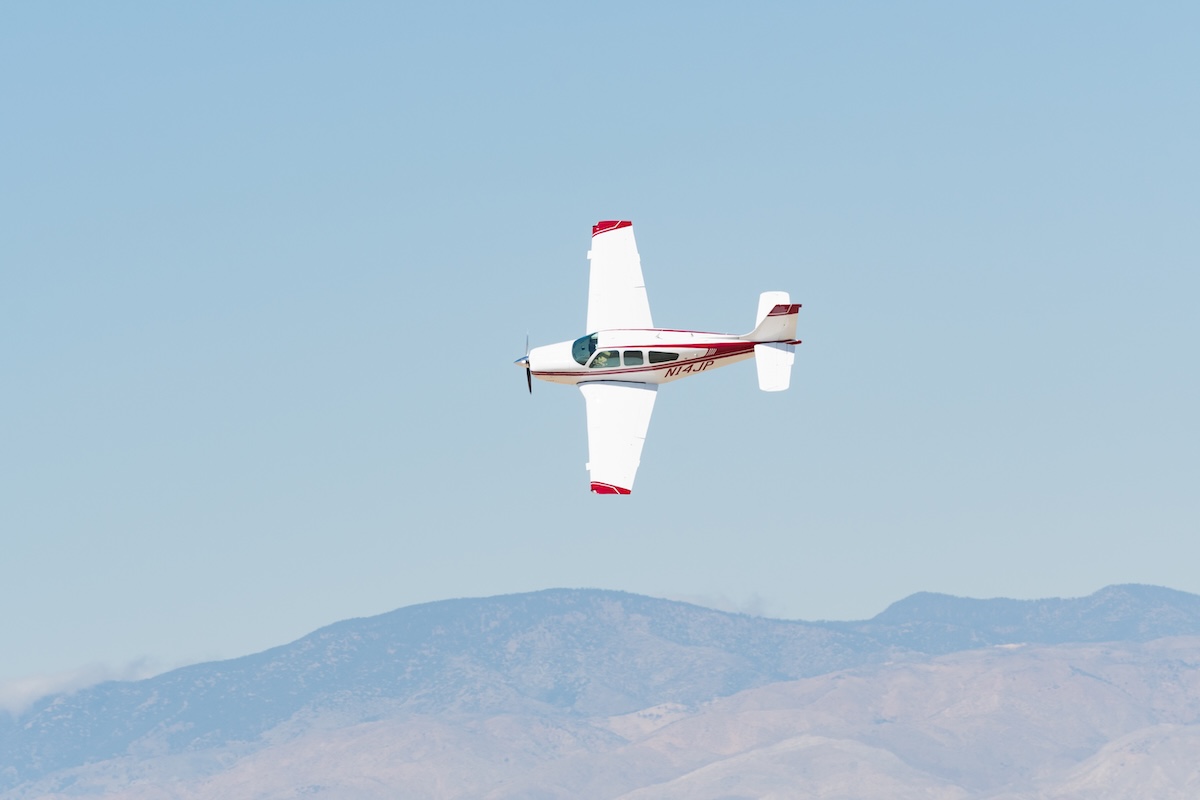
Shopping for an airplane is a bit like a car trip for which you know the destination but the route is unclear, with several possible paths.
Like many prospective aircraft owners, my wife, Alex, and I had Beechcraft Bonanza on the brain long before the shopping became serious. Newer models, such as the Cirrus SR22, were well beyond our budget, but the four-place F33A Bonanza seemed to be within reach.
For years, from the benign window-shopping phase to the ready-to-buy stage, we watched as Bonanza prices rose faster and further than those of competing models. We began speaking nostalgically about “Bos” we had seen years earlier, at reasonable prices, and worried that we had missed our chance.
We held on, though, perhaps stubbornly, to our hope that we could find an F33A that suited our needs and our bank account. We arrived at our fork in the road while driving home after meeting with a seller at Princeton Airport (39N) in New Jersey and examining a well-worn, mid-1980s example. During the hour-long ride home, we found ourselves speculating about the time and money it would take to get the airplane into what we considered acceptable shape. It needed new paint and a new interior. We could get by with the mildly updated panel. The engine was a mystery but seemed likely to need attention as well. We sensed a slippery slope.
We were barely halfway home before concluding that we should look into other makes and models. Fortunately for us, the used aircraft market offers many options in the high-performance, four-place retractable category. At the time (2022) competing models in nice condition often were priced $100,000 less than similar F33As.
The following list includes some of the aircraft we considered, all designed to compete with the Bonanza. Each has advantages and disadvantages when compared with the F33A, and as we found, some of the alternatives might suit you better.
Piper PA-24-260 Comanche

It took Piper until 1957 to answer the innovative Bonanza’s challenge, thrown down a decade earlier. But the company’s PA-24 Comanche also stood out as a departure from typical civilian light aircraft of the era.
Its smooth, graceful, all-metal design helped form the shape of things to come as general aviation headed toward major expansion. Early models came with 180 or 250 hp. The 260 hp model arrived in 1965 and is generally the most desirable.
While not quite as fast as the Bonanza, the Comanche is swift and usually costs much less in today’s market while still excelling in cross-country travel and looking great on the ramp. Prospective buyers should keep in mind that Piper dropped this model after a 1972 flood ruined the Lock Haven, Pennsylvania, factory where they were built. Even the newest examples are more than 50 years old.
Mooney M20J

Mooney’s M20 series set a new standard for efficiency and performance from its mid-1950s introduction, but the J model that arrived in 1976 truly challenged the Bonanza and other fast four-seaters with larger engines and much more power. The M20J also was known as the 201 because it could reach 201 mph with its 200 hp Lycoming IO-360 engine. This model’s ability to do more with less made it a strong seller.
Mooneys often are great values today, in part because the brand is not as well-known as some competing manufacturers. Some pilots feel its compact, aerodynamically clean airframe results in an interior that is less roomy than others in the same category. Some consider it cramped while experienced Mooney pilots say that is not true.
I have spent time in an M20 and found it comfortable. Prospective buyers should try one on and decide for themselves.
Bellanca Super Viking

While wooden wings, strut-braced empennage and fuselage stringers bulging under fabric covering might be charming on a late-1930s taildragger, they seem odd on a high-performance low-wing speedster that left the factory decades later.
The Bellanca Super Viking, though, provides impressive performance despite its seemingly old-fashioned features. Indeed, its speed and harmonious handling have attracted a devoted following of pilots who love the machine and are happy to put in the effort to protect its vulnerable wood and fabric structures.
Continental IO-520s power some Super Vikings while others use Lycoming IO-540s. Either way, they pack 300 hp and can keep up with Bonanzas.
I can vouch for the Super Viking’s speed. Last summer my son and I were fueling our Commander 114B before departing Blairstown, New Jersey (1N7), for Lebanon, New Hampshire (KLEB). A Super Viking pilot from a neighboring hangar was next in line at the pump.
We took off at least 10 minutes ahead of him, but about 100 nm into our 200 nm flight, ATC notified us of a Bellanca a few miles away, on a similar heading at the same altitude. We could see him on our GPS screen, appearing closer than he actually was, before finally spotting him about two miles away. He steadily overhauled us and eventually disappeared in the distance.
Impressive. I understand the Super Viking’s appeal.
Rockwell Commander 114

I was not surprised when the Bellanca left us in the dust during our trip to Lebanon. Our 1992 114B is a second-generation model built by Commander Aircraft Co., which acquired the design during the 1980s.
It is about 10 knots faster than earlier Rockwell Commanders but still is not the fastest four-place retractable in the sky. I believe it is, however, among the roomiest and most comfortable. The airplane’s wide cabin might be draggy, but it keeps me from rubbing elbows with my front-seat passenger while providing space to stretch out.
In our case, the Commander is just right.
Commanders also handle nicely, are surprisingly forgiving at low speed, and easy to fly overall. The model’s smooth flight characteristics have kept me from frightening family members in the cockpit while its trailing-link landing gear makes arrivals smooth enough to convince them that I am a better pilot than is actually the case.
Our Commander is also a social airplane, never failing to start conversations with other pilots, line crews, FBO staff or anyone else on the ramp. It is a handsome aircraft but sufficiently rare that few people know what it is.
Indeed, people sometimes think it is a Super Viking, probably because both have prominent tail surfaces. They ask, I answer, and then we have a nice chat.
SOCATA TB20

Built by the same people who more recently brought us the TBM family of turboprop singles, the SOCATA TB20 is a stylish, eye-catching model that was on sale from the early 1980s through the early 2000s.
My wife and I checked out a couple of these very-European airplanes while we were at the Princeton airport to see the faded, previously mentioned F33A a few years ago. It is a stable, smooth-handling airplane with a modern interior and great visibility. Its cabin doors swing upward, gull-wing style. Some say this feature makes entry and exit easier. It certainly adds flare when you arrive at the FBO.
Powered by an IO-540 engine similar to those in the Comanche, Commander, and numerous other GA aircraft, the TB20 is mechanically familiar although it is a somewhat rare sight in the U.S., where it never truly caught on despite many years on the market.
A few years ago, a friend who sold his Commander and was looking for another aircraft thought about purchasing a TB20 but dropped the idea because he did not want another rare, “orphan” aircraft without factory support. The fact is, though, that the TB has a resourceful type club, and Daher, which produces TBMs, still supports the older TB piston models, so servicing them is easier than you might think.
Your Decision
Fortunately for buyers, any of these aircraft could be the ideal Bonanza alternative. It all depends on what qualities are most important to you.
Pilots can trade a few knots of cruise speed for more comfort or enjoy competitive cruise and climb performance in exchange for a bit less cabin space or the need for special maintenance consideration.
More important than which aircraft you acquire is how you approach the transaction. Due diligence is vital, especially with aircraft as old as these.
When arranging the pre-buy inspection, which is an absolute must, it is worth spending extra time to find a shop that is well acquainted with the type you are interested in buying. Anyone inspecting a Super Viking, for example, should be well versed in wood, steel tubes, and fabric.
In the end, though, the basic process for finding the right used aircraft is the same: You have to do lots of homework, find a good example, and enjoy.


