











Every aircraft design has an underlying mission its designed to and best suited for. Human owners rarely have so narrow a need, however, so one of the greatest challenge of choosing an aircraft to own is finding a design whose perfect mission falls in the fat part of the bell curve for the range of missions you plan to fly. Expedition Aircrafts E350 is a backcountry load-hauler first and foremost; its a big crate with a fat wing and gobs of power. Load it up with the full 100 gallons of fuel and you can still toss in another 800 pounds of payload. That 3800-pound-gross-weight airplane will be off the ground in about 800 feet and climb at 1000 FPM. At 155 knots and 17 GPH, you could take that load a long way into the bush. While not that many new-aircraft buyers are itching to wring out their investment on gravel strips hundreds of miles from civilization, the ability to haul a good load a long way in comfort and at a reasonable speed has a wider appeal, and thats a niche Expedition is trying for. 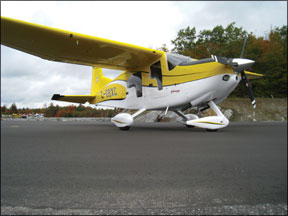
Not a Bush Hawk
The biggest change in the E350 from the Bush Hawk it descended from is the switch to tricycle gear. Tundra tires are optional, even with the nosewheel (but without the wheel pants), and all aircraft come with hard points for attaching floats.
The Bush Hawk was unusual in that its cabin was built on a steel cage skinned in non-structural aluminum. The E350 uses the same cage, but its skinned in carbon fiber. This makes the cabin both lighter and larger, because the carbon fiber curves can offset further from the steel frame. The cabin is 51 inches wide at the forward seats and 53 inches wide in back. The frame provides the attach points for the engine, wings and semi-monocoque tail, and is why the E350 can sport four doors. The rear doors are simply huge. Big enough to roll in the obligatory 55-gallon drum. The doors have a solid, car-door feel. (The door latches come from Land Rover, in fact.) Somewhat overzealous gas springs hold them open nearly