










-by Greg Travis
Hidden away in a nondescript corporate office park in an eastern suburb of Paris is a venture aiming to turn the general aviation engine marketplace on its ear. Society Mechanique dAviation (SMA) was born here seven years ago with one goal: to make piston engines for general aviation that would run on the same fuel that Air France puts into its Airbuses.
As if to showcase its global ambitions, SMAs facilities would be at home in any one of the thousands of disposable corporate office parks throughout the U.S. There’s no old-world charm here, no narrow streets with pushcart vendors, no architecture. Its all about form, function and the application of capital investment.
The place shares more in common with a Midwestern strip mall than the cultural center of the free world-at least as far as look and feel. (We did note three differences between American and French white-collar culture: you can still smoke in your office in France, you can have a bottle of wine at lunch and nobody answers the phone in August.)
Created in 1997 with an initial capital investment of roughly $14 million, SMA is equally owned by Renault, SNECMA and EADS. You know about Renault, the $36 billion dollar automaker, but the other two may not be as familiar to those of us on this side of the pond. SNECMA (a French acronym for The national company for the study and construction of aviation motors) is best known in the U.S. for its large turbine engines such as the CFM56.
EADS, which stands for the European Aeronautic Defense and Space company, is best known to us as the company that makes the Airbus series. Much of SMAs top talent, such as engineering director Benoit Guyon from SNECMA, came to the company from its much larger partners. Imagine Ford, General Electric and Boeing investing together to build a new piston GA engine and you can appreciate the seriousness behind SMA. They mean business and Lycoming and Continental ought to be paying attention.
The Engine
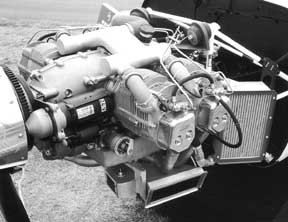
The SMA SR305, as the engine is known, is a turbocharged diesel four-cycle, four-cylinder engine of 305-cubic-inch displacement. With direct drive-there’s no reduction gearing-it produces a maximum of 230 HP with 200 HP continuous at a relatively low 2200 RPM. With its turbocharger, it can maintain maximum continuous power from sea level to 10,000 feet, something normally aspirated engines cant do.
And because diesels have lower exhaust gas temperatures, the SR305s turbocharger operates about 300 degrees cooler than the turbo in a gasoline engine. That might go a long way in helping to avoid the additional maintenance associated with turbocharging.
Externally, the engine appears to be no different than what weve seen for the past 50 years. Thats due in no small part because SMA chose the predominant aircraft engine form factor: opposed cylinders set around a two-piece crankcase. Exhaust plumbing runs beneath the engine backwards towards the turbocharger while induction plumbing runs along the top of the engine.
Closer inspection of the engine, however, reveals its differences. The first thing we noticed was just how beefy it is. Everything seems just like a conventional gasoline engine only bigger and more stout-which is a good thing given that this is a 305 cubic-inch engine that puts out as much power as a 540-cubic inch Lycoming. The engine evokes brick outhouse all the way from the 12-point nuts on the ends of the case through bolts to the ridiculously large piston pins and back to the crankshaft as heavy as a hot tub. The engine also departs from its commodity cousins in the area of detail design. Unlike conventional engines, the heads of the cylinders are not screwed onto their barrels. Instead, the entire engine from the cylinder heads to the piston barrels down to the crankshaft halves are clamped together via a through structure of tie rods. This cylinder head design, called a poultice head, hasnt been seen in general aviation since the 1970s and Continentals ill-fated Tiara engine.
In Continentals case, the design was chosen because its cheaper to manufacture. In SMAs case, we suspect it was chosen because a traditional threaded barrel and head wouldnt contain the much higher peak cylinder pressures encountered in a diesel engine.
After all, head/barrel separations are not exactly unheard of in gasoline engines. The downside of the poultice head is that its difficult to control the gas seal between the head and barrel. Continental had trouble controlling the head/barrel seal in the Tiara engine and it will be interesting to see if SMA has solved this problem, especially since the diesels combustion pressures are much higher than the Tiaras were.
After lubrication, the second function of an aircraft engine oil system is cooling and the SMA engine aggressively uses its oil system to help carry away waste heat. When we first looked at the SMA engine, we noticed that the cylinder barrels consisted of a sand-cast aluminum outer cylinder with a heat-treated (not nitrided) steel inner liner. Conventional aircraft engines use a steel cylinder with no liner.
SMAs design initially struck us as odd because it adds manufacturing complexity and weight, and hinders the transfer of heat from the cylinder to the air. Had we finally found the Gallic idiosyncrasy that we knew had to exist somewhere?
Then we saw it: the reason for the two-piece cylinder. Sitting on a bench in the parts house was an example of the aluminum outer cylinder without the steel liner. Machined into the inner dimension of the aluminum cylinder was a large spiral channel which functions to carry oil as a coolant around the upper cylinder and to carry away heat. In fact, the SMA engine has two virtually separate oil systems. One system is filtered and serves the traditional role of lubricating the engine while the other system serves only to cool critical areas such as the cylinders and heads as we’ll as the pistons through oil sprays. Both systems share a common seven-quart sump and pump.
The rest of the engine is built conservatively, which in aircraft parlance means expensively. The crankshaft is forged and nitrided while the pistons are cast and machined. The cast pistons were a surprise given the robustness of the rest of the engine and that forged pistons are common in other high-output engines.
At 423 pounds, the four-cylinder SR305 is not exactly a light engine. Its 50 pounds heavier than the six-cylinder 230-HP Lycoming IO-540-AB1A5 used in new Skylanes. We felt that the crankcase castings were overbuilt and could have metal removed for lightening without compromising the integrity of the engine. When asked about this, SMA replied that, yes, the current crankcase design was overbuilt for the initial horsepower but they plan to follow the 230-HP version of the engine with a 300-HP version using the same crankcase. A 300-HP four-banger will be something to see.
We cant bring up the weight difference between engines without also talking about the weight difference in fuel consumption. A four-hour flight behind the Lycoming will require approximately 50 pounds or 8 gallons more fuel than a four-hour flight behind the SR305. Thus, for flights of over four hours duration, the SMA engine package (meaning the weight of the fuel necessary plus the weight of the engine) is actually lighter than the Lycoming.
Manufacturing
SMA started out as what Lycoming has become: a final assembly facility for engines using parts made by others. To date, all of the 30 or so engines produced have been assembled in a small engineering facility adjacent to the corporate headquarters in Lognes. For volume production, SMA is building a new final assembly facility near the city of Bourges. Once complete, SMA will stabilize at roughly 100 employees.
We asked SMA if they had any reservations or concerns about their parts supply given the fact that they are totally dependent on other firms to make what they assemble and sell. After all, third- party parts supply and quality have consistently dogged Lycoming. SMAs response was that, yes, they were aware of the issues and because of supply and quality concerns, they rigorously enforced an internal rule that every part they use must have multiple suppliers. (In strike-prone Europe, this is a must.)
We then asked if that included the single Bosch diesel injection pump. SMA officials admitted that the Bosch injection pump was currently the only part for which they didnt have multiple sources. We were assured, however, that SMA had already marshaled the resources necessary to produce a clone of that pump should Bosch, a German company and a potential competitor, withdraw its pump from availability.
Regarding the major castings, such as the crankcase halves, the cylinder heads, the outer cylinders and the crankshaft, SMA was even more confident. The retention of national foundry resources is a general public policy initiative in France. That means that France will retain a viable domestic foundry infrastructure, ensuring multiple casting facilities and sources for companies like SMA, despite global pressures to move metal pouring to less expensive producers. The national psyche of France is not ready to outsource its core defense infrastructure and wants to ensure a healthy domestic supply of guns, engines and armor should it find itself in another grand guerre. In the meantime, if they use the facilities to build engines for Cessna warriors, so much the better.
Field Support
Next to the engine assembly and test area is a small (by U.S. standards) area dedicated to the maintenance of parts inventories. In this area are two large computerized inventory elevators allowing access to small and medium size parts through computer request. Larger parts, such as castings, camshafts, crankshafts and the like, were stored on adjacent racks. The parts build-up, especially given the small number of engines in the field, was impressive. We counted at least a dozen crankshafts, twice as many camshafts and a good number of cylinders, cylinder heads and pistons. Everything was bagged and tagged and ready to ship. SMA is in the process of setting up a worldwide parts and service network. Theyre also making available a program called part-in-air which allows an engine owner to essentially lease their maintenance hours to TBO.
In exchange for an annual operating hour commitment and monthly reports on engine activity, the engine owner will receive full coverage of both normal and abnormal maintenance for a monthly fee.
This program allows the engine operator to amortize the cost of engine maintenance, including engine overhaul, over the full proposed 3000-hour TBO.
At the end of the TBO period, SMA will overhaul the engine-possibly providing a spare to use during the overhaul-and reinstall it without any additional capital outlay from the engine owner. The program also covers any unscheduled maintenance, including failure of the engine prior to TBO. As SMA describes it, this allows owners (especially commercial operators) to accurately predict their cash flow and engine operating costs without the possibility of surprises. Some turbine operators know this concept as power by the hour.
Ownership Cost
The $80,000 price tag of an SR305 is bound to make some reach for the Tums. However, as SMA points out, the price is reasonable when compared to what youre buying. In addition to the engine itself, the price includes a new Hartzell prop and governor, a new turbocharger, new exhaust, a FADEC engine control computer and partial baffling.
Yes, thats right, a FADEC. The SR305 was designed from the outset as a single-lever control engine meaning that there’s just one cockpit lever to control engine power-no mixture control and no prop control. Even the power lever is non-traditional in that there are no cables, only electrical wires, between it and the FADEC.