











If the world of manufacturing offered such a thing, it would have to issue a special award to the light sport aircraft industry for sheer, blind tenacity in the face of hopeless market conditions. Dozens of companies persist in peddling so-so designs with no chance of achieving enough volume to survive, much less prosper. The smarter companies are figuring this out and are re-jiggering their business plans into hybrids whose sales rely not just on flightschools and owner operators, but other business lines entirely. An intriguing example of this is tiny Eastman Aviation, headquartered at Georgias Heart of Georgia Airport, south of Atlanta. The company is plying the usual sales leads among private owners and flightschools, but its also doing something unique: Its pitching its products to law enforcement and government agencies as a cheap replacement for expensive helicopters and its even exploring ways to convert them into unmanned aerial vehicles, a white-hot market segment with few inexpensive options. Diamond has done the same with its DA42 MPP twin, converting the airplane into a multi-sensor surveillance platform that can be manned or unmanned. There’s little doubt that demand exists for such products. Eastmans challenge will be to break into a field dominated by products many small agencies cant afford.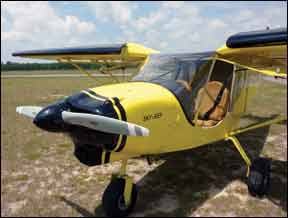
Twists and Turns
When, in 2004, we first visited the spacious hangar where Eastman now lives, it was home to another company: Aircraft Manufacturing and Development, a company that was building the CH2000 Alarus, a light, two-place trainer meant to compete with the likes of the Diamond DA20. Although that model achieved moderate success, the trainer market is thin and fickle and AMD failed to sustain. After an ownership change, the company morphed into a second AMD-Aircraft Manufacturing and Design, and moved into the LSA market, tooling up to build the CH601 LSA, a design that originated with the prolific Chris Heinz of Zenith Aircraft. Zenith was also responsible for the Alarus design and the original AMD