











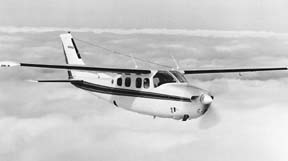
In 1978, the Cessna P210 was a real landmark. While not literally the first pressurized single (the Mooney Mustang was the first real attempt), it was the first one that was truly viable. It was (and is) remarkably inexpensive for a pressurized airplane. What that means is that its very expensive, just not as bad as the other choices a prospective purchaser is faced with.
What pressurization does, directly, is offer the ability to fly over much enroute weather in relative comfort. Indirectly, it offers somewhat lower noise levels and a more solid feel, the result of the reinforcement needed for pressurization.
There is a price to be paid for operating a pressurized airplane at flight-level altitudes. Part of it comes in the form of mechanical woes-the engines are short-lived, often don’t make it to TBO, and cost a lot to overhaul; pressurization adds another complex system to maintain and operate. Part of it comes in mundane problems: separate, unpressurized baggage compartments and the need to fit everthing that goes into the cabin through the pilots door. Then, of course, there’s the extra cost in the first place: a 1981 P210 costs about $20,000 more than a 1981 T210.
Rough start
Cessna said that the P210 was a daring technological leap when it came out in 1978, and sold nearly 400 in the first two years. In fact, though, the P210 was hardly a fresh, innovative design exercise. Instead, it was a derivative of nearly two decades of C-210 Centurions. The airframe was vintage 1960s, the engine was nothing new… even the pressurization system had been lifted from the pressurized Skymaster. No matter, though. It was still a unique airplane: the pressurized single.
In 1979, Cessna changed the gear. The main gear doors were removed (theyd been troublesome on the 210), which cost some of the original 196-knot cruise speed and a little climb rate. At the same time, however, the gear-extension speed was raised to the top of the green arc, making it a good speed brake (more about this later).
Like other Cessnas such as the first Cardinals, the early models had some real design flaws that had to be redressed after the fact. Severe problems started cropping up in 1980.
A pair of P210s crashed after engine failures caused by detonation. The FAA issued emergency ADs calling for extra-rich mixtures to cool the engines, along with other anti-detonation measures that reduced performance and, of course, boosted fuel burn significantly. The detonation apparently was caused by a poorly matched engine-turbocharger combination. High back pressure on the exhaust system and very hot induction air temperatures caused the engines to run hot and, sometimes, experience destructive detonation from the excessive heat.
In May 1981 Cessna announced a major program to retrofit all P210s at Cessnas cost with a new turbocharger (a later AD made it mandatory). This was supposed to eliminate the need for ultra-rich mixtures and provide improved range, performance and fuel economy. What the retrofit did, instead, was to lower performance, with P210 pilots finding they couldnt hold manifold pressure or cabin pressure above 16000 to 18000 feet. Said one owner: The new turbo has turned the airplane into a sick dog at altitude.
Late in 1981 Cessna came up with another solution to the problem: a new air induction system that would be retrofitted free by the company, to restore the lost performance. Consisting of a larger intake scoop and redesigned air plenum, it increased manifold pressure by up to seven inches at high altitude. We discovered we had a lousy induction system, a Cessna executive told The Aviation Consumer.
1982 brought a number of improvements that make these and later airplanes more desirable than earlier models. Among these were a new slope turbo controller that maintains deck pressure at a steady two inches above manifold pressure, in the process eliminating a lot of unnecessary load on the turbo. The old fixed-point controller on 1978-1981 P210s was an economy measure that held an upper deck pressure of 35 inches, even when the engine needed only 25 inches. This caused the turbo to work a lot harder than it had to, resulting in more exhaust back pressure and hotter induction air. (Upper deck pressure is the pressure between the turbo compressor and the throttle butterfly.) Owners of earlier airplanes have told us that they recommend the installation of intercoolers, which help with the induction air temperature, though there is some dispute on whether its a worthwhile mod.
The 1982 models also received a new fuel system with two significant features: proper vapor-return lines and a left-right-both fuel tank selector system that reduces chances of fuel mismanagement. Other upgrades included: valve, ring and valve guide improvements and a TBO hiked 200 hours to 1600 hours; dual vacuum pumps and alternators available as options; improved cowl flaps to reduce chances of overcooling on descent; a TIT (turbine inlet temp.) gauge, along with a restriction of 1650 TIT to limit leaning and keep exhaust temps down.
Keeping up with the Joneses
The biggest change in the the P210 was due to the arrival of competition in the form of the Piper Malibu. Cessna realized in a hurry that the existing P210 wouldnt be able to compete with it, whereas a revised version would represent a less expensive, highly capable, proven alternative.
The result was the P210R. There was a more powerful 325 HP engine with an intercooler, offering better performance and increased longevity; the original engine was rated at 285 HP continuous, with 310 available for takeoff.
Along with engine compartment improvements came significant airframe upgrades like longer wings and a three-foot-longer horizontal stabilizer. The extra wing span (over two feet longer with some 10 feet of new wing area) allowed an extra 30 gallons of fuel in the tips and helped climb performance. Fuel capacity rose to a generous 120 gallons, eliminating the complaint by many P210 pilots that earlier models were a bit short-legged on range. Since the tips feed by gravity into the mains, there is no pumping or switching required, so from the pilots standpoint the aircraft seems to have one big tank.
The new tail allowed elimination of the downsprings and bobweights required in the control systems to achieve proper stability in the old 210s. This made pitch forces much lighter, so takeoff rotation, steep turns and the landing flare could finally be managed with one hand.
On top of all that, the new P210R flies much faster than older P210s. Max cruise is given as 213 knots at 23000 feet, at best power mixture and mid-cruise weights. That is more than 20 knots faster than the earlier model. Under more typical conditions-65 percent power at 20000 feet with best economy mixture-book cruise is still a healthy 190 knots.
The marketplace
The preferred airplane is the P210R model, though it commands a hefty price commensurate with its value, and its rare (only 40 built). And here were talking about $290,000 or so retail for an average-equipped 85 model, according to the Aircraft Bluebook Price Digest. Next in rank is the Mark II model built in 1982 and 1983 (none were delivered in 1984). The 82 model was going for about $225,000 at last glance at the Digest. And finally, the last choice would be the Mark I models built between 1978 and 1981. The former lists at around $178,000.
The prices quoted are for average airplanes in average condition. Many P210s have mods, however, making it tricky to find an average airplane.
For those who desire pressurization, there really arent too many other choices. The cheapest Malibu costs the same as the most expensive P210, and there just arent any other viable pressurized singles. The pressurized Skymaster can be had for about the same price as the P210, but it adds its own set of problems along with the extra maintenance of an additional engine.
Pressurization, however, is rarely the only consideration. Buyers are more likely to compare the P210 to a high-performance turbocharged single, such as the Beech B36TC. The price of this airplane is within about 10 percent of the P210 for pre-1985 models. For the P210R, the Cessna is as much as $40,000 more epensive. For comparison purposes, the 1983 Piper Turbo Saratoga SP retails for $195,500, more than $50,000 less than a same-year P210N. A 1983 T210N goes for $250,000.
Handling
Big singles like the 210 have heavy control forces as a rule, but the P210 is heavier still due to th routing of control cables through tight-fitting air seals where they pass through the pressure vessel. As with most Centurions, aileron forces are lighter than pitch forces by a large degree, though elevator response is much improved in the P210R model thanks to the new elevator.
Of course, heavy forces also mean an airplane that likes to stay where its put, and that means a solid IFR platform. Since this is the design mission for the P210, thats a desirable trait. But good use of the trim system is necessary, and electric trim is a must-have item.
Part of the reason for the heavy pitch forces is the huge loading envelope permitted by the aircraft. Load more in the rear, and bicep power required is reduced on the landing flare.
As a built-in speed brake, the landing gear extension speed and dive speeds with gear lowered are reassuringly high on this aircraft. On the 78 P210, gear lowering speed is 140 knots/161 MPH indicated, but with the 79 models it was raised to 165 knots/195 MPH, thanks to elimination of the gear doors.
With both aircraft, however, the pilot can dive right to redline Vne speed of 200 knots/230 MPH with the gear already extended. Needless to say, this might come in handy on a speedy descent if pressurization were lost. Its also nice to have the capability to slow down without shock-cooling the engine.
Flight checks in the P210R showed a moderate pitch-up with 20 or 30 degrees of flap were suddenly extended, and a pitch down with flap retraction after takeoff. The stall was preceded by a good horn warning and light buffet, with excellent aileron control down through stall recovery.
Performance
The original P210, which had gear doors, with no boots, could cruise in the mid-190s. Add boots, lots of antennas, and even radar pods, and the cruise drops quite a bit. Compared to a T210, the performance is generally inferior, since the pressurization system steals bleed air from the induction, thus robbing some power.
Real-world cruise speeds for the P210N reported in our latest survey range from 165 to 185 knots, depending on power setting and altitude. The P210R, with its more potent engine, can break 200 knots quite easily. Fuel burns are substantial, however: 15-20 gph for early models and up to 23 GPH at 75 percent on the P210R. Because of time-to-climb limitations and cabin pressurization levels, most P210 pilots told us they prefer cruising below 20,000 feet-at 14,000 to 19,000 feet on average. All reported occasionally moving up to as high as FL 230 to get over weather, however.
Most of those who responded to our survey had installed extended-range tip tanks, reporting good endurance with them (as much as six hours). As is often the case, however, pilots prefer to break long trips into three-hour legs, since the endurance of the human bladder is typically less than that of the fuel system.
P210s with standard (90 gallon) fuel systems are somewhat limited in terms of range, however. The P210R had an 85-gallon system as standard, with 115 optional; we don’t know how many of the few P210Rs that exist have the smaller tanks.
Speaking of the fuel system, our sister publication, Aviation Safety, found some years ago that under certain circumstances the full fuel load could not be put on board, especially if the airplane is not perfectly level during fueling. This also applies if the nose strut is not properly inflated.
This corroborates past pilot comments weve received from owners. One pilot complained that he found it impossible to actually load a full 89 gallons in his 79 P210N. I now flight plan to use no more than 70 gallons, he warned.
Loading
All the Centurions are renowned for their load-hauling, and the P210 is no exception. Owners typically report payloads after full fuel of 900 to 1,000 pounds. The earlier models carry more, and payload varies considerably depending on equipment. Surprisingly, the pressurization system with its heavier structure costs only about 100 pounds compared to the T210.
On top of that, the loading envelope is so broad and forgiving that its extremely difficult to louse up CG calculations. In fact, the P210 flier is more likely to find himself loaded out the front end of the center-of-gravity envelope rather than the rear, particularly on well-equipped airplanes. One owner removed the center row of seats to give passengers more legroom in the rear. Thats a relatively unusual practice.
The P210 has only one door, so whatever goes in has to go through it. Airplanes like the Beech B36TC win hands-down in this regard. Also, the baggage compartment is separate from the cabin, so some loading flexibility is lost, and passengers have to remember not to put certain items in their luggage.
Cabin comfort
The P210, on the whole, is quite comfortable. As noted above, the combination of heavier structure, thicker windows, sealing of the pressure vessel and muffling effect of the turbocharger add up to less noise.
In winter, the extra heat kicked out by the pressurization system further enhances snugness. But in summer, the airplane can be an oven if its not equipped with air conditioning. Even though Cessna has designed a fairly efficient bleed air intercooler for the cabin air, one owner told us, the air still enters the cabin piping hot.
But the most important comfort factor by far is the fact of pressurization. No masks or cannulas, no popping ears. However, this is about as rudimentary as pressurization gets. The pressure differential is a rather anemic 3.35 pounds, the lowest of any current pressurized airplane. On top of that, the system has no rate controller. It simply starts to pressurize at the altitude selected by the pilot, maintains that cabin altitude as long as it can, and then maintains the max differential as the climb continues.
Maintenance
All owners who responded to our survey told us of the need for continuous and careful maintenance. As a result, all noted that their costs were high, but none complained that they were out of hand. It seems that those who buy P210s take a deep breath and prepare for the bills before buying the airplane. (Interestingly, just about everyone said that my costs are probably above average, since Im so particular about maintenance, indicating that the owners as a group are a careful bunch.)
Naturally, the 1,400-hour TBO on the earlier engines is nothing to boast about. But even that figures not etched in stone. The 1,400-hour engines will make TBO, said one owner, but usually with one top overhaul. Mine was topped at 700 hours. Judging from Service Difficulty Reports, cylinder cracking is a matter to be reckoned with. Another owner said Suffice to say that most operators will have changed a couple of jugs by 800 to 1000 hours, so you might as we’ll plan for it.
Also, buyers should check to see if aircraft have Inconel exhaust systems. Without them, the P210 system is regarded as quite troublesome and carries a 50-hour AD inspection for cracks.
Owners report that the two big trouble areas are alternators and vacuum pumps. Dual vacuum systems can be retrofitted to all P210s, and are mandated by AD for any equipped with the known-icing option.
By the same token, dual 60-amp alternators were available on 1982 P210s, and some 1980 and 1981 models were retrofitted at the factory. Some earlier P210s have a small emergency standby generator, which is not as good, but certainly better than nothing.
One owner went so far as to build his own emergency avionics bus that can run for an hour on battery power alone in the event of total electrical failure. We think this is an excellent idea.
In summary, buyers should be prepared to assume some not insignificant maintenance costs commensurate with operating a complicated aircraft. A purchaser needs to consider the P210 as a large general aviation airplane in keeping with the traditions of 400 series Cessnas, etc., advised one owner. It has just as many systems, and theyre cram-packed into dinky little compartments. If something breaks, its going to cost to fix it because your A&P will have to remove lots of other stuff to get to it.
Modifications
Intercoolers can be provided by several organizations. Among them are Riley International Corp. and Turboplus.