











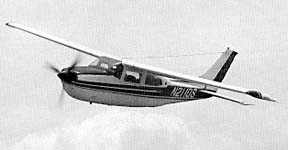
The upper end of the nonpressurized, single-engine retractable market is sparsely populated. If you need one of these big, fast, six-place load haulers, your choice is essentially limited to the 36-series Bonanzas, the Piper PA-32R Lance/Saratoga, and the non-pressurized Cessna 210 Centurion.
The Bonanza is widely regarded as the king of this particular hill, but the 210 can offer quite respectable performance and load-lifting capability for a lot less. The Piper is closer in price, but is both slower and slightly short on load carrying. There is a catch, however: 210s have a reputation for gear problems and poor quality of construction.
The 210 in many ways is a truly remarkable airplane, one that evokes expressions of awe and respect from owners. Even with the normally aspirated models youre talking about cruise speeds around 170 knots, coupled with useful loads of about three-quarters of a ton, equipped.
Add to that cruising ranges of 1000 NM and better with full tanks, and you have an airplane to be reckoned with when shopping for a fast aerial U-Haul.
History
The aircraft is a classic case of the grandfather clause carried to extremes. Certified way back in 1959 as a 2900-pound airplane with a strut-braced wing and a redline speed of 174 knots, it ultimately evolved into a 4100-pound, 325-HP pressurized behemoth with a 200-knot redline, designed to fly above 20,000 feet in icing conditions. The P210 was, in fact, the first pressurized single.
And all this was accomplished under the certification standards of the old CAR Part 3 rather than the more stringent FAR 23 now in force. Cessna reports that with later models it has conformed to newer criteria, but of course, it is under no obligation to prove this. The matter has in the past been a debating point in connection with the Cessna 210s in-flight airframe breakup rate.
The aircraft owes its origin to even earlier sources, since it is based on the Cessna 180 airframe. One of the interesting challenges posed to Cessna engineers way back then was the need to retract the gear into the fuselage instead of the wing. The system they came up with is more complicated than most, relying in early models on an engine-driven hydraulic pump, later upgraded to an electro-hydraulic system. The original system was also fitted to the early Skymasters, which also got the upgrade.
Service Difficulty Reports show landing gear problems remain at the top of the gripe list among owners and mechanics-by far. This is not unusual for retractables in general, but the Cessna system seems to have more than its fair share of problems. Many owners, however, report no trouble with the gear; this is probably due to diligent maintenance. Nevertheless, a complex system with numerous of actuators, pumps, plumbing, fittings, limit switches and the like is bound to be more troublesome than a simpler one.
The first 210s were fitted with 260-HP Continental IO-470s, a more powerful, fuel-injected version of the engine then in use on the Skylane. In fact, the first 210s were quite similar to the Skylane of the same era: Gross weight was 250 pounds greater, and empty weight was about 200 pounds more. At the time, of course, there was no other Cessna retractable. The niche filled by the first 210s was later occupied by the Skylane RG; by that time, the 210 had grown into a heavier, more capacious and more powerful airplane.
As the years went by, a series of changes was also made to cabin, wings and powerplants. In 1962 the cabin was enlarged a bit and outfitted with rear windows. Then, in 1964 engine power rose from 260 HP to 285 HP, and in 1965 a turbocharged model was introduced that went on to outsell the normally aspirated version by nearly two to one. In 1967, presumably to counter the scoffing of competitors, Cessna replaced the strut-braced wing with a cantilevered one (later used on the Cardinal), at the same time boosting the standard fuel capacity from 65 gallons to a whopping 90. However, since the airframe breakup rate of the cantilever models exceeds that of strutted ones, some critics question the wisdom of that change.
In 1970 Cessna made a big change in the cabin, boosting the seating from four places to six (four adults and two kids) and adding extra baggage space, while simultaneously increasing the gross weight by a hefty 400 pounds to 3800 pounds. A year later the 210 got a boost in takeoff horsepower, to 300.
Gear improvements
In 1972 Cessna finally reworked the gear system. While still hydraulic, it no longer relied on an engine-driven pump. Instead, it became a simpler electro-hydraulic system, though it was still more complex than straight electromechanical systems.
1979 brought another simplification in the form of elimination of the main gear doors. By getting rid of actuators, linkages and various switches, the system was made more robust (fewer points of failure) lighter and less expensive to build and maintain in one fell swoop. Loss of speed, if any, appears negligible, though there has been some debate on this point. Owners of older models can have their doors removed if desired.
In the same year, Cessna raised the gross weight to 4000 pounds (210N), then another hundred in 1985 (210R).
Since the Centurions were (and are) highly desired as instrument-flying ships, the specter of instrument loss from the failure of accessories led Cessna in 1982 to offer optional dual alternators and vacuum pumps. The dual pumps became standard with 1983 models as the turbo versions were offered with certification for flight into known icing conditions; pneumatic boots naturally imposed an extra burden on the vacuum system.
Also in the 1983 models, Cessna began installing new Slick pressurized magnetos to prevent misfiring at high altitudes. And in 1984 engine TBO went up from 1400 to 1600 hours.
Performance and handling
As we mentioned before, the 210 series is certainly fast. Pilots say that real-world cruise speeds lie in the 160-170 knot range, with climb rates of about 750 FPM at 120 knots indicated, though many do cruise climbs of 500 FPM all the way to altitude for better speed and cooling. With an IFR-equipped payload of about 970 pounds after full fuel, a late-model 210 can haul the astonishing load of five adults with about 22 pounds of baggage for each one. No other single comes close to this except the Piper Saratoga, which is still about 30 pounds shy. Furthermore, the Centurions have an unusually broad center of gravity envelope that tolerates loading extremes that would cause chaos in other airplanes (like the Bonanza, to name one).
The airplane does not have well-harmonized controls. Though the ailerons are delightfully quick for such a big airplane, pitch pressures are typically Cessna-heavy, as in the Skylane. The other side of the coin, as one owner noted, is stability: Its not meant to be an aerobat.
Thanks to limited elevator travel, the big Centurion is tough to wrangle into a full-stall break, so there’s nothing particularly nasty about them. Since its the heaviest airplane in its class, it must naturally be handled with respect, especially on landing. Judging from the number of hard landings, swerves, runway overruns and gear collapses in the accident reports, this is a matter to be reckoned with.
Although most Cessnas have an excellent reputation for short-field operation, the 210 (on paper, anyway) does not shine in this category in comparison with its peers. Minimum runway over a 50-foot obstacle tallies out at a little over 2000 feet, which is close to the figures given for the A36 Bonanza, but longer by several hundred feet than those posted by the other Bonanzas and Piper PA-32R.
Comfort and finish
With a cabin width of 44 inches in the middle and a height of 47 inches, the aircraft has a roomy interior for four adults and perhaps two kids. Wrote one owner: Its been a family machine, comfortably carrying, for example, four skiers about 165 pounds, skis, boots, poles, banjo, guitar and clothes for a week.
Fit and finish in many Cessnas is not the best, and the 210 is no exception. Owners complain of leaks and Royalite interior panels that crack and come apart with age.
Owners also complain that the rear cabin has a serious heating deficiency. The difference between the N and R models (hes owned both) is that the 1986 model is a flying freezer for anyone behind the pilot. The pilot roasts; the middle row passengers require full winter gear, and water freezes behind them. He noted that hed duly complied with Cessnas service bulletins on the matter. But nevertheless my family remains reluctant to fly again this winter.
Maintenance
Most of the owners offering feedback on 210s reported an average maintenance burden and annuals that run around $2500-$3000. Overall costs, depending on usage, area of the country and how each owner figures them, run about $150-$175 per hour.
Though production of 210s ended a dozen years ago, owners report good parts availability, albeit with high prices.
Gear woes
The main gear doors on 210s have been an ongoing problem for years. One of the more popular mods has been to simply remove them, a step eventually taken by the factory as noted above. The SDRs show a lot of gear-related problems in the 210, ultimately due, we suspect, to the complexity of the hydraulics used to swing the legs into place.
Among the various components blamed for gear problems in the SDRs: thermal relief valve in power pack unseated; landing gear door valve failure; hydraulic reservoir depleted from chafing by control cable; filter housing ruptured in flight; power pack pump failure causing continuous running and overheating; motor burned; and so on and on.
The historic nemesis of older Centurions, fatigue cracks in landing gear saddles, has apparently not abated completely. While a repetitive AD from 1976 addresses the issue, it still crops up from time to time in the SDRs. All 210s built from 1960 to 1969 live under the shadow of this problem. With luck, the cracks are found during annual inspections. If for some reason theyre missed, the saddles eventually break and the pilot finds out when one landing gear leg hangs up in the halfway position.
The AD calls for dye penetrant inspections at 1300 hours and annually thereafter. But mechanics have found cracks sooner in the life span. Saddle replacement was required for 1960 and 1961 models, but even they must be replaced every 1000 hours. Buyers should check the saddles and replacement times on these aircraft. Some owners simply replace them whether theyre cracked or not.
The 1962-67 models had the same original defective saddles, but differences in the retraction system allowed an improved saddle to be retrofitted. But even they have not eliminated the cracking problem. Later, 1968 and 1969 models came with the improved saddles as original equipment, but they must be inspected at 1200 hours and annually thereafter, and still run the risk of eventual cracking.
Finally, the landing gear system was redesigned in 1970, thus apparently ridding the line of the problem once and for all.
Magnetos
Mag failures also come up often in service reports. These involve Slick magnetos on all 210s, pressurized, turbos as we’ll as normally aspirated versions.
The FAA issued an AD late in 1988 (88-25-04) calling for inspection of pressurized mags for moisture contamination within the next 50 flight hours and at each annual thereafter for Part 91 operators. But the SDRs suggest that contamination was only part of the problem. Others called out failures from a variety of causes such as bearing failure, worn brushes, partially disintegrated distributor blocks, worn gear teeth, broken impulse couplings and broken mounting flanges, to name a few.
We talked to Slick Aircraft Products to see if they could explain the problem, and they said they believed it occurred when pilots flew through visible moisture and was a function of the plumbing design on the 210, which takes air from the induction manifold. They suggested that the problem was not as great in other aircraft that use pressurized Slick magnetos.
As for other types of mag problems, a Slick representative suggested that some might be related to improper maintenance in the field. In particular, extensive improvement and changes in Slick components since 1980 mean that some critical parts must be mated, and this means a mix-and-match use of cannibalized parts by some mechanics can pose a real problem.
Cylinder and other problems
Also cropping up fairly regularly are cracked cylinders, particularly in pressurized and turbo 210s. In 1986 Cessna brought out a service bulleting (SEB86-3) tagging, in turn, a Continental SB (M86-7) calling attention to unexplained cylinder barrel cracking that had caused instances of head separation. Inspections were required, to be repeated every 100 hours, on certain IO-520 and TSIO-520 engines.
In addition, those old bugaboos of any aircraft-vacuum pump and alternator failures-take their toll on 210s as well. In this context, AD 82-6-10 requires certain Cessna 210s to have two operable vacuum pumps before flying into IMC.
Potential buyers should also take care to check the horizontal tail for a variety of problems, including stabilizer and bracket cracking. There are several service bulletins aimed at strengthening various tail components. And make sure the elevator skin itself has not become corroded thanks to water absorption by the foam filler, especially in older 210s.
Back in the 70s the FAA received numerous reports of damage (loose or broken rivets, cracking and other problems) near the forward fittings, bulkhead and doublers. The problem is confined to fuselage station 209, and Cessna has kits to repair the problems or prevent them from happening.
More recently, Cessna issued service bulletins dealing with cracks in the lower forward doorpost and strut fitting (affects other Cessna singles as well); if any are found, a mod must be done. If not, repetitive inspections at 1000 hour intervals are called for.
Another bulletin warns of cracking in the nose gear downlock actuator pins. Again, its a repetitive inspection or installation of a service kit. Failure of the part could prevent the gear from locking down.
AD 91-22-1 calls for the replacement of cracked and chafing wires in the nose gear tunnel on all 210s. Other recent ADs include 97-26-17, inspection and possible replacement of the crankshaft, 94-12-8, calibration and labeling of the fuel system; and 93-13-9, replacement of the air induction hose on T210s.
Fueling gotcha
There’s one more thing to be aware of about the 210, a trait that could bring the pilot who pushes the limits to grief.
The position of the fuel caps on top of the wing, as designed, places them at the high point of the tanks. Its entirely possible that, if the airplane is not level or if the nose strut is not properly inflated, they may not actually be in the proper position. The effect of this is to prevent the tanks from being fully filled.
Given the dismal accuracy to be expected from aircraft fuel gauges, this potential mismatch between what the pilot thinks is on board and what is actually there poses a possible hazard.
Mods, clubs
Most airplanes are draggy enough that there’s a healthy selection of speed mods available. Its a testament to the 210s basic good performance that this is not the case.
Thats not to say there arent mods available, of course. Like any high-performance single, the 210 can benefit from the installation of speed brakes. Precise Flight makes electric brakes that work we’ll and are a good value. Precise Flight also makes standby vacuum systems.
Also of interest is the IO-550 engine upgrade, which is generally done in conjunction with a prop upgrade. Bonaire and Atlantic Aero offer this
There’s also the aforementioned gear door elimination mod, from Sierra Industries. Sierra also makes STOL kits, as does Horton and Bush.
All Cessna owners should join the Cessna Pilots Association ((805) 922-2580, www.cessna.org). They published a book on the 210 a few years ago, which several owners recommended as a further source of 210 lore.
Owner comments
I have owned five airplanes. The required Cessna 172, a Piper Arrow (a wonderful aircraft), a Cessna T182RG, a T210L and most recently my pride and joy, an A36 Bonanza.
The 182 was a maintenance nightmare. I sold it with tears in my eyes and quit flying because of the continuous problems. Six years later I got the flying bug again and I did what every smart person does who has trouble with a specific type of aircraft: I bought the same type, but bigger and more complex, older (19 years), with higher times (3200 TTAF, 950 SMOH) and more avionics to go wrong…yes!!! A turbocharged 210.
History repeated itself and I sold my T210 for the same reasons I dumped my T182RG, buying the A36 to replace it. This gives me the opportunity to provide a first-hand comparison between the 1975 T210L and a 1978 A36. There are good and bad points on each aircraft.
The biggest problem with the 210 was the constant maintenance. I just could not keep up with it. It was not really a matter of cost, but the actual maintenance scheduling and the constant hassle, almost a full-time job. I believe to own a mature high performance Cessna you need to be married to an A&P.
The gear wouldnt come up four times and more importantly it did not want to come down twice. I had constant problems with the ARC Cessna avionics including an electrical fire. This is in addition to nuisance problems like flaps that would not come down, engine stoppages due to vapor lock…you know, little stuff. Thank God for Flight Safety training: without it I think I would have been a fatality statistic. I was afraid to touch anything because often it would come off in my hand.
The Bonanza, by comparison, has been perfect. Tight, no rattles, doors don’t blow open and everything seems to work. Flying the Cessna, I was becoming neurotic, expecting equipment failure at any moment and constantly watching for falling debris.
The 210 was fast at 162 knots, 65 percent power on 15.5 GPH. The A36 will do 171 knots on 14 GPH but it has a speed kit installed. I miss the 89 gallons of fuel on the 210: the A36s 74 gallons seems inadequate. The Cessna is much more stable than the Beech. You put the nose down on the A36 and it really goes, right to yellow line.
Landings are easier in the Bonanza than the Cessna and the Beech seems to handle bumps better. It rides them out, versus the jolt you get in the 210. One item I thought Id miss in the A36 was the Cessnas rudder trim: it does not exist in the Beech. They must cant the engine, though, because it is not an issue and the ball stays fairly close to center during climbs.
Ive always heard how the Bonanza line is a joy to fly, with we’ll harmonized controls, a real pilots airplane. I personally prefer the stable, garbage truck with a loose front end feel of the Cessna. I would not want to fly the A36 without a working autopilot in IMC. The Cessna, no problem…which is good, because the Cessna autopilot doesnt work all that often anyway. Also the first time I stalled the A36 I was surprised how it bites and falls off sharply. In normal flight the A36 is a delight; the 210 is stable and relaxing. I vote for the 210.
It really is interesting that the insurance company views the Bonanza as easier and less complicated to fly than the Cessna. Im sure its because of the turbocharger, but hands-down, the Cessna is easier to fly. Insurance from the same carrier, by the way, was about the same cost for the two airplanes despite a hull value for the A36 of more than double that of the Cessna.
The Cessna wins on cabin comfort plus people ergonomics. You have a door on both sides, plus a wing that shelters you from the sun and rain. I also miss the center area for chart storage, lots of cubby holes for stuff (like the odd bits and pieces of the airplane that fall off) and, of course, the elbow room.
The payload on the 210 is much higher than the A36. The Beech with full fuel can carry 766 pounds, the Cessna with full fuel, 900. The normally aspirated model probably has another 100 pounds or so available. The CG problem you hear about on Bonanzas is not a real practical issue on the A36, but again the Cessna is better; you don’t even have to think about it for the most part.
I averaged about $17,300 per year on gas, maintenance and hangar for the Cessna. Looks like the Beech will be about $12,000, apples to apples. Is the cost disparity a fluke? Maybe, but I have two Cessna airplane data points over six years. For the flying I do, this works out to $192/hour for the 210 and about $105/hour for the A36.
I love my Beech. The emotion towards the 210 was disbelief that an airplane in which so much of the design and maintenance is regulated could be so problematical. It is actually less reliable than my 1951 Harley Davidson Panhead motorcycle, a machine not exactly known for its stellar reliability record. Both of my Cessnas have been worse…much worse. Was my Bonanza worth 2-1/2 times the purchase price of the Cessna? You bet!