











Many an aircraft owner has rationalized an expensive airplane purchase with this reasoning: Yes, it costs a ton of money to own but it saves me so much time that its a bargain.
Put a sharp pencil to that equation, however, and the numbers start to look like that fuzzy math a certain Texas governor has so much trouble understanding. The truth is, for GA owners, airplane economics rarely push the bottom line into black ink.
One exception to that is a certain class of working airplanes, the sort that haul freight and passengers over short distances, spray chemicals and fertilizer, snap photos for survey work and, in general, do the scut work where there’s profit but no glamour.
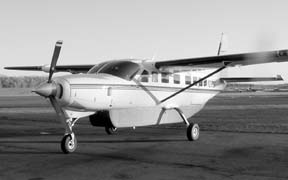
And within this class, the Cessna Caravan is a standout. Certificated in 1984, when the industry was on the big downhill slide, the Caravan married a 600 HP Pratt and Whitney turbine to a massive airframe with volume enough to haul large and heavy stuff with ease.
In essence, the Caravan advanced the humble bushplane to the next level. But unlike a bushplane, it was frightfully expensive, selling for nearly $650,000 in 1985 dollars and upwards of $1.3 million today.
But Cessna and buyers soon discovered that the Caravan was so reliable and hauled so much that it could carry both cargo and debt load and still turn a profit. Thus was born one of the most unique and successful small utility airplanes ever to roll off an assembly line.
History of the Line
In the early 1980s, Cessnas Pawnee Division, where the 208 was designed, enjoyed a period of productive serendipity. John Berwick, a knowledgeable chief engineer with extensive experience in homebuilt aircraft teamed with Dave Ellis, one of the finest advance design engineers in general aviation.
The flight test department was headed by legendary general aviation test pilot, Bruce Barrett, and this team produced two of the best handling airplanes ever built, the T303 and the 208. Only the recently certificated Cirrus SR20 is as nice to fly as these airplanes.
With the continuing success of its utility line of singles, the 180, 185, 206 and 207 (in seven- and eight-seat versions), each bigger than its predecessor, and the booming aviation market of the late 1970s, Cessna felt it could develop a bigger single-engine hauler. This new airplane would carry DeHavilland Beaver or Otter-sized loads, but at decent speeds, perhaps replacing those aging workhorses.
Cessna did its homework. It spent hours with the users of the 180 and 206 series on wheels and floats to find out what was good and what could be improved in a bigger machine. Engineers visited bush operators in the Yukon and Alaska and the oil rig-supply operators in Louisiana.
Many got a little dry-mouthed at the rides they had but they came away with the understanding that cargo operators wanted strength, toughness, absolute reliability, or at least something that could be fixed easily in the middle of nowhere.
They also wanted the ability to haul as big a load as possible, a huge cargo door so the airplane could be loaded with a fork lift, a flat floor and as few things that could break as possible. They didnt care about creature comforts, yet were very aware of pilot fatigue and the resultant faulty decision-making that comes from hours in a poorly-designed seat in a roaring, vibrating airplane. They also wanted a tailwheel. But all complained of the difficulty in finding competent tailwheel pilots.
207 Template
The starting point was Cessnas limousine-with-wings, the 207, which was simply widened. That plan didnt last long. The next step was to look at what the users wanted and what the company had a history of doing well. The result a strut-braced, high wing, nosewheel airplane that was extremely strong.
The tubular main landing gear appears to be one long piece, although its really a three-piece steel tube arrangement thats hell for stout but is attached to the fuselage in such a way that it can be quickly removed to install floats. Also, it will snap off in a crash without deforming the cabin floor, thus helping keep the folks inside alive.
The nosewheel was built substantially larger than anything seen before and has an oil snubber arrangement that eliminates air space that can lead to condensation and ice crystals in cold environments and also obviates oleo strut leaks.
For aft loads, the nose strut is braced with a drag link that started life as a main landing gear leg for a 172, thus it can handle severe up and aft loads.
The only Cessnas the military bought in quantity after the Bird Dog had nosewheels and Cessna wanted to sell the 208 to the military. Cessna had also learned that airplanes that require finesse to fly, such as the Cardinal, don’t sell well, so the 208 would have to be easy to handle. So, the tailwheel that bush operators wanted was ruled out.
Cessna was still uncertain about whether to go ahead with final development and production of the 208 until its discussions with Federal Express bore fruit. FedEx, looking for a way to service smaller communities, agreed to buy more than 100 208s right off the bat, with options for more. As it happened, FedEx got the first several hundred airplanes. Their experience evidently impressed other potential customers, for there are more than 1000 Caravans in service, fewer than half of which were originally built for Federal Express.
By the end of 1985, Cessna had certificated the 208A Cargomaster, essentially the 208 with no windows, different avionics and no air stair door. Its believed that all 208As have been modified back into no letter 208 configuration.
Powerplant
The powerplant decision was difficult. A heavy hauler requires lots of power. Turbines provide that kind of power in small packages with reliability and long periods between overhaul when compared to pistons. However, theyre staggeringly expensive for an operator flying single-engine bush planes. Still, in Cessnas favor was that it was becoming difficult to obtain avgas in many parts of the world. So the nod went to the Pratt and Whitney PT-6A-114 with 600 shaft horsepower. It would swing a wide-chord, 100-inch long, Kevlar propeller from Hartzell.
The engine was canted down and to the right to minimize the effects of power changes. The PT-6A has earned a reputation as a reliable easy-to-operate workhorse and history has proven that Cessna chose right.
The fuselage was designed to carry 10 people without being too cramped and still have a cargo area behind the seats the size of a regular pickup truck bed. The 62-inch wide cabin allows three abreast seating with an aisle.
Float operators wanted doors on each side of the fuselage for docking, so two crew doors were mandated. The doors open a full 180 degrees so that a person on a float can get past the open door quickly. A 50-inch high by 49-inch wide cargo door on the left side of the fuselage is split so that the top half opens upward while the bottom swings to the side. It can be removed and a roll up door installed for skydiving operations.
The cargo door is behind the wing so a forklift can drive up to the fuselage at a 90-degree angle. Opposite the cargo door is an air stair for the comfort of passengers. Because the floor is 42 inches off the ground, the pilots board via individual ladders that cleverly fold to form outboard arm rests for the crew seats. The seats were designed to progressively collapse or stroke to meet the new FARs for impact loads.
High-Performance Wing
To get the necessary cruise performance, a high-aspect ratio wing was chosen, with a NACA 230 series airfoil, similar to the 300 and 400 series Cessnas. It needed such long span flaps to reduce the stall speed to the required 61 knots, that there was little room left for ailerons.
Even with a span of more than 51 feet, the available aileron area simply couldnt give the roll control desired. Cessna had built a Model 308 in the early 1950s with a wing only four feet shorter and discovered just how sluggish in roll a long wing could be.
In what is still a surprisingly little known decision, the Caravans roll control is primarily via slot-lip spoilers that start moving when the up aileron deflection goes past five degrees. The relatively small ailerons are considered feeler ailerons and mostly exist to get rid of the dead spot in a spoiler control system when both spoilers are stowed. The result is that a pilot who isn’t told about the spoilers will never guess they exist, other than noticing there’s almost no adverse yaw with roll input.
The wing structure is designed so that failure of one or two components will not be catastrophic. For crashworthiness considerations, fuel is stored between the spars, and we’ll outboard of the cabin. The flaps reduce the stall speed by a full 14 knots at max extension, 30 degrees. There’s virtually no pitch change during extension or retraction.
Simple Systems
Systems were made to be as simple as possible. The flaps are electric and there’s no hydraulic system other than for the brakes. The inertial separator in the engine intake is manually controlled by what looks like a snow shovel handle.
The cowling halves can be opened with three simple latches. A pilot facing a morning start after a freezing night can take the battery out of the airplane in about 30 seconds and carry it in where it can stay warm.
The engine controls for the PT-6A are standard, however, there’s an additional emergency power lever to the left of the power lever. Its connected to the manual override lever on the fuel control unit of the engine and governs fuel supply to the engine should a pneumatic malfunction occur in the fuel control unit.
A pneumatic failure results in the fuel flow dropping to minimum idle power setting. The emergency power lever allows the pilot to restore power in the event of a pneumatic failure. It makes a very reliable engine even more reliable.
Interestingly enough, the flight testing leading to known-icing certification showed that boots were needed for the wing struts as we’ll as the usual leading edge surfaces, leading the 208 to be the only airplane with which we are familiar that has deicing boots on the struts. (As noted later, TKS is now an aftermarket option for the Caravan.)
Originally, the 208 was certified with a Hartzell, composite propeller, to keep weight down, plus the Hartzell had fairly short, wide-chord blades, which improved ground clearance, considered to be essential to avoid erosion on unimproved strips and on the water.
Naturally, this made one of Cessnas divisions, McCauley, unhappy, as it had provided most of the propellers for Cessnas for years. McCauley then developed a 106-inch diameter aluminum propeller which was eventually offered as an option.
McCauleys timing proved fortuitous as field experience with the Hartzell composite was not good. Erosion, even with a metal leading edge, proved to be worse than anticipated. While repairs to a composite surface can be relatively easy for someone trained to do them, its still necessary to get the surface up to room temperature, something that was difficult to do in the arctic.
To our knowledge, once the McCauley propeller was offered as an option, no more Hartzells were sold as original equipment. Users didnt care about the weight, they wanted the aluminum props.
Cargo is King
The Caravan was designed from the outset to be a load hauler but its especially good at large, bulky items. In fact, FedExs concern was bulk rather than weight, and since Cessna had put cargo pods on a number of its singles, it responded with a cargo pod for the 208. It increases the available volume of the airplane by about a third.
Service experience indicated that the airplane could be cubed out before it was overloaded, so, as it did in turning the 206 into the 207, Cessna stretched by the 208 by four feet and made the 208B, the Super Cargomaster.
Initially, it had the same 600 SHP engine as the 208, but the PT-6A-114A with 675 SHP almost immediately became available to buyers. The higher power engine option was added to the 208 as we’ll in the last two years. A passenger version of the 208B with windows, the Grand Caravan, has proven popular with small airlines around the world, particularly outside the U.S. where they can be fitted with 14, and, we are told, in some cases, 16 seats.
Its gotten to the point where a Grand Caravan will be filled with passengers, the cargo container filled with their bags and a Cessna 206 will follow along behind, carrying the remainder of the suitcases.
The upshot of the 208 series has been owners who report dispatch reliability that exceeds even marketing writers ability to exaggerate. We routinely hear of dispatch reliability of over 95 percent with some reporting in excess of 99 percent.
For outfits that had been running aging Twin Beeches for years, the idea of sending airplanes out night after night without anything breaking was a new experience. Operators report that 208s need very little unscheduled maintenance, as opposed to the machines they had replaced.
With maintenance costs reduced substantially, the initial purchase price and monthly note proved to be easier to swallow than having to pay mechanics to swarm the airplane every time it landed. The engine reliability finally lead the FAA to approve single-engine, IFR-for-hire, passenger operations under Part 135 for the Caravan, something that generated even more customers for the airplane.
No Macho Handling
Yes, there are those few who can afford a personal Caravan on amphibious floats. Frankly, we envy them. The only downside is that its only the 208 thats so approved; the 208B, has not been certificated for floats. Some tourist operators that run 208s on floats and are grateful for the fact that there are a number of cargo compartments in each float, a tribute to some bush pilots who said they wanted any open space in the airplane to be capable of carrying something.
Flying a 208 leaves one with mixed feelings. The macho feel of sitting up high and looking down on other singles, and the great fun backing into parking spaces is nearly cancelled by the dirty secret that the airplane is so easy to fly that we suspect a brand new student pilot could be soloed in a Caravan in about five hours, with little worry about handling the airplane safely.
Every pilot weve spoken to comments on how simple the airplane is to fly and how nicely it handles. While many compare it to a Cessna 182, its lighter on the controls, more solid, with even better control harmony than the Skylane.
While the 208 is easy to fly for the beginner, it does reward the more experienced pilot as finesse is developed. Its a solid instrument platform and a good pilot can use its wide speed range and high flap operating speeds to fit in at high density airports or slow nicely to get in and out of shorter strips.
Its not a STOL airplane, but it will deal with most all general aviation airports in the U.S. as we’ll as many of the unimproved strips around the world.
Most versions of the series have a payload in excess of 4000 pounds, some will carry that even with a couple hours of fuel. When loaded to gross, most will climb in excess of 900 FPM at sea level. Given that the no letters max takeoff weight is 8000 pounds and the B models is 8750 pounds, thats respectable. The CG range is adequate, if not generous. Skydiving operators report that the airplane gets tail heavy with lots of jumpers hanging out and none up front, while a Twin Otter will tolerate this better.
In flight, the pilots position we’ll ahead of the wing on all models means that visibility is as good as the Skymaster. The only way to improve visibility would be to make the airframe and engine out of Plexiglas. As 208s are often found in the patterns of small town airports at any time of the day, being able to see we’ll is a nice safety feature.
Fully loaded, the airplanes in the 208 series take from 1200 to 1400 feet to get off the ground, and about 2500 feet, worst case (Super Cargomaster) to clear a 50-foot obstacle on a standard day, at sea level.
Being able to select reverse thrust after landing is a pleasure at smaller airports where snow removal may not be the best.
Full reverse after the mains touch puts the airplane firmly on the ground, especially if the flaps are raised immediately, so heavy braking can be laid on to stop the airplane in very short order.
Taxiing in, pilots like being able to put a wing tip over the top of parked airplanes on crowded ramps, so the 51-foot wingspan is rarely a problem, other than it wont fit into a T-hangar.
No matter how long the trip, it rarely pays to climb above 8000 feet, as the fuel burned getting to altitude usually cancels any advantage gained in reduced fuel burns once there. In general, the 208s without cargo pods will move along at max cruise at about 180 knots. With a cargo pod, subtract about 10 knots from the cruise speed. Subtract 20 knots or more for floats.