











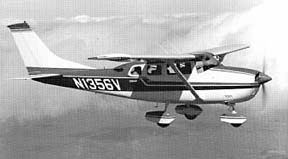
A long-standing axiom is that speed sells. Thats true, but only half way: The other side of the coin is load carrying, a trait that for some is more important than getting there fast.
Periodically, the public decides that big, heavy load-haulers are desirable (usually when fuel is relatively cheap). That accounts for the current popularity of enormous truck-like vehicles on the roads, and the skyrocketing prices of airplanes like the Cessna 206.
This aerial sport/ute is not fast, but its stable, rugged, reliable, has six real seats and is remarkable for being able to carry a half-ton or so after the tanks are filled.
So popular is the combination of simplicity and load-carrying that Cessna has fired up the 206 line once again, and its possible to go out today and order a brand-spanking-new 206 for considerably more than $300,000. It speaks we’ll of the 206 that its one of the three piston singles Cessna saw fit to bring back to the land of the living, the other two being the Skyhawk and Skylane.
History
Cessnas biggest fixed-gear piston single is really three models, though all are essentially the same airframe. It was originally introduced in 1963 as the 205, with two doors up front and a relatively small rear door. The engine was a 260-HP Continental IO-470. This airplane was a fixed-gear version of the recently revamped 210; it was produced for two years, with 577 delivered.
In 1964 Cessna responded to demand for more utility and created the U206 (U for Utility) Super Skywagon, with a 285-HP Continental IO-520A, redesigned wing and bigger flaps. Intended as a flying pickup truck, even the seats were optional. There was one door for the pilot and a big double door aft on the right side.
1965 saw the 205 become the P206 Super Skylane, P representing (according to a reader who owns one) Personal. The P206 had the same door arrangement as the 205, but with the bigger engine from the 206. The U206 was by far the more popular of the two.
In 1967 the U model got a takeoff weight boost and new engine, a 300-HP Continental IO-520-F, while the P model kept the 285-HP IO-520-A. Turbocharging became available on both variants in 1966, with a 285-HP Continental TIO-520C. The P206 was discontinued in 1970, with a total production run of 647. The remaining U206 and TU206 were offered with either a utility or passenger interior, and renamed Stationair.
A stretch of the fuselage brought the 207 Skywagon into being in 1969. One more seat was added, bringing the number available to seven. Useful load went up by about 30 pounds. An additional bonus was the inclusion of a nose baggage compartment, easing the task of getting the CG in the proper place during loading. The turbo model of the 207 had a variant of the TIO-520, with 300 HP.
Camber-lift wings, which feature a slightly cuffed leading edge, were added in 1972. These improved low-speed handling at almost no cost to cruise speeds. At the same time, the baggage compartment got a seven-inch stretch (more on this later). An aerodynamic cleanup in 1975 boosted cruise speed by about six mph. The cleanup included more-streamlined wheel pants and improved cowl flaps.
In 1977 the horsepower of the turbo engine was upped to 310 (for takeoff only) on both the TU206 and the T207. A wet-wing fuel system was introduced in 1979.
In 1980 the seventh seat of the 207 was widened to hold up to eight passengers. This created the Stationair 8, but the designator remained 207. The world would have to wait for the Caravan to see the 208 and the ultimate evolution of the high-wing, strut-braced single. The 207 was discontinued in 1984, and the 206 two years later.
Marketplace
Enormous fixed-gear singles arent all that common in the marketplace. In terms of mainstream aircraft, the choices are pretty much limited to the Cessnas and Piper PA-32 Cherokee Six/Saratoga. Prices are comparable, and which makes the better choice depends in part on your needs. The Pipers have the wing spar running through the cabin right behind the front seats, disrupting the loading area somewhat, and the Cessna is definitely the airplane of choice for floats. Both companies products have proven to be reasonably reliable over the years.
The Pipers do have an edge in TBO. While the best one can hope for from any Stationair model is a 1,700-hour TBO, the -540-series Lycomings bolted on the Pipers have a TBO of 1,800 hours (for the TIO-540-S1AD), and as much as 2,000 hours in the case of the IO-540-K1G5 on the Saratoga and Cherokee Six.
Loading
This is the name of the game for Stationair pilots. While no airplane can handle anything you can fit in it, the Stationair comes closer than most. Full-fuel payloads of 1000 pounds or better are not at all uncommon.
The big rear cargo doors-which create an opening more than 44 inches wide-make getting bulky cargoes inside less of a chore than in other aircraft. Indeed, in the U (for Utility) models there are no seats, leaving a mostly flat floor for cargo. Another nice touch is the lack of a lip at the doors, so cargoes don’t have to be maneuvered up and over to get them inside. Specialty kits were made available so the Stationair could take on such jobs as glider towing, parachute jumping and even aerial hearse service. There was also a cargo pod available.
With or without the cargo pod, the Stationairs offer ample loading flexibility. The allowable CG range is fairly wide, making cargo/passenger positioning less of a juggling act than with many aircraft. However, despite some pilots assertions that, If you can get it in, you can take off, weight and balance computations are not optional. Several accidents over the years show it is possible to load a Stationair outside its envelope.
Comfort
While the Stationairs have large cabins, theyre not long on comfort with a full load of passengers. Noise levels, particularly during takeoff and climb, can be fairly high as piston-engined singles go. And the rear-most seats-row three in the 206, rows three and four in the 207-leave little in the way of leg room.
Another comfort consideration is the baggage compartment. In spite of Cessnas best efforts, it doesnt quite match the capabilities of the passenger compartment. As a result, passengers may find themselves sharing space with their bags.
Performance
Top cruise speeds will run in the 145-knot area while burning 15 gallons per hour or more. Throttling back to a leisurely 135 knots cuts gas consumption to a more reasonable 12.5 GPH.
Handling matches the aircrafts size. Pilots who enter the Stationair after climbing the Cessna model ladder may find the aircraft is just more of the same (only heavier). None of the respondents minded a bit: snappy handling was not why they bought the airplane.
This is not without its benefits, though. It makes the Stationair an excellent IFR platform-stable and rock-solid. It also makes for a relatively smooth ride in turbulence.
Another benefit is that the Stationair is reluctant to stall. Pitch forces are fairly heavy to begin with. Compounding this is the generally nose-heavy loading of the airplane. Since the CG envelope is so long, and most everyone wants to sit up front, the CG is often at or near its forward limit. Also, with power on, the deck angle required for a wings-level stall is alarming. Put it all together and the Stationair is not generally a willing participant in stalls.
A drawback of this nose heaviness is a tendency to arrive nose first during landing, especially at light weights. It takes a hefty pull on the yoke to flare properly. Thus, the Stationairs are no strangers to hard, nose-first landings that sometimes damage the aircraft. In the 207 version, the nose baggage compartment can simply add to the nose heaviness. However, using less than full flaps for landing (say only 20 degrees) can ease the control forces required to flare. Also, as one reader aptly put it, that is what trim was invented for: use it.
Like most Cessna singles, the 206 does pretty we’ll in short/soft/rough field operations, a big factor in the purchase decision for many of our respondents. Early models had 40 degrees of flap, which helped tremendously for short arrivals. However, the airplane just wont climb with that much aluminum hanging out in the breeze. Cessna later limited flap travel to 30 degrees.
Maintenance
Simplicity is a good thing, and helps keep maintenance costs down…but on the other hand, Stationairs are working airplanes by and large, and wear and tear can easily turn the tide in the other direction.
Weve seen problems with the tail, mostly corrosion caused by the foam-filled elevator and trim tab getting soaked with water and pulling of rivets, screws and nuts.
Some of the brackets in the tail can crack. There have also been some instances of cracking door posts, though these problems have not proven to be a safety issue.
Given the number of respondents who routinely operate out of short and rough fields, combined with the nose-heavy landing tendency, we recommend paying close attention to the landing gear (particularly the nose gear) and brakes.
And, of course, there’s the perennial favorite: case and cylinder cracking. This is not quite as much of a problem as it once was, since owners seem to be more willing to pamper their engines these days. The availability of quality engine monitoring instruments helps, too.
There have been a couple of 206/207 specific ADs: 85-2-7 calls for inspection of a roll pin in the fuel selector, and 85-10-2 mandates recurrent inspection or modification of the induction air box. Other ADs of note are 91-15-4 and 82-27-2, inspection of the prop; 97-26-17, ultrasonic inspection and possible replacement of the crankshaft; and 96-12-22, recurrent inspection of the oil filter adapter.
The 206/207 is also subject to the infamous 84-10-1 fuel tank bladder AD.
Mods, club
There’s probably a modification available for the 206/207 to allow it to do most anything someone might want to do. This includes skis, floats, long-range tanks, STOL kits and various speed mods.
A recent mod is an engine upgrade to the Continental IO-550, available from Bonaire Aviation. This has the potential to add some utility to the airplane; wed love to hear from anyone whos had it installed, to let us know how we’ll it works.
As far as owner organizations, the Cessna Pilots Association (www.cessna.org, (805) 922-2580) comes highly recommended.
Owner comments
I purchased a 1985 C-206 in May of last year, with only 475 TT. Since then I have flown about 300 hours all over Venezuela where I live. The airplane was and still is in like-new condition, as it has been always hangared. I purchased it for $138,500, in addition I had to pay for all the ADs and SBs which were overdue-they amounted to $5,500 for parts and labor including replacing all the hoses, and a 100 hr. inspection which included magneto overhaul and paint retouching, totaling US$2,500 parts & labor. Other than that I replaced all the Cessna radios and had two KX155 navcomms, a KT76a transponder and a GPS 35 from King installed and coupled to the HSI.
The airplane has been a real joy to fly and lets me get into the tight runways often found in this country. The heaviest load I have carried was last January when I visited Angel falls: we were five 175 pounders plus two cases of beer, five small backpacks, a 10 gallon cooler full of ice and full fuel (92 gallons). The airplane behaved nicely and the only precaution I took was to land with only 20 degrees of flap and a tiny bit of power.
Ever since I bought the airplane I couldnt use 2300 RPM above 5000 feet due to the onset of vibration, felt in the wheel like a car with the front tires not balanced. The vibration started at about 2380 RPM and increased rapidly when lowering the RPM until 2300 RPM when it got really bad. I tried everything, magneto overhaul, spark plug change, dynamic balance on the prop, I even had a witch doctor from one of the tribes here take a look at the engine and prop. Probably the latter worked, because a couple of days later I read the yearly summary of products that The Aviation Consumer publishes and the GAMI injectors article caught my attention. Without really knowing why, I ordered a set for my C206 and had them installed; the vibration disappeared completely and the engine runs very smoothly, with lower cylinder head and oil temps. Fuel consumption after installing the injectors is about 50 liters per hour; before, it was about 55 liters/hour. Oil consumption is 1 liter per 20 hours.
Insurance in this country runs $4,500 per year, and a typical 100 hour inspection goes for $1,500 labor and parts. I usually cruise at 130 to 135 KTAS, 21 to 23 in. MP, 2300 RPM at 5500 to 8500 feet. I expect in the next 12 months the need to overhaul the vacuum attitude gyro, the HSI and the electric attitude gyro. It should run into about a thousand dollars altogether. So adding it all up I should expect to pay about $4,000 for maintenance, $4,500 insurance, and about $3 (no, its not a mistake) per hour in fuel in the next 12 months.
I think this is the perfect airplane for fun, business or both, easy to fly, economical to maintain. Although it is a little slow, 130 to 135 KTAS, it gets me to the tightest runways this country has to offer.
Andres Visani
Caracas, Venezuela
I have owned a 1978 turbo-charged Cessna 206 for two years. In my 21 years of flying I have owned a 1978 T-tail Turbo Lance, a 76 straight-tail non-turbo Lance, a 1970 H295 Helio Courier turbo, a 74 Piper Navajo, a 680V turbine Commander and a 79 Britten-Norman Islander.