











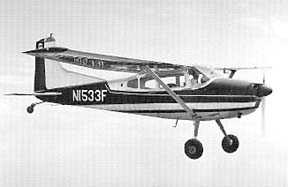
This big, burly single is Cessnas equivalent of a mid-sized pickup truck, able to tote a load into (and out of) a variety of out-of-the-way places. The 185 is in many ways the epitome of the working airplane, designed specifically to haul big loads and operate from unimproved strips. Over the years, its proven very capable and popular.
History
The Cessna 185 was introduced in 1961 as a more powerful sibling to the popular 180, which had already been in production for eight years. The 185 outlasted the 180 by four years: the 180s last year of production was 1981, the 185s was 1985.
Physically, the two airplanes are quite similar with comparable dimensions. The difference can be found under the cowl.
While the 230 HP 180 has always been a fine utility airplane, it did come up a tad short where it really counts: Useful load. The original 185, fitted with a 260-HP Continental IO-470F and 84-gallon fuel tanks, can perform the rather remarkable feat of lifting more than its own weight: The useful load of 1,680 pounds is about 200 pounds more than its standard empty weight.
Over the years the 185 didnt change a great deal. It never got the improvements of a back window and swept tail that graced (afflicted?) most other Cessna singles. Call us conservative, but weve always preferred the looks of the straight-tailed, fastback Cessna singles to the later airplanes.
The 185s options list was work-oriented from the start. The airplane could be ordered with Edo floats, a big belly-mounted cargo pod having a capacity of 300 pounds, or an ag spray rig. This equipment was offered throughout the production run.
The biggest alteration to the 185 came in 1966, when Cessna made the big Continental IO-520D engine an option. This engine put out 300 horsepower at takeoff, 285 continuous. (Piper fitted a 300-HP Lycoming on their load hauler, the Cherokee Six, the same year). The 300-HP Skywagons are called A185s.
The bigger engine did good things to the 185s performance. The 10-pound increase in empty weight was offset by a 100-pound increase in gross, cruise speed went up by five knots, the takeoff ground roll went down by 200 feet, and service ceiling went up to 17,300 feet.
The engine proved so popular that it was made standard in 1967. Also new that year was the addition of an aft baggage compartment, along with an optional stretcher door, which make loading bulky objects easier.
The only other major change to the airplane came in 1973, when a new wing profile was introduced. The Camber Lift wing was originally created by Robertson as part of their STOL kit. It drops the stall speed slightly and improves roll control at low speeds. Robertson can retrofit the leading edge to earlier 185s.
This change resulted in the A185F, which is by far the most popular variant of the 185; more than half of all 185s built were this model. A185s as a group account for 74% of all 185s built.
Other changes werent so dramatic. In 1974, some interesting options were offered, in the form of bubble side windows, more windows built into the doors, and skylights.
1976 saw an increase in flap-extension speed (Vfe) from 96 to 120 knots, and the fuel selector was changed to Cessnas nearly idiot-proof left-right-both arrangement. Lift handles were offered to keep ground handlers from yanking on the horizontal stabilizer when moving the airplane (one problem shared by most Cessnas is the potential for stabilizer damage resulting from line personnel shoving on the horizontal stabilizer to more the airplane; weve all seen it, and while it makes the airplane easier to move, it also can cause significant damage).
The same year saw a reduction in usable fuel from 81 to 74 gallons, which cut into the airplanes range significantly.
In 1978, a three-blade McCauley prop was made optional. Like the bigger engine, this soon became standard along with a heavier engine mount. (One reader reported that retrofitting the later mount helps reduce vibration in earlier airplanes as well.) The benefit of the three-bladed prop is a reduction in noise. The bigger two-bladed prop makes a heck of a racket at takeoff, mostly because the tips are moving so fast.
1979 models had a new wet wing fuel system with an 88-gallon capacity, of which 84 is usable. The older bladder-style tanks were optional. While the bladders had less potential for leakage, they had other problems (more on this later).
After 1980, when the three-bladed prop was made standard, few changes were made to the line. Production dropped off dramatically after 1980-81: In that two-year period, 389 Skywagons were built. 82-83 saw only 87 come off the line, and in 1984 and 1985, only 34 made it through the factory doors. During those six years (1980-1985 inclusive) the average equipped price nearly doubled, from $55,670 in 1979 to $108,090 in 1985. The airplane has been a good investment: Today, that same 1979 model will bring $135,000, while the 1985 model can fetch $185,000.
Performance and handling
Owners love the 185s performance. If youve got the cash to feed fuel to that big IO-520, it will pay dividends in solid performance figures. Heres an example of what you can expect: Load a Skywagon with full fuel, four 220-pound people, and better than 40 pounds of baggage per person, and the airplane will take off in just over 800 feet, climb at better than 1,000 FPM, and then fly 800 miles at 140 knots. Thats impressive.
The big fuel-injected, normally aspirated engine gives good climb performance. Service ceiling is up at 17,900 feet. Climb rates of 500 FPM at 10,000 feet are easily achieved.
The engine is, predictably, a gas guzzler, yet still not that bad considering the airplanes performance. Fuel flows range around 14.5 GPH, depending on power setting and atmospheric conditions. 10 nautical miles per gallon is fairly good for a vehicle as capable as the Skywagon. Think of it as a sport-ute; the mileage and hauling capacity isn’t all that different, but its a whole lot faster.
While the 185 can cruise 147 knots at 7,000 feet, most owners reduce the power a bit and settle for a couple of knots less in cruise speed.
If you need efficiency, the 185 can climb to 12,000 feet, where a power setting of 2400 rpm and 18 inches of manifold pressure will yield 130 knots TAS, burning only 10.8 GPH. And this is with an 1,100-pound payload.
The Skywagon, like many Cessnas, is almost a STOL airplane out of the box. The big barn-door flaps can be cranked out to 40 degrees, and the full-flap indicated stall speed is just over 40 knots, power off. Landing distance, according to the book, is 585 feet at full gross with no wind. Weve heard of bush pilots pushing the envelope and plunking the Skywagon down in as little as 300 feet. The trick, apparently, is to keep the nose up, carry some power, and shoot for a speed of between 50 and 55 knots. Then, after a full-stall three-pointer, dump the flaps and stomp on the brakes (though not hard enough to nose over, thank you). This technique can be very dangerous, because it makes no provision for a power loss or wind shear.
The 185 is not easy to land. Like all taildraggers, its easy to groundloop if youre not sharp on the rudder pedals after touchdown. Still, it doesnt suffer from some of the ills found in other taildraggers. Its possible to see over the nose while taxiing (if youre tall enough), so S-turns arent necessary. Its also a fairly long airplane, so its not as twitchy as some of the close-coupled designs.
One landing quirk stems from the design of the landing gear. The 185 has the typical Cessna spring-steel landing gear legs, which means that its easy to bounce during a wheel landing. If the pilot doesnt stay on top of things and turn that first bounce into a full-stall three-pointer, a series of hops down the runway, likely to end in a loss of control, will probably result. Most pilots prefer three-point landings because of lower speeds. Readers report excellent low-speed controllability right down to the stall, so making a good three-point landing isn’t that hard once you get the hang of it. The tailwheel locks, incidentally, which helps during crosswind landings and on rough fields.
In the air, the 185 is steady and pleasant. The airplane is similar in handling to a 182. Some pilots report that it does require some rudder to fly well, however.
Control harmony is said to be good. Trim, unlike that on most Cessnas, is through a jackscrew in the tail rather than via a trim tab. Its geared low, so that a lot of movement of the trim wheel is necessary to have a significant effect. Cessna didnt offer electric trim, but some autopilot installations include it, and the pilots who have it like it much better than the manual system.
The 185, thankfully, has manual flaps. Weve always preferred manual flaps to electric ones, for two reasons: First, theyre stone-simple and therefore easy and cheap to maintain. Second, there’s never any doubt about how many degrees of flap youve extended.
Full-flap go-arounds should be approached with caution. The 40-degree flap setting, coupled with the slow response to trim and all that horsepower, means that cobbing the throttle for a go-around will result in an impressive-and dangerous-nose-high attitude. The pilot will get very busy trying to dump flaps and crank the trim wheel while at the same time keeping the airplane from pointing straight up. A better technique is to apply partial power (enough to stop the descent), reduce the flaps and some trim, then firewall it.
Load carrying
As weve noted, the 185 can haul a lot of weight. Getting that weight on board is another matter, however.
Despite the availability of an extended baggage door, the 185 cant hold a candle to the Cessna 206 or Piper Cherokee Six when it comes to getting bulky items on board. Cessna promotional photos show ranchers loading 55-gallon oil drums on board a 206, and a Piper brochure showed a piano, of all things, going into a Cherokee Six.
Some years ago, while talking to the Cessna marketing department (this was before they stopped building small airplanes), we asked about the lack of a decent cargo door in an airplane otherwise so we’ll suited to carrying cargo. We were told, If they want to carry oil drums or pianos, they should buy a 206.
The key is a set of big double doors aft of the wing in these airplanes. The 185, by contrast, has the relatively puny baggage door (18 by 20 inches), and a pair of regular fuselage doors. These cant even open all the way, because the wing strut interferes. Fortunately, the right front door can be removed easily, as can the back seat. This helps, but not all that much…cargo must still get past the front seat.
Extra cargo (though not bulky items) can be carried in the optional belly pod. The fiberglass pod is nine feet long and 14 inches deep. There are two doors, one in the side and another in the back. While truly large objects cannot be loaded, its perfect for otherwise awkward items like skis, fishing tackle, or big suitcases. For airplanes without one, the pod could be bought as a retrofit item for about $5,000 in 1983. We don’t know if you can still get a new one, but if you could we shudder to think what it might cost.
Accommodations
Cessna interior photos show six seats, and the airplane was billed as a six-placer. As is typical of such marketing claims, its best described as a gross exaggeration. The third-row seat is not fit for humans, at least not anyone over the age of about six. Its even limited to 120 pounds. Most owners don’t bother, and simply chuck the back seat, leaving a nice, spacious baggage area and four comfortable seats.
An option on later 185s was a pair of articulating seats for the front row, with adjustable height and reclining seat backs. The back on the rear seat was split, and it too could recline.
As is typical of most Cessnas (the two-seat trainers notwithstanding), head and legroom are quite good, with a distinctly upright seating position. (This is in contrast to the sports-car stretch one finds in a Mooney.) The cabin is a bit narrow at only 41 inches, but the front seat occupants can get around this to a degree by staggering the seats.
As we noted earlier, the three-bladed prop cuts down on cabin noise, but even with it installed the din is considerable. As with all small airplanes, headsets and/or earplugs are a must if you don’t want to be saying Eh? for the rest of your life.
Maintenance
Keeping a 185 in the air is not all that hard or costly. None of our reader responses included cost information, but general comments and past experience indicate that the 185 isn’t a maintenance hog.
The 185 is a derivative airplane, being based on the 180, which was, in turn, a bigger version of the 170. Therefore, Cessna had years to get the basic flaws worked out of the design, and by the time the late 70s came along there wasnt much left to go wrong.
There are some individual spots to watch. Tailwheel shimmy can result from wear of the bolt which holds the fork to the tailwheel spring. Airplanes with McCauley wheels and brakes are not as desirable as those with Clevelands (retrofits are available). Mufflers tend to crack after a few hundred hours.
Pre-1981 airplanes had a bit of trouble with the trim. At cruise speeds, the jack screw needs 300 ft-lb of torque to move. That stresses the roll pins connecting the trim wheel to the chaing drive sprocket. When these shear, the trim is left stuck wherever it happens to be set (fortunately, thats usually at a cruise setting). Later airplanes replaced the pins with rivets. Simple fix, and it works.
The big Continental has, by and large, been reliable, though not as good as the Lycoming equivalent, the IO-540. As noted below, many of the ADs apply to the engine, but as with the airframe by the time the airplane was nearing the end of its production run many of the problems had been dealt with.
In many airplanes the engine installation is at the root of short engine life and other problems. The 185 installation boats a big, roomy cowling and large cowl flaps, so overheating is generally not a problem. Shock-cooling can be, but these airplanes generally arent operated in areas where rapid power-off descents are really necessary (like busy terminal areas).
Rated TBO on the engine is 1,700 hours, and some owners report no problems making it that long. In the past, though, weve heard that the 1,700 mark is unrealistic, with 1,200 being more likely. Its the top end that goes, particularly the exhaust valves.
Parts have not been difficult to come by, and nobody complained about cost. This is in contrast to Beech. When we solicit comments about them, everybody complains about parts costs.
As with any used airplane, we highly recommend having a reliable, disinterested mechanic to a thorough pre-purchase inspection. The Skywagon is, for the most part, a typical Cessna single, so there are plenty of mechanics around who are qualified to examine one. Of particular note, however, is the possibility of corrosion if the airplane has ever been on floats, as many 185s have.
Airworthiness Directives
Most of the ADs that affect the 185 are of the shotgun variety, of which most are one-time fixes. There are a few worth mentioning, however.