










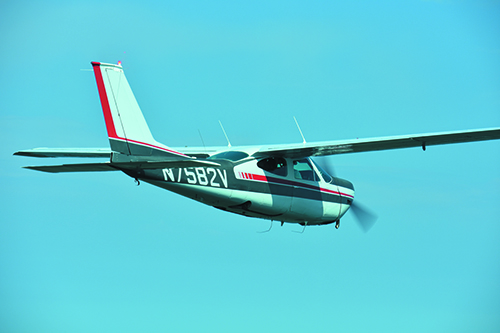
To some eyes, the Cessna 177 Cardinal RG is the sleekest and most attractive piston single the manufacturer ever built. The Cardinal RG shares its fixed-gear siblings strutless wing, rakish cowl and windshield, along with a seating position that lets the pilot see past the leading edge of the wing, while allowing all four occupants to ride in the shade.
Owners say that the Cardinal RG has many good points. Its faster than most of its peers (Mooneys being the obvious exception), roomier than all but the Beech Sierra, and has a better useful load than the competition, to boot. However, there are some notorious problems that prospective buyers should be aware of before considering the purchase of a 177RG. Foremost among these is Cessnas problematic electro-hydraulic landing gear system. If carefully maintained, checked and rigged it should work properly, but it does have a troubled record.
History
Its easy to forget that until the introduction of the Cardinal RG, Cessnas only retractable single was the top-of-the-line, six-place 210. At the time of the Cardinal RGs introduction in 1971, Piper had been building its successful Arrow for four years, Mooney was we’ll established with various flavors of M20 and Beech had just started selling the Sierra. It was a lucrative market segment, attracting buyers wanting a high-performance single but without the means to afford a more powerful airplane like the Debonair. Also, it was the time of the gas crisis, so fuel efficiency was foremost in the minds of many buyers. The first 177RGs carried a base price of $24,795 – believe it or not, several thousand dollars more than the Mooneys of the time. Most buyers added many thousands of dollars of options to that figure.
From a structural standpoint the Cardinal RG is basically the same as the fixed-gear Cardinal, which had come out in 1968. The straight-legged Cardinal had been intended to replace the 172 (which never happened, thank goodness; the 172 is one of the best singles ever built), but due to some aerodynamic foibles and a lack of power, sales were disappointing. It took Cessna two years to get the Cardinal sorted out, first upping the horsepower by 20 percent, then adding a constant-speed prop, and finally fitting the stabilator with leading-edge slots to correct a tail-stalling problem.
By the time the Cardinal RG came out, all of this was history. (Association with the original Cardinal may have hurt RG sales, however; the Arrow easily outsold it.) The new airplane, in addition to its folding gear, was fitted with a fuel injected 200-HP Lycoming IO-360-A1B6 engine and a constant-speed prop. Various versions of this engine power most retractable singles in this class; only the Mooney uses it to better advantage when it comes to speed.
The larger engine gives the RG a welcome boost in gross weight compared to the fixed-gear airplane (2800 vs. 2500 pounds), though empty weights are higher as well. The net gain in useful load is about 100 pounds.
The original fuel system was an unusual (for Cessna) design that had only On and Off settings. This occasionally caused problems, since its possible for one tank to empty more quickly than the other. Eventually, an imbalance can occur.
There were several minor improvements to the Cardinal RG during its production run. The 1972 model gained a few knots in cruise and a slightly better climb rate thanks to a new prop. Also, the fixed cabin steps were dropped. They tended to expose the bottom of the fuselage to even more grief when the aircraft landed gear-up (as they did with some regularity). Instead, small foot pads were placed on the main gear struts. In addition, landing and taxi lights were mounted in the nose instead of the wing.
In 1973 the fuel capacity was raised from 50 gallons to 60, improving the airplanes flexibility and usefulness for instrument flight. Along with the bigger tanks came a more conventional Left-Both-Right-Off fuel selector.
In 1976 the instrument panel was redesigned and enlarged, and a simplified landing gear hydraulic system was offered, along with a stronger nose gear trunnion. For the 77 model, the aircraft received a fuel selector that gave it commonality with other Cessna singles, had a more positive detonate and was supposed to be more easily maintainable.
And finally in 1978 the aircraft received a 28-volt electrical system and an improved gear retraction power pack that cut retraction time in half to six seconds.
Production of the Cardinal RG ended after the 1978 model year, with 1366 aircraft built. Unlike many designs, the 177RG didnt linger on with production trailing off to a trickle; about 100 airplanes were built that last year. However, in 1978 Cessna introduced the larger, more powerful Skylane RG in that same year and its likely the manufacturer didnt want to wind up competing with itself.
Cabin
Cessnas are big favorites with passengers, for several reasons. The cabins are generally quite roomy, and the high wing makes for a cool, shady ride as we’ll as a better view. The Cardinal adds to this with its low sill height and wide doors.
Those doors – four feet wide – can be a problem on windy days. Theyre fairly light and can fly right out of your hand if they get caught by a gust. The doors also have proven to be leaky in many (though not all) Cardinal RGs. Some of the doors fit too tightly, others too loosely, probably due to poor quality control at the time. Its interesting to note that the sales brochure for the 1973 Cardinal RG says …a new locking system, on both cabin doors, gives a better seal. All the way around. So wind noise doesnt disturb the cabin quiet. Translated from marketspeak into English, that says We know the doors leak, and were trying to convince you weve fixed them.
Air leaks mean cold air, and some Cardinal owners report that the back seat gets pretty chilly despite Cessnas attempts to warm things up with heater ducts.
Air leaks also imply water leaks, and this too seems to be a problem for some owners.
Up front, the panel is we’ll laid out, though pre-1976 models had an unusual three-quarter width design that robbed pilots of a fair amount of avionics space. The plastic panel, along with most of the other plastic in the cabin, is Cessnas infamous Royalite. Good luck finding some that hasnt cracked.
Visibility from the front seats is among the best in any Cessna. With the seats slid forward into flight position, the pilot sits about even with the wings leading edge. This allows a view around the wing during maneuvering. The seats, themselves, could be ordered with vertical height adjusters – a boon to short pilots.
At the other end of the cabin, the baggage compartment is, to put it mildly, oddly shaped. Cessna had to put the wheels somewhere, and the wound up in the baggage bay. The usual Cessna cavern has a big hump in the middle of it, leaving a slot between it and the rear seat back, and another between the hump and the aft bulkhead. Unfortunately, this blockage is located right next to the baggage door.
Said one owner, however, The much maligned baggage compartment swallows an enormous amount of luggage, despite the hump. A useful load of 1025 pounds works out to four adults, 120 pounds of baggage and enough fuel to fly four hours with IFR reserves. It is a true four-place single.
Indeed, its difficult to load the Cardinal RG out of its CG range. However, be careful to note that the CG will shift aft during gear retraction.
Performance
Pilots say that the Cardinal RG makes for a good, stable instrument platform, but its still nimble. Compared to a Skylane RG, said one, Its like a sports car.
As noted above, the speed is good in its class, though not up to that of the Mooney. Owners report cruise of about 140-145 knots at 11 to 12 GPH, or about 135 at 9 to 10 GPH. Proper rigging is important in reported speeds – several owners attributed slow speeds to a lack of it.
The early fixed-gear Cardinals reputation for loss of stabilator authority in the flare was fixed by the stabilator slot modification, and never did apply to the RG. Also, the extra horses under the cowl make for reasonable climb performance of about 900 FPM.
Cessnas flaps are among the biggest in the business, and the Cardinal RG uses them to get respectable short-field performance for a four-place retractable. Landing distance over a 50-foot obstacle is a claimed 1220 feet, shortest in its class.
Because all three gear legs retract aft, there is a noticeable pitch trim change during both extension and retraction. Its easily handled with an adjustment of the trim wheel, but its little things like this that can cause some white-knuckle moments for transitioning pilots during high-workload moments like missed approaches.
The stabilator feels a bit different than on other stabilator-equipped aircraft like the PA-28; forces are somewhat higher.
Resale value
Until recently, the used marketplace did not treat the Cardinal RG kindly. Prices did the typical nosedive that all new airplanes experience, but they stayed depressed for years. The original 71 model dropped from about $31,000 to around $20,000 and remained within a couple thousand dollars of that until 1988. Its now worth $56,000 and rising steadily; thats on a par with the Arrow 200, at $52,000. The last model, the 78 ship, dropped from about $54,000 to $29,000 in the classic four-year span, and has now come back to $68,500. A 1978 Arrow is $75,000.
That landing gear
Through the eight years of its production, the Cardinal had four different landing gear systems, as Cessna strived to correct all its quirks. The first, most problem-plagued one on the 71 and 72 Cardinal RGs, was a Rube Goldberg combination of electrical and hydraulic components whose weakest link was its electrically actuated main gear downlocks. The 73 Cardinals got hydraulic downlock actuators that improved reliability. Then on the 74 aircraft the gear selector handle itself was turned into a hydraulic valve and hydraulic pressure was routed not directly but through a panel-mounted valve controlled by the handle. This system also eliminated the remote electrical control unit.
Finally, with the 78 models the 12-volt Prestolite hydraulic power packs were eliminated in favor of a 24-volt power pack of Cessnas design. This has proved to be the most satisfactory of all the systems and, of course, would be the one to choose if cost considerations permit. At any rate, potential buyers should check to see which, if any, of Cessnas recommended service instructions have been applied to which ever model they are looking at. There are at least eight of them, including numbers 71-41, 72-26, 73-28, 74-26, 75-25, 76-4, 76-7 and 77-20.
Clubs
Cardinal owners have a choice of two clubs: The Cardinal Club, 1701 St. Andrews Dr., Lawrence, Kans. 66047, ((785) 842-7016, E-mail at cardinalclub@juno.com or visit them on the Web at cardinal.mlink.net), and the Cessna Pilots Association (www.cessna.org, (805) 922-2580). Both come highly recommended by owners, and should be joined by anyone considering the purchase of a Cardinal RG.
Owner comments
I purchased a 1973 Cessna Cardinal RG in November 1996. I considered several similar types, including Arrows and Mooneys, and chose the Cardinal because I like the convenience and safety of two doors, the apparently larger cabin and the high wing for a good view down. Because the Cardinals layout places the wing further back than most strut-braced Cessnas, an advantage it has over other four seat Cessnas is excellent visibility during turns through the top of the windshield, a good safety benefit.
My aircraft seems to fly slower than book speeds, which I have attributed to improperly rigged flaps. They appear to remain a couple of degrees down when the flaps in the up position, a problem I plan to address at the next annual.
I purchased the aircraft in Canada, an effort I will never go through again. The required import annual to change it to a US registered aircraft ended up being significantly more expensive than expected, and took three weeks longer than anticipated. The import annual was performed in Sanford, Maine, and cost approximately $2,200, or about $1,000 more than anticipated. Part of the three extra weeks to complete this annual was because of seemingly unsolvable problems with the gear down warning horn, which began operating continuously at all power setting after the aircraft arrived in Sanford.
During my first flight after the annual was completed, which was a trip from Sanford to my home base at Caldwell, NJ, the now-repaired gear down warning horn never stopped blaring, and the ADF, DME and GPS all decided to quit at once. The ADF problem was attributed to a faulty filter on the alternator, which was replaced.
While the company in Sanford was trying to repair the gear down warning horn itself, Caldwell Air Services in New Jersey determined the problem was associated with the gear down switch.
Two other problems encountered within the first few weeks of operation included the failure of the autopilot and a carbon monoxide problem.
The CO problem was difficult to solve. I placed CO monitors in the aircraft before the second flight, and they turned black within 5 minutes of take off. This resulted in some costly problem solving. Caldwell Air Services inspected the exhaust system and reported that it was new and in perfect condition (Total cost for trouble shooting was around $500). It was then suggested I place duct tape over the inspection hatches in the cabin floor, which had no benefit. A time went by when no one, including the Cessna Pilots Association and the Cardinal Owners Association, could provide any suggestions. Then one of Caldwell Air Services aircraft engineers, remembering a tiny paragraph in the Cardinal maintenance manual, noticed that the wrong style inspection plates were installed on either side of the fuselage, just ahead of the stabilator. These are supposed to be formed into a forward facing air-scoop to pressurize the rear portion of the fuselage during flight. Evidently, in 1971, Cessna discovered that a low pressure was being created in the rear fuselage during flight, which caused engine compartment gases to flow through the cockpit on their way to this low pressure area, resulting in a CO contamination in the cabin. As my aircraft is a 1973 model, someone must have erroneously replaced these scoop-shaped inspection plates with flat ones, probably when it was last painted 10 or more years ago. Two $14 inspection plates and 10 minutes finally solved the CO problem.
Since owning the aircraft, I have had two mechanical problems in the air. One was an intermittent electrical problem due to the alternator beginning to fail. The second was a gear down problem in which I could see the gear was down, but was receiving no gear down indication. The second resulted in an emergency being declared, fire trucks and all, and, after an uneventful landing, a $1750 bill for overhauling the landing gear system. Cessna recommends a gear system overhaul every 5 years, and it appears from the condition of the power pack and the o-rings, that this had never been performed once in its 24-year life.
I have done extensive work on the interior. The Cessna plastic parts were generally badly cracked, discolored and brittle. I have been ordering parts from Kinzie Industries, Inc. in Alva, OK (405-327-1565), and have had very mixed results in terms of fit. Kinzies service and staff was excellent until a mix up occurred in one order, resulting in me returning some parts. Then Beverly Kinzie took over my account and was generally rude and uncooperative. She really couldnt have been less interested in the problems I was having with some parts installations, and two requests, one verbal and one in writing, that she have one of her in-house parts installers contact me with some installation advice, remain unfulfilled to this day. They have, however, been good about accepting returns on parts that were incorrect or did not fit properly, even if the parts had been trimmed in an attempt to fit them. I still have a few parts to install, and three more ill-fitting parts to return once I complete replacement. There is no doubt that Kinzie parts are a better bet than equivalent Cessna parts. The Cardinal seems to have many more interior plastic parts than other Cessnas, and I would highly advise any other owners to seriously consider redoing their interior using a professional shop. Parts alone have cost me nearly $2,000, and the time required to trim the thicker more robust Kinzie parts was far greater than anticipated, with fit and finish not ending up as good as I would have hoped.
As a part of the cabin upgrade, I purchased an Airtex carpet. Airtex (Morrisville, PA), and especially its president, was incredibly helpful, and, for $400, delivered a reasonable quality carpet that was easily installed into the aircraft with no modifications necessary.
I recommend all Cardinal owners purchase a wing mounted gear mirror. I don’t know who makes them, as my aircraft had one installed when I purchased it, but it is definitely helpful, especially in the event of a gear problem in flight.
The Cardinal RG is a delight to fly, offers excellent range, and at least 135 knot cruise on 11 to 12 gallons per hour. I do a lot of instrument flying, and have found it a comfortable and stable instrument platform. I am hopeful that after all the work done on it during the past nine months, the next annual will be relatively straightforward and affordable, though, this is an aircraft and that may just be wishful thinking.
Even after the seemingly endless array of problems I have experienced so far, I would still chose a Cardinal RG when shopping this category of aircraft in the Cardinal RGs price range. I would try to purchase a later model with the full size panel instead of the automotive styled panel in early Cardinals. Shoppers should also take careful note of the fit of the two huge doors. Although these doors provide great access, they act like sails when the tail is pointed into the wind, and can be easily damaged when they swing rapidly to their stops. Cardinals are also known to leak a lot, although I personally don’t have that problem.
For owners in the Northeast, I can highly recommend Caldwell Air Services (201-808-9049) for Cardinal maintenance. They already maintain many Cardinal RGs, including one operated by their flight school. I have been using C&W Aero Service (201-882-0204) at Caldwell for avionics work, and I am very satisfied with their work as well.
Craig Barnett
New York, N.Y.
I bought 1944Q at the end of February 1996, and have put about 250 hours on it since then. Its been very healthy. 44Q hasnt had any appreciable down time other than that of my own making, and that has been significant. Cardinals cry out for modification.
Ive installed an aftermarket turbo-normalizer, rationalized because I fly out of Truckee CA, which often has 8000′ density altitudes in summer. Mid-day takeoffs under those conditions are very comfortable, although you still need to be careful of thermals and sink. I routinely fly between 16k and 18k on long trips – I get about 158 knots, and the air is nice and smooth for the eastbound trips. Even westbound, Ill often fly in that range to avoid weather, etc. Fuel burn is about 11 to 11.5 GPH with the turbo, which is quite a bit higher than before. Even so, with 60 gallons, a full-tank leg is more than enough. I typically run 4 to 4.5 hour legs, which leaves plenty of reserve. Going eastbound, Ive gotten >200 knot ground speeds on several occasions.
In the 8k-10k range (my typical 1-2 hour altitude), I get between 145 and 150 knots at 70 percent power.
Ive got a Hartzell 3-blade prop. Its reasonably quiet, but tends to have some vibration at lower RPMs. Works beautifully in the climb.
To go with the turbo, I needed oxygen, so I built-in with the tank in the tail. This moved the CG back closer to the middle of the range (it was rather forward due to the turbo and 3-blade), and makes for a nice, tidy interior.
You can see some info on my plane at http://members.home.net/peterhenry. There are links to two other pages on Cardinals, and lots of other Cardinal info.
Cardinals seem to attract a strong following – lots of participation in our email list, annual national fly-ins, and in CA therere several owners that have gotten together informally.
Engine-wise, post-turbo I had 2 exhaust valve seats reground at the annual about 2 months after turbo installation. I had been pulling the prop through by hand, even before the turbo, and felt there were weak cylinders, but two compression checks, one by a CA mechanic and one by FlightCraft (now Turbo2000) prior to turbo installation claimed they were OK. Seems they really werent, and now on pull- through, theyre all strong.
I have had some annoying oil seeps, which have been there since before purchase, and deny any ability to find them.
The turbo installation relocates the heater ram inlet to an absolutely useless position. There’s no ram air in its location; you get very hot feet, and the rest of the cabin freezes. Blankets are essential. My mechanic has figured out a relocation for the air inlet so we’ll get ram air, but the heater muff goes from one on each side to one smaller one. we’ll see how we’ll it works.
There was one Cardinal owner who installed an exhaust fan in the back panel to the tail – reports were that it was very effective in pulling heat to the rear seats, but rear-seat heat has been a problem in my plane and others.
Some Cardinal owners report getting showers in rain. I never used to, then I replaced my windshield. Now were adding more RTV to seal it. Water can come in through the eyeball air inlets, although mine havent given much precipitation, there have been reports of some from other owners.
Doors are big, and flap in the wind. Theyre one of the real features of the Cardinal, but also a weak point. Mine fit reasonably we’ll and don’t leak, but I expect Ill be redoing the pilots side hinge in a year or two.
Hauling capacity is pretty good. Its a true 4-seater if you don’t go modification crazy, like I did. For my needs though, it holds my wife and I (at 280 lbs. total), my two kids, plenty of baggage for us, and full fuel. And with the turbo, it will take off in 2000′ of runway at Truckee very comfortably, and have plenty of altitude by the end of the full runway. Even on the hot days.
My wife and kids love the plane, and Im very comfortable flying long XC in it. Its reasonable on the pocket-book. Amongst the retractable planes, the insurance agent I talked to prior to purchase said that the 182RG & 177RG were considered lowest risk, Bonanzas were medium, and Mooneys & 210s fairly high. I thought hard about a Bonanza, a 210, or a 310, and ended up sticking with the Cardinal as fitting my need for a family plane the best. After paint & interior , itll be in the better than new category. Some day after I finish doing the upgrades, Ill get a real idea of maintenance expenses, but I believe itll end up at about $1000 per year, including the annual and miscellaneous tweaks.
Peter Henry
1944Q
I have owned a 1972 Cardinal since 1995. It was advertised in Trade-A-Plane for $28,500. A dealer snapped it up, and immediately resold it to me. I did get a prebuy inspection from Glenn James at Rialto Aircraft, who told me to expect the first annual to exceed $5000. I expected it to exceed $10,000, and I was nearly right. After upgrades, I figure the true cost is $46,000.
True to form, the gear has been a headache, even though the power pack was only a couple of years old. For awhile the gear would intermittently fail to retract. After hours of work getting the rigging just right, the power pack burned out. My mechanic installed a rebuilt unit, but while cycling the gear to test it, ominous grinding sounds came forth. We had to send it back to be re-rebuilt…the part was under warranty, but not the installation cost. At the moment, I have a problem with the gear horn refusing to shut off unless the throttle is backed off below 10 inches and the self-test actuated. Weve looked at the circuit diagram for hours and can see no way for this to happen. Of course, it cant be replicated in the shop.
Ive heard how badly the doors leak, but mine never did until I got a new interior. The problem seems to be the poor fit of the door plastic; it bulges the doors out just enough to catch the rain and funnel it in. My old plastic did not have that problem, though it was so worn you could stick a finger through it. I carry a towel and try to mop up the water as it comes in. This can be difficult in turbulent IMC while trying to copy clearances and navigate.
The 1972 model has no left/right tank switching, so the pilot must monitor fuel flow from the tanks. If an unbalanced condition develops, you just raise the heavy wing and fly in a slip for as long as you can. The problem occurs when fuel gets into a vent line; the way theyre plumbed, this causes fuel to stop flowing until the other tank is almost empty.
After all this grousing, I must say I love the airplane. I generally cruise at 130-135 knots and 9-10 GPH, depending on altitude. Load carrying ability is three people, fuel and camping gear or four people and carefully selected baggage. For back-country strips, I can carry two people, 25 gallons and camping gear to most of the places I like to fish.
Dave Chuljian
Port Townsend, Wash.
Comments and data in the Aviation Consumer Used Aircraft Guide, 4th ed. convinced me that the Cardinal RG was an airplane I could enjoy and afford. There have been no regrets.
The Cardinal is easy to slip into and out of and gives a nice ride with the excellent visibility for all occupants…and you ride in the shade. A very stable instrument platform, it trims out nicely and stays where you aim it on instrument approaches. It is also the rare high-wing airplane in which the pilot can lean forward and see in front of the wing; very helpful on base leg turns to final.
Useful load of 900-plus pounds, fuel consumption of 11 to 12 GPH overall with 140 knot cruise speeds puts the Cardinal RG into the economical family class. Like most four-place airplanes, the fourth adult boards and the expense of less than full fuel; but few trips demand the full load of 60 gallons.
The Cardinal isn’t perfect. Flying in rain, we utilize golf towels to sop up the water that leaks in. Cardinal owners have tried a lot of fixes for these leaks; we just mop it up as required. Rear seat passengers will need a lap robe to augment the bit of warm air that gets to them in winter.
Maintenance costs average $1500 annually for this pampered Cardinal. I use a bottom line planning figure of a dollar per minute of operation for 100 hours of flying per year.
An early problem of high CHT in summer was corrected with an exhaust fairing mod that reduced CHT by 50 degrees and probably added a knot or two of airspeed.
My operation at cruise is typically 23.5 in. MP and 2350 RPM with EGT at 100 degrees rich of peak. That will produce 140 KTAS at 7 to 8000 feet. The engine is happy and went to TBO so I continue that feeding schedule. Fuel flow at cruise is 10.5 GPH, under 10 above 8000 feet.
B. Gepperman
Owensfille, Mo.
Also With This Article
Click here to view charts for Resale Values, Payload Compared and Prices Compared.
Click here to view the Cessna 177RG Cardinal features guide.