











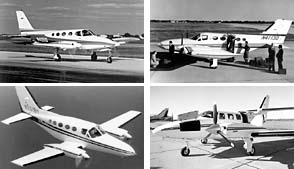
Your ship has come in; youve unloaded it for a healthy pile of cash and now you can buy a high-performance twin. And not some clunker Apache, either, but a cabin-class job, maybe with known ice protection and pressurization.
But guess what? Even more so than with light twins, the choices in this class of airplane are staggering. We cant devote an entire issue to cabin class twins so we’ll be breaking the species into smaller helpings, beginning with Cessnas offerings this time around.
And we’ll omit a few, such as the Cessna Bobcat-yeah, we know, you never heard of it-and the Cessna 335 because so few were built. Ditto the 404, which we’ll mention only in passing. But that leaves plenty to choose from because say what you might about Cessna, the company had a cabin-class twin for every mission and price point, far outdistancing Piper or Beech in variety if not quality.
Cessna 303 Crusader
In the 1970s, Cessna planned to get on the light-light twin bandwagon with the model 303. Early development indicated that it wouldnt exceed the performance of the Piper, Grumman and Beech twins by enough to make it worth doing so Cessna turned the airplane into a sophisticated, cabin-class replacement for the 310.
The result, produced for the 1982 through 1984 model years, was best described as interesting. Some loved it while others preferred the 310. The 303 had perhaps the finest handling of any twin ever built, but the merciless quest to make it light resulted in amenities that seemed cheap in an airplane that was anything but. And the airplane wasnt as fast as a 310.
Handling and Performance
Although no slouch, the Crusader doesnt match the later 310s speed simply because it has a bit less horsepower. The airplane will realistically cruise at 170 knots down low and 190 knots up high.
A T303 can be slowed to below 90 knots with confidence on a circling approach, and gets in and out of fairly short runways as a result. Single-engine handling is straightforward and Vmc is so low (65 KIAS) that only a feckless dolt would lose control when flying on one.
The landing gear configuration causes most pilots to have trouble smoothly lifting the nosewheel on takeoff and transitioning to the climb. It takes a tug then a quick relaxing of the backpressure to avoid a pitch bobble on departure. (A little nose down trim helps.)
The responsive handling means that a functioning autopilot is nice to have in cruise; any control input bumps the airplane off altitude or heading. When letting down, the ability to drop the gear and approach flaps at 175 KIAS means never having to chill the engines.
Flight Deck, Cabin
The flight deck is we’ll appointed and the cabin is of adequate size, but only just. Its snug with six aboard. The drive to keep weight down resulted in cabin appointments that are, in our view, somewhat tacky. Many owners have refurbished their 303s to higher standards.
As high-performance twins go, the 303s operating costs are average, which is to say expensive. Although the exhaust system AD that affects the other twin Cessnas doesnt apply to the Crusader, you still need to mind the exhaust system.
The airplane has a long overboard exhaust pipe thats prone to cracking and should be checked every 50 hours.
For an airplane initially viewed as being too light for the rigors of the real world, we don’t hear of consistent problems with components breaking. The airstair door was a problem until users learned to hold on to the chain when letting it down or until snubbers were installed to protect the hinges from over-extension damage.
Only about 305 T303s were built and because this model has few parts in common with other Cessnas, were told that parts availability can be a problem.
Cessna 340
There’s no other way to describe the Cessna 340A than as an attractive personal aerial hotrod. Its reasonably fast for the power and has handling that experienced pilots enjoy. However, as with a 310 or Baron, its not considered forgiving of the hamfisted.
The original 340 came out in 1972 with 285 HP per side. It looked like a pressurized 310, which it was in a way. But it shared wings, flaps, ailerons, landing gear and, eventually, engines, with the larger 414.
By 1976, Cessna bumped the power to 310 HP per side, a much-needed increase, creating the 340A. Virtually all 340s have been converted to at least 310 HP engines, or higher, with various mods available. In fact, because of their popularity, it s difficult to find a 340 or 340A without at least some modification, including vortex generators (VGs), spoilers, or bigger engines.
The 340 tends to be an owner-flown airplane leading, we have observed, to two effects: 1) a large number of mods as the aircraft are personalized, and 2) some absolutely horribly maintained airplanes.
In speaking with pilots seeking a good 340, we were told time and time again that there are lots of dogs on the market due to crummy maintenance, so a careful pre-purchase inspection is a must. We suspect that potential buyers will have to be prepared to pay a premium for a good one.
Handling and Performance
Having a smaller diameter cabin than the 340, the 303 is faster but the tradeoff is weak payload. With two people and modest bags aboard, itll range out to 1000 miles with the optional 203 gallons of gas.But if you need to fill six seats and go some distance, don’t bother with a 340. True, VGs add 300 pounds to the allowable gross weight, a nice little touch, but that eats into single-engine rate of climb.
Reasonably loaded, you can climb into the teens and whistle along at about 200 knots at 65 percent for five hours and still have about an hour of gas aboard. Loading has to be watched, as its easy to crowd the 340s aft CG limit.
Service ceiling is nearly 30,000 feet and depending on engines, the 340A will climb nicely to 20,000 feet or above before things start to sag. About the only piston twin that will out climb a 340A on one engine is the P Skymaster.
Accelerate/stop distance is less than 3500 feet on a warm day so caution is advised in basing a 340 at a short strip. Even though approach flaps can come out at 160 KIAS (with a substantial pitch change), the gear speed is a relativiely slow 140 KIAS, so slowing down after a descent can be difficult, thus spoilers are a popular aftermarket mod among 340 owners. Once the gear and split flaps are extended, there’s plenty of drag, so steep approaches are doable. The gear is somewhat stiff, thus smooth landings take practice.
Flight Deck, Cabin
The 340s airstair door isn’t particularly wide, nor is the aisle, so the portly wont waltz through the cabin. Once seated, leg, elbow and headroom are adequate but not generous.